Analog Devices posted a record $4.02 billion quarter on data center demand. SK Hynix voted to cancel $29 billion in treasury shares, Korea’s largest ever, and Marvell gave Google an option to buy $12.2 billion in shares tied to a TPU chip supply deal. Samsung is also hiking foundry prices up to 15% as TSMC’s CoWoS fills.
Let’s get into it. —Austin & Vik
Quick hits, high signal. Takes from semi industry experts. Sign up for free daily updates!
Be sure to check out the Semi Doped podcast on YouTube or your favorite podcast player!
Analog Devices Posts Record $4 Billion Quarter on Data Center Demand
Analog Devices reported fiscal third-quarter revenue of $4.02 billion, a company record. Data Center and Industrial led the growth. Trailing twelve-month operating cash flow reached $5.5 billion, equal to 40% of revenue, and the company returned $1.7 billion to shareholders through dividends and buybacks in the period. Semiconductor materials makers broadly recovered profitability in Q2 as AI chip investment lifted demand for advanced materials, with revenue growth expected to accelerate next year as customers expand capacity, according to The Elec. CMTX, a South Korean silicon parts supplier, logged revenue growth for 11 consecutive quarters, the only Kosdaq-listed semiconductor materials, parts, and equipment company to sustain the streak.
Austin: My interest in ADI is Empower. ADI closed the $1.5B all-cash acquisition on July 7, and the CEO Roche is positioning it as the future of power delivery. Next-gen AI chips want thousands of amps at sub-1V, and you can’t push that across a board without paying the I²R tax, so conversion has to move into the package. Catch up on that topic with our earlier podcast: Power as the Next Physics Wall for AI.
Vik: ADI revenue is up 40% and EPS is up 163% YoY. A lot of their earnings is from the industrial sector, military and defense. Not everything can be chalked up to AI.
SK Hynix Plans $29 Billion Buyback, Korea’s Largest Share Cancellation
SK Hynix’s board voted on August 19 to repurchase and fully cancel 40 trillion won ($29 billion) of treasury shares, what the company called the largest treasury share cancellation in South Korean listed-company history. Bond yields have been compressing chip-stock multiples across Korea, Bloomberg reported. SK Hynix attributed the decision to its view that the current share price underrepresents intrinsic value. The program also lifts the shareholder return target from “within 50% of cumulative free cash flow” to “over 50%,” a commitment the company plans to fulfill ahead of the program’s original schedule. Reuters put the dollar total at $28.6 billion, a minor difference from the won conversion rate used.
Vik: SK Hynix has lots of confidence that their share growth will continue. Memory underpins all of AI. Fair assumption.
Marvell Grants Google Option to Buy $12.2 Billion in Shares
Marvell has given Google the right to buy up to $12.2 billion in Marvell shares as part of a TPU chip supply agreement, not as a standalone financial investment. The deal builds on an existing AI chip collaboration in which Marvell develops custom accelerators for Google’s AI infrastructure. Google acquires the right, not the obligation, to take a stake in its chip partner; $12.2 billion sets the ceiling on what it could invest, not what it will. Marvell’s TPU development work sits at the center of the supply arrangement that now carries the equity option.
Austin: The vesting schedule is interesting. About 59M shares, roughly 7% of Marvell, and nearly all of it vests in 240 tranches, one for every $500M of custom-silicon revenue from Google through fiscal 2033. Full vesting takes 240 x $500M = $120B of Google purchases in about six and a half years, call it $18B a year from this one customer.
Vik: This is positive for Marvell CXL too because Google is understood to be buying from them. Marvell’s engagement with Google could pave the way for a $1T company, as Jensen joked at Computex 2026.
Samsung Hikes Foundry Prices Up to 15% as TSMC CoWoS Fills
Samsung has hiked foundry prices up to 15% following a demand spike linked to TSMC’s CoWoS advanced packaging running near its capacity ceiling, per Reuters sources. Customers who can’t get CoWoS slots are rerouting tape-outs. Some volume is landing at Samsung; some is flowing to Intel’s EMIB-T packaging platform as CoWoS access tightens. TrendForce reports that Unimicron and ASE stand to gain substrate and assembly business as the CoWoS crunch drives demand toward EMIB-T. Commonwealth Magazine reports TSMC is developing COUPE as a next-generation successor to CoWoS, with production volume dates not yet publicly disclosed.
Vik: CoWoS crunch and people going to Intel and other packaging houses is not a net negative for TSMC. More chips being packaged means more chips being fabbed.
Cerebras Launches CS-4 Rack to Widen Inference Lead Over Nvidia
Cerebras unveiled the CS-4, its first multi-wafer inference rack, positioning the system as a faster alternative to Nvidia hardware for AI chatbot workloads. Connecting multiple wafer-scale chips in a single unit, the rack pushes inference throughput beyond what any single-wafer system can deliver, Cerebras says. The CS-4 runs on Cerebras’s existing wafer-scale engine: no new chip inside, just more of them, arranged at rack scale. Cerebras claims the system widens its inference speed advantage over Nvidia. The launch arrives as an earnings-driven stock selloff has put fresh pressure on the company, according to The Economic Times.
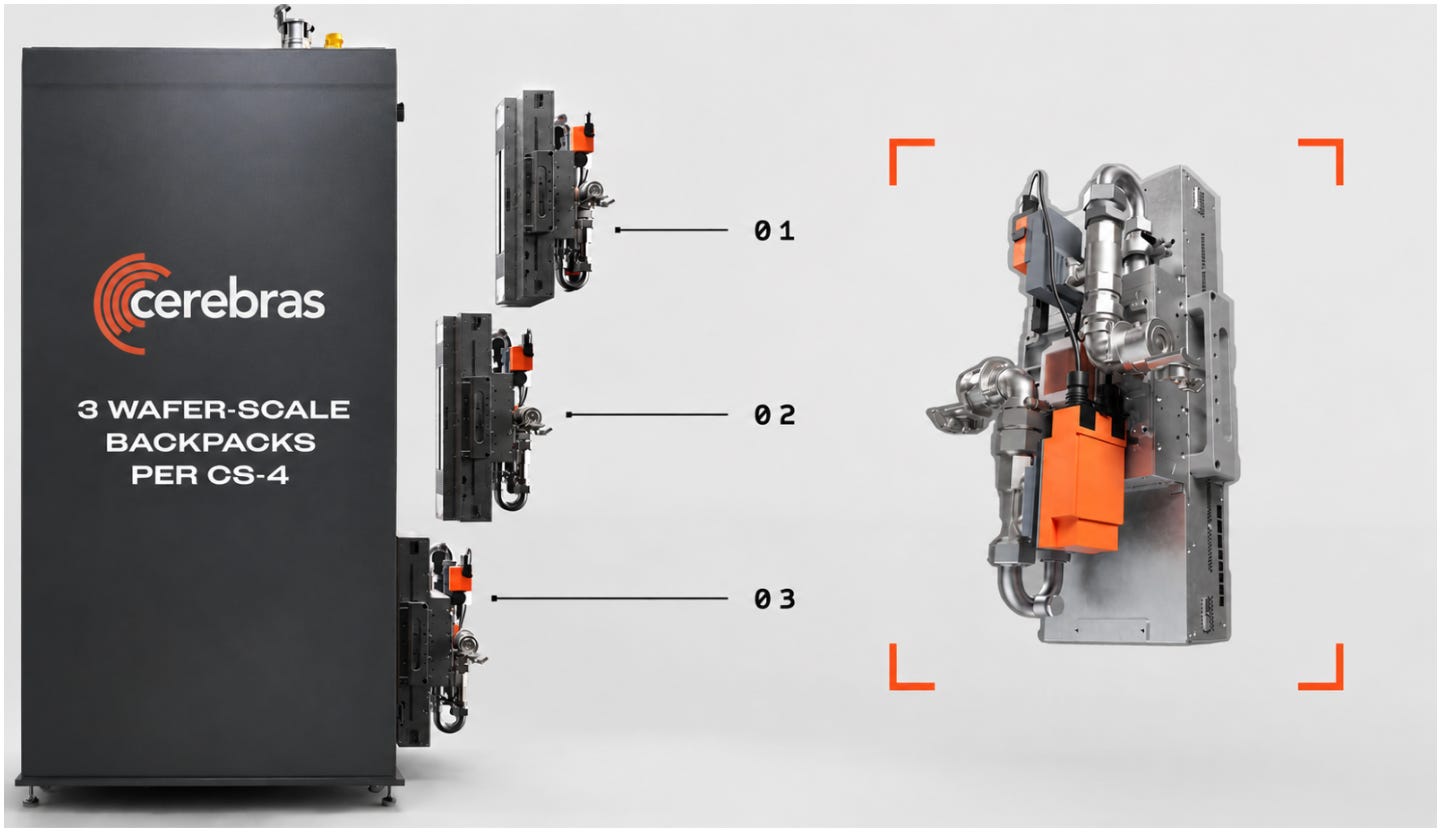
Austin:This is a thermal, power, and systems iteration, not an architectural improvement. The CS-3 rack had two wafer-scale engines, each with 44GB of SRAM and 900K harvested cores on TSMC 5nm. The CS-4 rack has three wafer-scale engines. Same 44GB of SRAM, same 900K cores, same TSMC 5nm. The extra wafer plus better cooling and power delivery allows higher clocks, so more tokens per second and a bit more compute density per square foot of datacenter. Still an improvement! Props on the system engineering eye-candy:
Vik: I attended the event last minute since I happened to be in SF. These backpacks were cool, and the “engine block” has undergone significant redesign to allow three WFEs to fit in a rack as opposed to two. 50% higher SRAM density per rack. The messaging is more going to rack-scale solutions here; not really new chips.
Sector Watch
Compute
Cadence Design Systems CEO says 45% of revenue now comes from companies designing their own chips, up from a historically semiconductor-vendor-dominated customer base. (CNBC)
Etched AI inference chip startup doubles valuation to $21 billion in under a month, marking one of the fastest valuation doublings in the current AI silicon funding wave. (Reuters)
Velaura AI closes a funding round valuing the chip startup at more than $1 billion, entering the AI silicon design race. (Reuters)
Foundry & Packaging
Socionext taps Intel 18A-P process for high-performance compute chiplet development, adding a notable ASIC design win to Intel Foundry’s advanced-node customer roster. (digitimes)
Ajinomoto cuts ABF chip packaging film shipments to China by 30% following Beijing’s rare earth export curbs, accelerating the race to qualify domestic substitutes. (Tom’s Hardware)
NXP to more than double 300mm back-end semiconductor manufacturing capacity in Malaysia through a new joint-venture facility build. (The Elec)
Thanks for reading! This post is public so feel free to share it.