

Good morning, it’s Friday, August 7.
AMD is acquiring Toronto-based AI inference chip startup Taalas, a deal that brings back co-founder Ljubisa Bajic, a former AMD executive and ex-Tenstorrent CEO, to fold purpose-built inference silicon back into AMD. SK Hynix is committing 54 trillion won across two South Korean fabs, while SpaceX and Tesla are putting up $16.8 billion for the Terafab chip plant in Texas.
Let’s get into it. — Austin & Vik
Be sure to check out the Semi Doped podcast on YouTube or your favorite podcast player!
AMD to Buy Taalas
AMD has agreed to acquire Taalas, a Toronto-based AI inference chip startup, in a move that extends the chipmaker’s push into purpose-built silicon for running AI models. Taalas was co-founded by Ljubisa Bajic, a former AMD executive who also served as CEO of Tenstorrent, and the Taalas team will join AMD under Vamsi Boppana’s AI group. The company’s focus is chips designed to accelerate individual AI models rather than serve as general-purpose accelerators, a distinction AMD is now actively building toward, according to ServeTheHome.
The acquisition comes weeks after AMD’s Cerebras-adjacent moves and lands shortly after a strong financial quarter. Bajic’s background straddles both AMD’s own history and the broader AI chip startup world, which makes the hire as notable as the deal itself. Bloomberg and Reuters both reported the acquisition; financial terms were not disclosed.
Vik: There is an emerging trend of hardcoding AI models into silicon, which is the approach that Taalas pitches. Interestingly, Google is also developing an experimental custom chip called Frozen V2 that is designed to embed parts of Gemini directly into silicon. It is aimed for a 2028 rollout with 6 to 10x better power efficiency than TPUs.
SK Hynix Commits 54 Trillion Won Across Two Fabs for AI Memory
SK Hynix announced it will invest 54 trillion won across two South Korean fabrication facilities, splitting the commitment between 35.2 trillion won for the Yongin “Y2” fab and 19.1 trillion won for the Cheongju “M17” facility. The company framed the decision as a move to “seize opportunities in line with the market’s growth speed” and to support stability in the global AI semiconductor supply chain. M17’s cleanroom is scheduled to open in December 2028, with Y2 following in June 2029, meaning the capacity additions are timed well into the next decade. Both sites will expand production of DRAM and NAND, with output calibrated to customer demand rather than speculative builds.
The dual-fab commitment stands as the largest single memory CapEx announcement of the current cycle.
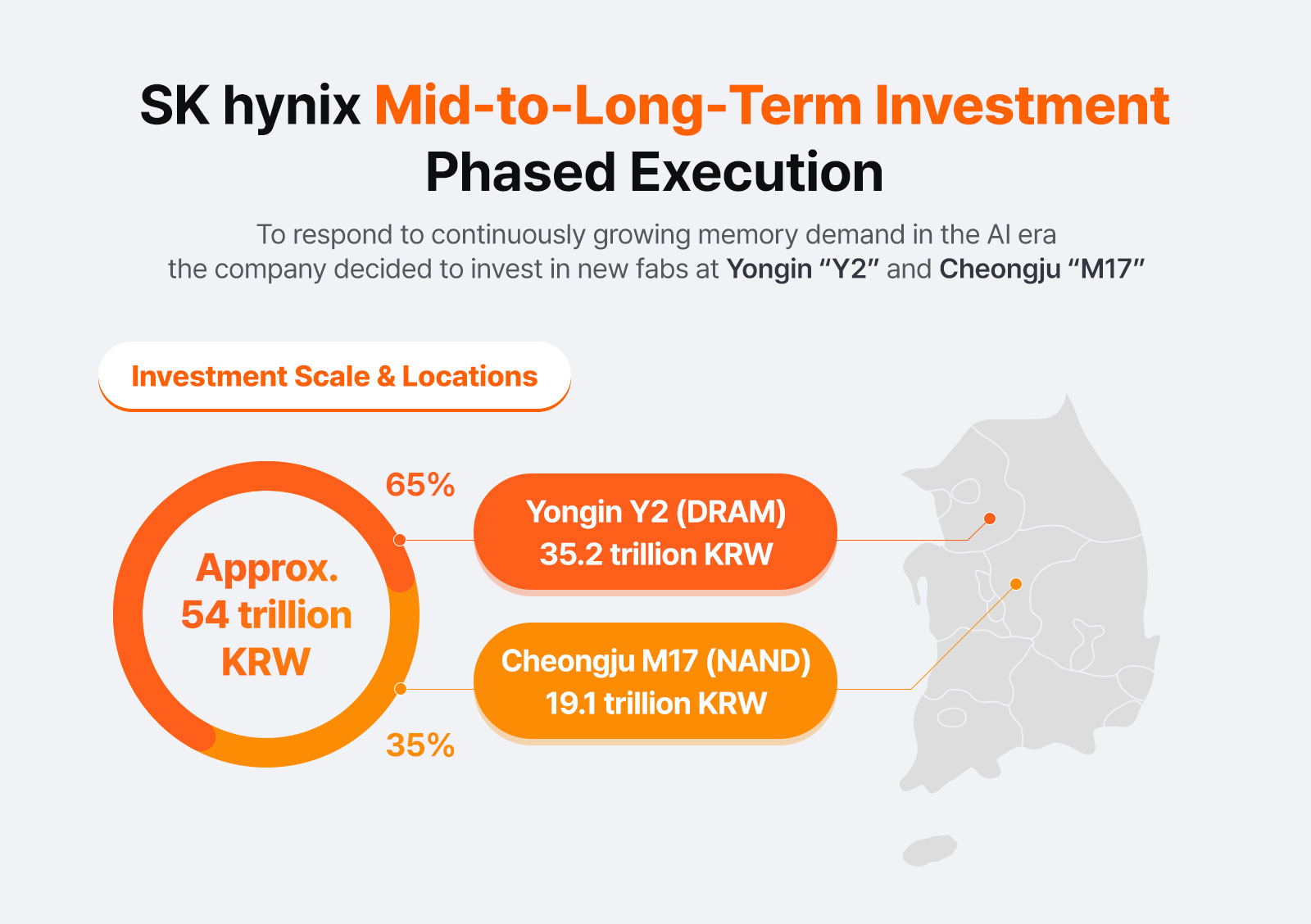
Vik: SK hynix’s fab expansions are a high-stakes bet on sustained AI memory growth. For this kind of capacity expansion to make sense, sustained demand for memory needs to continue through to 2028 or 2029, which is an eternity if you consider the current pace of AI. There is a nonzero possibility that some new memory technique or tier emerges between now and then, rendering this fab capacity or less in-demand than it is today
SpaceX, Tesla and Nvidia Back Captive Chip and Data Center Buildouts
SpaceX and Tesla plan to spend $16.8 billion initially on the Terafab chip plant in Texas, a facility where SpaceX will also build natural gas power plants to supply the site’s energy needs directly. The vertical integration is thorough by design: the same companies consuming the chips are paying to manufacture them, collapsing the distance between silicon and deployment. That logic is finding company in Australia, where data center firm Firmus Technologies has closed a $2 billion fundraising round backed by Nvidia and Coatue, among others.
Firmus nearly doubled its valuation to over $10.5 billion in the Nvidia-backed raise, with Jane Street also joining the investor group. The round gives Nvidia a direct stake in the compute infrastructure running its own chips, a structural position rather than a customer relationship. Firmus is building AI data center capacity in Australia, a market investors are treating as distinct from the crowded North American pipeline. The two deals, separated by an ocean, are drawing from the same logic: own the stack.
Also moving:
Nscale, a European GPU cloud provider, is targeting a September US IPO and claims $51 billion in contracts, showing independent data center operators are still racing to list before the window narrows.
Optical Component Earnings and Fiber Capacity Bets Show AI Supply Chain Monetizing
Applied Optoelectronics and MACOM both reported second-quarter and fiscal-third-quarter results on August 6, 2026, adding to a growing pile of evidence that AI infrastructure spending has reached the optical supply chain in earnest. MACOM, reporting for the quarter ended July 3, joins AOI in what has become a crowded earnings calendar for photonics-adjacent names.
GlobalFoundries posted revenue of $1.786 billion for its second quarter and used the results to strengthen the commercial rationale for its U.S. government-backed silicon photonics investment.
Taken together, the earnings prints and capital programs trace a supply chain where optical components are now clearly moving from commodity inputs to priced scarcity.
Vik: Investors are rotating out of memory and into optical names. The recent drama with proposed chinese optical transceiver bans has sparked fear into investors as they understood how important optics is for the AI buildout. Expect this growing interest to continue.
Sector Watch
Memory & Storage
Renesas launches Gen 3 MRDIMM chipset solutions pushing DDR5 performance to 16,000 MT/s for next-generation AI and HPC server platforms. (StorageNewsletter)
NEO Semiconductor launches NEO.AI memory platform combining new SRAM and DRAM architectures to address capacity bottlenecks in AI processors. (EE News Europe)
Foundry & Packaging
Wistron is reportedly in line to win an Oracle AI server order, broadening its hyperscaler customer base beyond existing accounts. (digitimes)
Koh Young expands Korea production capacity to meet accelerating demand from AI server assembly and advanced chip inspection customers. (Chosunbiz)
Power & Energy
Wolfspeed and LITEON partner to deliver 800 VDC power solutions for hyperscale AI data centers, expanding the 800V DC ecosystem beyond server racks. (Wolfspeed)
Alphabet returns to the bond market with a jumbo sale drawing $115 billion in investor demand to fund AI infrastructure and CapEx. (Bloomberg.com)
Data Centers
Microsoft opens its largest India data center hub in Hyderabad as Azure crosses $100B in annualized revenue, with a fourth India cloud region now live. (Reuters)
UAE sovereign fund is weighing a $6.3 billion investment to build an AI data center campus in Japan, per Bloomberg reporting. (Bloomberg.com)
IMC selects CoreWeave as its AI cloud infrastructure provider to scale research computing. (CoreWeave)
PCB & Components
China’s MLCC supply chain is rapidly expanding domestic upstream capacity as global AI hardware demand drives multilayer ceramic capacitor shortages. (SCMP)
Victory Giant Technology is aggressively expanding PCB manufacturing footprint and international operations to capture surging AI-driven board demand. (SCMP)