

Reuters says xAI has 59 gas turbines near Memphis and no federal clean-air permits, in Black communities already carrying elevated lung disease. It reads as if the richest man does whatever he wants for AI, and New York just became the first state to say “Not here!” This is turning into a crisis communications issue for the industry.
Meanwhile, Intel is getting its high-NA EUV reps in, running a $400 million ASML tool on shipping Panther Lake. Last time, Intel was slow to EUV and lost years. Not again!
Plus: Nokia turns the radio tower into a surface for GPU inference.
Be sure to check out the Semi Doped podcast on YouTube or your favorite podcast player!
New York Data Center Moratorium, xAI Permit Crisis Put Energy Limits on AI Buildout
New York has become the first U.S. state to impose a moratorium on new large data centers, a regulatory first that arrives as xAI’s Memphis-area Colossus 2 facility faces mounting scrutiny for installing 59 natural gas turbines without federal clean-air permits (Reuters, Bloomberg Tech).
Reuters reported that the unpermitted turbines are disproportionately impacting Black communities already experiencing elevated lung disease rates in the surrounding Mississippi counties (Reuters).
The largest U.S. power grid is missing supply targets amid AI-driven demand growth, and a planned £2 billion UK AI supercomputer is stalled by grid connection delays — together signaling that energy infrastructure has become a binding geographic constraint on the pace of hyperscaler expansion (Bloomberg.com)
PJM, the largest U.S. grid, missed its power supply procurement target in a capacity auction, with AI demand cited as a key driver of tightening supply conditions (Bloomberg.com)


Vik: AI data centers may be sucking up memory, but what upsets people more is if it spoils air quality around where they live. If New York is the first state to impose a moratorium, it’ll be interesting to see how many states follow, or what kind of pressure comes to follow New York’s steps. Would this be a blow to behind-the-meter generation?
Austin: Datacenters aren’t new… the world already runs on them (X, Substack, SaaS, your credit card, etc). What’s new is where the power comes from. Connecting a new datacenter to the grid can be a slow process, so the workaround is to generate your own! Onsite gas, behind-the-meter. xAI’s Memphis turbines, for example…
But it seems behind-the-meter has it’s own proper dance (getting permits) that allegedly xAI chose to forgo. Hmm… that part doesn’t get mentioned when everyone praises Elon’s insanely rapid build out of Colossus datacenter…
Reuters’ story leads with “xAI has installed 59 natural gas turbines for it’s Colossus 2 data center project in Tennessee without securing federal clean air permits…” which obviously will get interpreted as “world’s richest man can do whatever he wants in the name of AI” and the public will push back hard on that; not in our backyard says NY.
This is a crisis communications issue for the AI and datacenter industry. Someone needs to own this problem … who is that person?
ASML Raises Outlook Twice as High-NA EUV Enters Intel Volume Production
ASML posted €9.3 billion in Q2 2026 sales and raised its full-year forecast for the second consecutive time this year, driven by AI-fueled demand for advanced lithography equipment (CNBC).
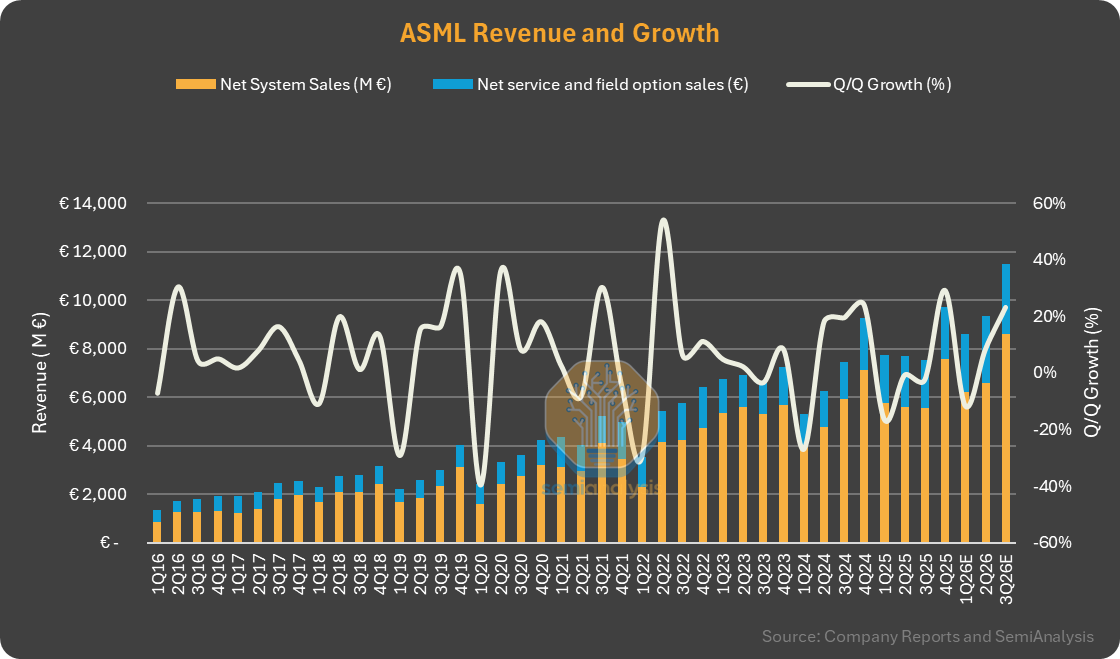
The company confirmed that its High-NA EUV technology has entered high-volume manufacturing at Intel, where it is producing chips on the Intel 18A process node for Panther Lake laptop processors (Reuters). The milestone is the first commercial deployment of High-NA EUV in volume production anywhere in the industry.
ASML is expanding manufacturing capacity to meet demand (Reuters), a signal the company expects order intake to remain elevated.
Vik: Pretty exciting if high NA EUV technology is actually being used. TSMC has avoided this ultra-expensive technology so far, but would this be Intel’s move into dominating the next gen of leading-edge semiconductor technology? Around Intel 10 node, Intel famously avoided going to EUV while TSMC did, which set them back a significant number of years. Guess they are not making that mistake again!
Austin: Definitely exciting. But read the fine print from ASML. High-NA was used on a subset of Panther Lake and on select layers. So there’s an asterisk.
Now, this is still great news for Intel and for ASML. Intel is running a ~$400 million ASML tool on real, shipping product instead of test wafers. Yields reportedly match the existing (regular) EUV process. And real volume on a current node (18A) is a much better proof point than a lab demo. Clearly Intel has done a lot of learning with the tool under real conditions to mature the process to the point they can use it in production.
18A doesn’t need High-NA. Intel is keeping it optional for 14A and using 18A to get reps in early.
TSMC skipping High-NA isn’t obviously wrong either though. If regular EUV plus multipatterning still pencils out for TSMC, why pay roughly double per tool?
What’s interesting to wonder is when comes the time where High-NA is mandatory? Intel’s bet is to have the tool mastered before that day arrives, instead of scrambling for it like they did with low NA EUV.
So my framing here is that Intel has a great head start on the learning curve. Does getting there first actually convert to taking foundry customers from TSMC? Not sure. But Intel is definitely acquiring know-how and competitiveness. That’s still great for Intel Foundry and ASML.
Nokia Launches Nvidia-Powered AI-RAN Platform; Ericsson Warns of Component Cost Pass-Throughs
Nokia announced what it calls the industry’s first commercial AI-RAN platform, built on Nvidia silicon, with commercial sales targeted for 2027 (Bloomberg.com).
The launch, which Nokia frames as one of the most significant shifts in radio architecture in decades, positions radio networks as a new surface for GPU-driven inference workloads (Nokia).
SK Telecom was simultaneously selected to lead a two-year South Korean government pilot testing AI-RAN use cases for physical AI (Light Reading). As the buildout accelerates, Ericsson used its Q2 earnings to flag that AI-driven component cost increases are already materializing and will be passed through to telecom customers.
Vik: AI RAN allows you to unlock more speed and performance from the spectrum that is already available, without additional hardware upgrades. Exciting development!
Key Data
h/t to dnystedt on X. WFE 🚀

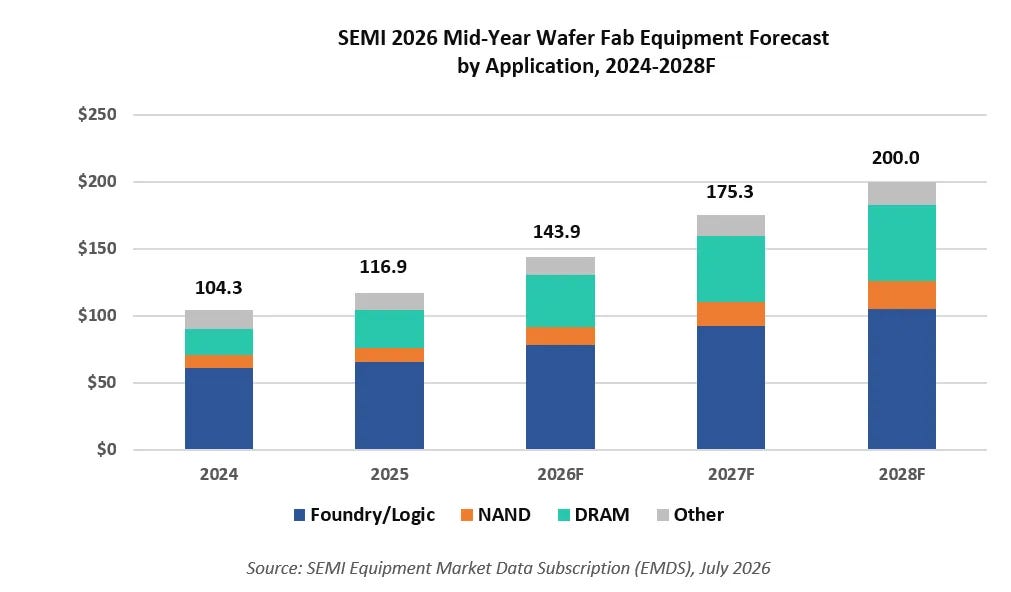
Read more here.
Funny
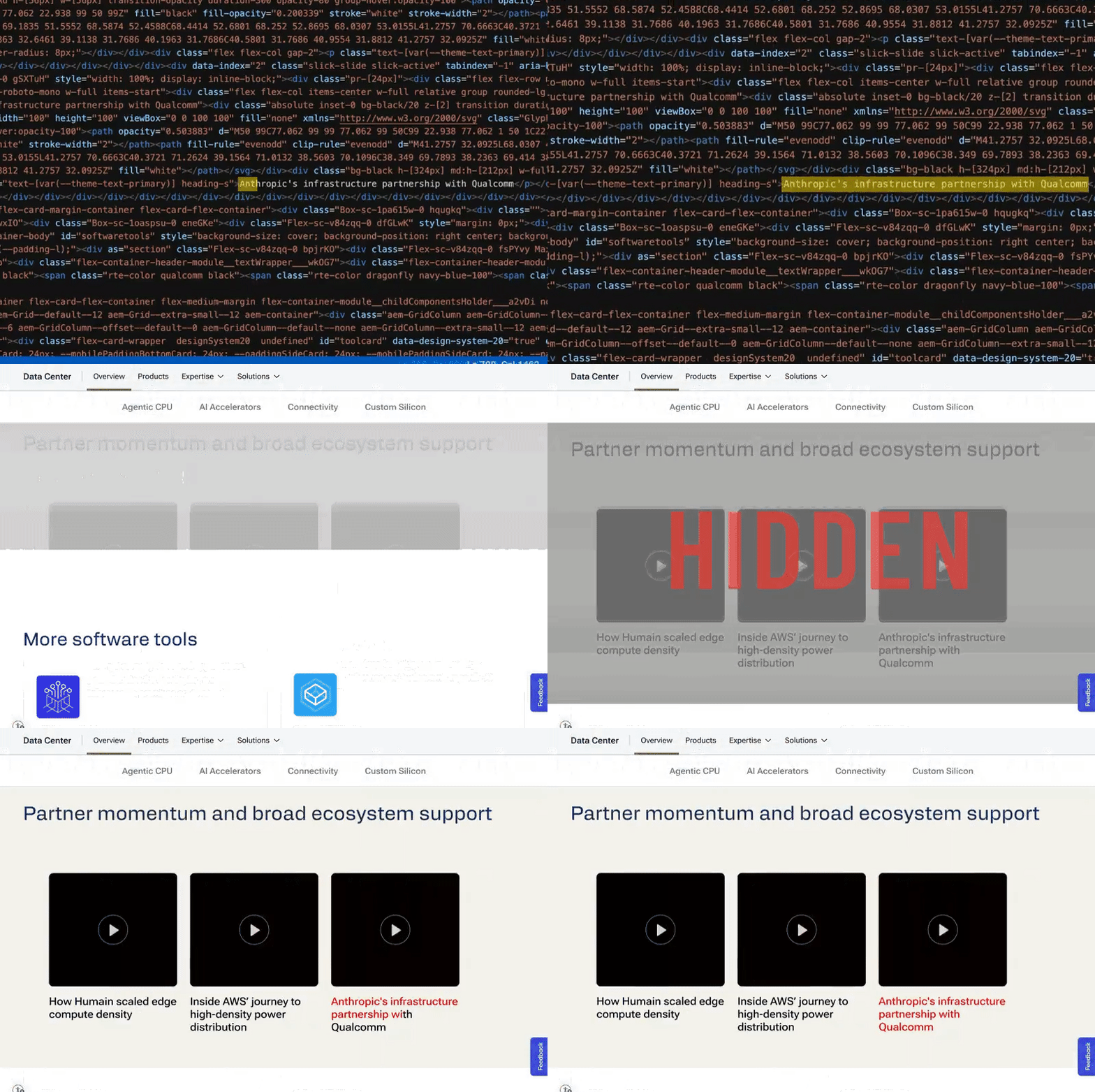
Careful what you vibe code semiconductor friends!

Quick Hits
Apple wins Chinese regulatory approval for Alibaba- and Baidu-powered iPhone AI tools, ending a multi-month licensing wait and reopening Apple Intelligence to the China market. (SCMP, Bloomberg.com)
Hanmi Semiconductor posts record quarterly earnings at a 52% operating margin driven by HBM TC-bonding demand, and is accelerating Plant 8 construction to meet equipment backlog. (Chosunbiz)
Diodes Incorporated acquires ElevATE Semiconductor from Presidio Investors for $250 million, expanding its analog and mixed-signal portfolio. (Business Wire, Pulse 2.0)
Aehr Test Systems reports record quarterly bookings of $60.7M and a $100.6M effective backlog, driven by silicon carbide wafer burn-in orders tied to accelerating global EV programs. (Aehr Test Systems, Stock Titan)
Switch taps banks for an IPO at up to $80 billion valuation, which would rank among the largest data center listings ever. (Reuters)
DeepSeek is preparing IPO filings as soon as this year, as the Chinese AI lab simultaneously pursues a ~$70 billion valuation financing round. (SCMP, Bloomberg.com)