TSMC blew out Q2 and doubled down on America; Japan mailed Jensen a purchase order the size of a national industrial policy; and China’s memory champion is targeting $8.6B to scale DRAM.
Let’s get into it.
— Austin & Vik
Quick hits, high signal. Takes from semi industry experts. Sign up for free daily updates!
TSMC Q2 Profit Jumps 77%, Commits $100 Billion More to US
Taiwan Semiconductor Manufacturing Co. reported a 77% year-on-year profit surge in the second quarter, far exceeding analyst forecasts, as AI-driven chip demand showed few signs of abating. TSMC formalized an additional $100 billion US investment pledge, part of a broader agreement between Washington and Taipei to deepen semiconductor manufacturing on American soil. The combined signal, record earnings alongside a generational capex commitment, reinforced the company’s assertion that the AI buildout represents a durable “megatrend” rather than a cyclical spike. (Reuters, Bloomberg Tech)
Vik: TSMC earnings are an indicator of the health of the semi industry. A 77% YoY surge combined with 4 additional planned 2nm node fabs in the US is a positive sign.
Austin: I look forward to digging into TSMCs earnings deeper, as it’s obviously a great proxy of the AI industry and semis broadly. I love that Intel Foundry and Samsung Foundry are increasingly relevant, as it’ll make the analysis more fun. A lot of interesting strategy playing out on that front, especially this additional $100B in US investment by TSMC. Sure, Trump admin will likely take some credit here, but if you’re Intel you have to feel like your hard work is getting noticed by the incumbent.
Japan Launches National AI Infrastructure With Nvidia as Anchor Supplier
Japan has unveiled what it describes as the world’s first national AI infrastructure, anchored by a planned procurement of 27,500 next-generation Rubin GPUs from Nvidia to develop a sovereign foundational AI model for robotics.
The country’s leading industrial firms—including Fujitsu and Fanuc—joined Nvidia’s Cosmos physical-AI ecosystem, with the coalition explicitly framed as a response to intensifying competition from China.
Jensen Huang visited Japan to court suppliers and cement partnerships, while Nvidia expanded its collaboration with Toyota to cover smart cities and factory applications and opened access to Nemotron open models for Japanese enterprises and startups.(Nvidia News, Bloomberg.com).
Austin: Nvidia’s Physical AI has a “three computer” business model; training computer, simulation computer, and edge robotics computer. Japan buying 27K Rubins for training is a very positive signal, and I would expect to see these companies buying Nvidia’s other computers in the future. Nvidia recently changed how it reports revenue, and presumably this purchase order will show up in Data Center, under ACIE:
Vik: Japan is serious and Jensen just got a big PO in the mail for 27K Rubin GPUs. Now he just has to make them without delays. Chop Chop Nvidia. Japan’s industrial workforce hangs in the balance.
CXMT Prices Record $8.6B Shanghai IPO to Fund DRAM Scale-Up
China’s ChangXin Memory Technologies (CXMT) priced its Shanghai IPO at ¥8.66/share, targeting ¥57.9B (~$8.6B) in gross proceeds from ~6.7B shares — the largest mainland listing by a Chinese semiconductor company — at an ~$85B valuation (SCMP, Reuters). The raise accelerates China’s push for indigenous DRAM capacity as U.S. export controls tighten around advanced memory supply chains.
Vik:Well, the extra cash infusion will help offset the crazy memory shortage. But don’t assume they will “swamp” the market and crash prices. They can use the $8.6B to build more capacity for sure, but given how things are, it will just be swallowed up without changing things for the big-3 memory guys.
Austin:If CXMT’s addressable market is largely captive domestic demand behind tariff walls, does that really even impact the broader memory market significantly?
Thinking Machines Releases Inkling
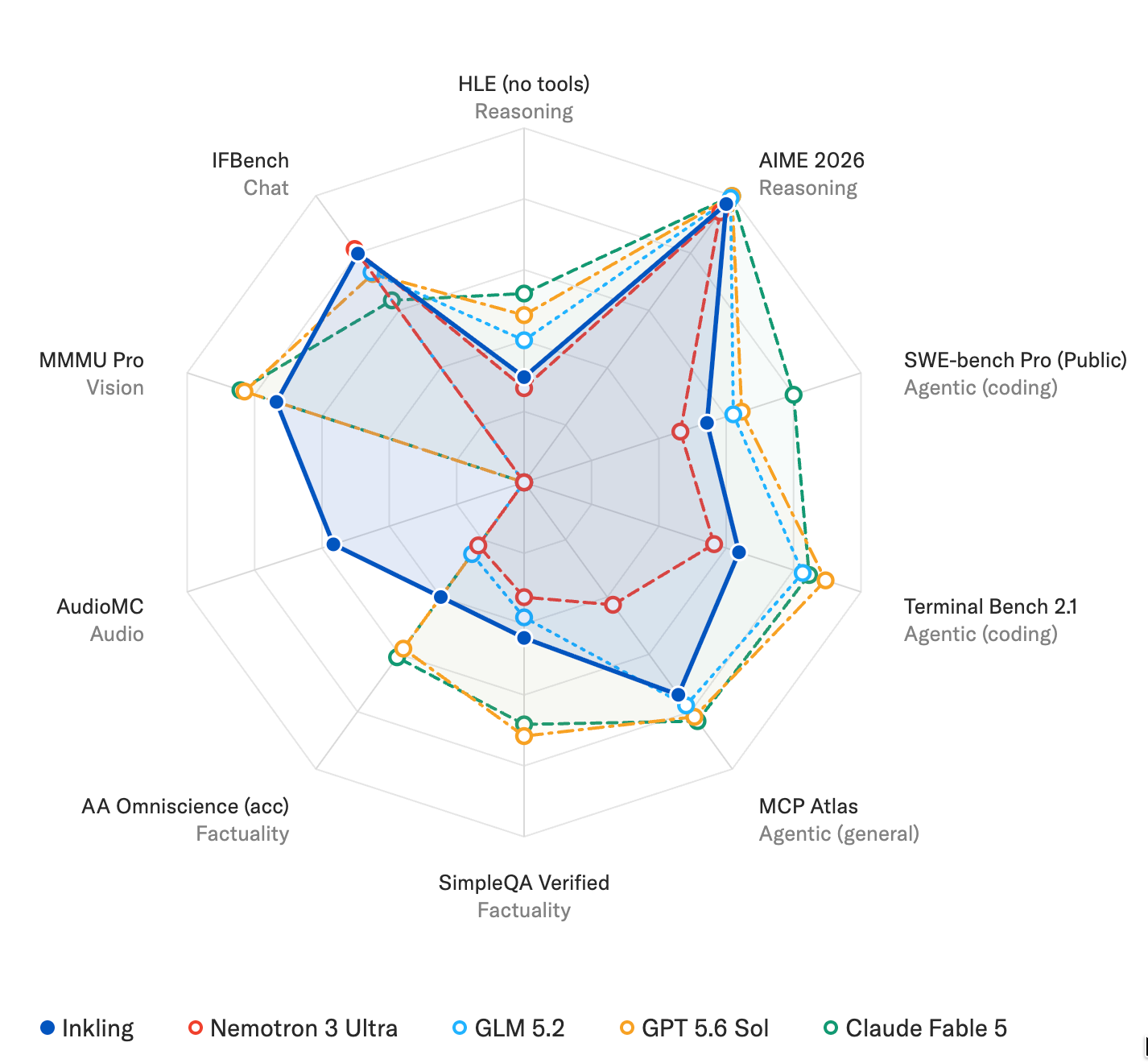
This is nice broad, generalist model with open weights with multi-model reasoning capabilities. From their release:
“Inkling is not the strongest overall model available today, open or closed. Instead, a combination of qualities makes it a good open-weights base for customization: multimodal capabilities, efficient thinking, and availability on Tinker for fine-tuning. Inkling is just the start: our first release in a model family we will continue to build on.”
Nice to see a model release from thinking machines. Chart below shows how it performs against various benchmarks.