

Good morning, it’s July 23rd, 2026.
AMD locked in Anthropic for up to 2 GW of MI450 compute across Helios rack-scale systems, backed by a $5 billion investment. Separately, Intel and AMD are signing long-term CPU supply commitments with Chinese cloud firms as the squeeze that started in memory reaches server processors. Elsewhere, hybrid bonding is having a moment: BESI’s order book more than doubled, and Samsung is planning a 50-tool line at Pyeongtaek.
Let’s get into it.
— Austin & Vik
Be sure to check out the Semi Doped podcast on YouTube or your favorite podcast player!
Presented by … (this spot is open: reply to this email to talk sponsorship)
AMD Locks In Anthropic for Up to 2 GW of MI450 Compute, Invests $5 Billion
AMD and Anthropic have signed a multi-year chips-and-investment deal in which AMD will invest up to $5 billion in Anthropic (Reuters), while deploying up to 2GW of Instinct MI450 GPUs in AMD’s Helios rack-scale systems. This represents one of the largest circular deals in the AI industry where chipmakers are investing in AI labs, who will eventually buy their hardware. The deal hands AMD its third marquee AI training customer in a year and represents the most concrete large-scale commitment by a frontier lab to non-Nvidia silicon.
Reuters reports that Nvidia may invest $30B in OpenAI, and that would make it an even larger circular investment compared to AMD’s deal today.
Vik: AMD is emerging as a strong non-Nvidia alternative. While the latter holds 95% of the AI GPU market today, AMD will encroach on that market share like they did with server CPUs with Intel. Although these circular deals are unnerving, its actually a bet that we will always need more compute. As long as that is true, we should be fine? 🤷🏽♂️
Austin: Underappreciated — AMD is Claude-pilled. From the announcement, “In addition, AMD and Anthropic are launching a multi-year engineering collaboration to use Claude to accelerate AMD software development. Specifically, the teams will use Claude to optimize workloads for AMD Instinct GPUs and accelerate ROCm software development. AMD will also broadly adopt Claude across its engineering and product development teams.”
Note that the tide is turning in AMD’s favor… last year AMD chose to give Meta equity in the Instinct GPU partnership announcement. Now, AMD is giving a $5B equity investment instead. Much better terms. Not to mention, it’s Anthropic pre-IPO, so that $5B will grow.
Also this is a multiyear partnership, which means Anthropic feels positive with MI500+ specs.
Intel, AMD Lock Chinese Cloud Firms Into Long-Term CPU Supply Deals
After the memory crunch hit 40-week lead times, the supply squeeze has reached server CPUs — Intel and AMD are signing long-term purchase commitments with Chinese cloud and internet firms as prices surge, Reuters reports.
Chinese cloud and internet buyers are being pushed into deals once reserved for the tightest parts of the market
CPU prices are rising as AI cluster buildouts drain server processor supply
Vik: Uh oh, LTAs are coming to a CPU store near you. If you have been paying attention to memory, you know what happens next. CPUs are not subject to the same export control restrictions GPUs are, and they can therefore be sold to China. This increases revenues for CPU makers — Intel, AMD, Nvidia, Arm, and Qualcomm come to mind when CPUs are in short supply.
Austin: When will consumers revolt en masse? More memory and CPU increases means laptops and phones that cost an extra several hundred dollars… there’s going to be a breaking point. By Christmas?
GE Vernova Orders Surge 88% as AI Data Centers Drive Power Buildout
GE Vernova posted an 88% year-over-year jump in orders in Q2 2026, with AI data center customers driving demand for gas turbines to record levels and lifting quarterly revenue 22% year-over-year — though the company still missed core profit estimates as persistent wind segment losses weighed on earnings. (Industrial Info Resources)
Brookfield Asset Management agreed to acquire battery storage developer Aypa Power for $7 billion, the largest grid storage transaction this year, a bet that AI-driven electricity demand will require large-scale storage to complement new gas generation capacity. (Bloomberg.com)
The Trump administration is preparing to expand its power cost pledge to cover a broader set of data center operators, a policy shift that would make AI infrastructure a more explicit priority for federal energy programs. (Reuters)
Vik: Behind-the-meter (BTM) generation is where all datacenters are going as they cannot wait for the grid buildout. Bloom Energy SOFCs, GEV turbine, Boom turbojet engines, whatever makes energy is getting thrown in datacenters. I’m waiting for the time when small modular reactors (SMRs) become a thing. Nuclear BTM is where its at!
BESI Orders More Than Double as Hybrid Bonding Tools Near Critical Shortage
BE Semiconductor Industries reported that orders more than doubled in its second-quarter results, driven by AI chip demand and rapidly expanding adoption of hybrid bonding technology. (Reuters)
Samsung plans a 50-tool hybrid bonding production line at its Pyeongtaek campus. (thelec.net) Pricing negotiations with BESI have dragged, and the company is now evaluating Korean equipment suppliers like SEMES and Hanwha Semitech as potential alternatives. Besi’s bonders are estimated to be 2x more expensive compared to their competitors. (digitimes)
Samsung Foundry is also developing 3D Cube-H, a vertical integration platform that stacks logic dies along the Z-axis, uses through-silicon vias for alignment, and connects the dies through hybrid copper bonding.
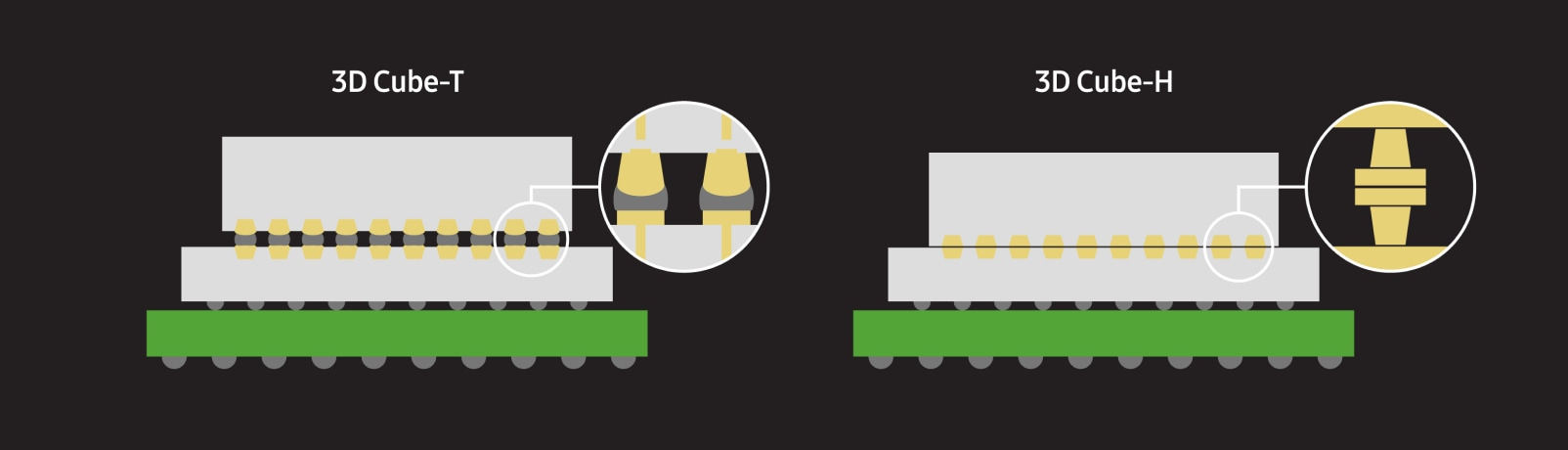
Vik: Hybrid bonding is going to get important from about 2029-2030 because the next generation of HBM requires stacking even more chips which requires hybrid bonding. 3D stacking of logic is another emerging trend fueled by Huawei’s Tau scaling / LogicFolding claims. I bet others are putting similar approaches on the roadmap. Still a long play though.
Quick Takes
Wistron opened its first US-based AI server factory in Texas, where it will mass-produce Nvidia’s GB300 compute boards for the North American market. (qz.com, Fort Worth Inc., DigiTimes)
xLight, Pat Gelsinger’s startup, raises $350 million to build the first American EUV lithography rival to ASML. (Startup Fortune) — whole Chipstrat article on this company
Texas Instruments reported Q2 revenue of $5.46 billion, beating estimates and signaling a recovery in the industrial and automotive analog chip markets. (Texas Instruments)
STMicroelectronics reported strong Q2 results and raised its AI data center revenue target to over $1 billion in 2026, citing strong demand from the sector. (STMicroelectronics)
Renesas files a trade secret lawsuit against power semiconductor rival Navitas Semiconductor. (Reuters). — first Wolfspeed lawsuit, now Renesas? 🤯
Nokia is building its in-house InP supply chain by acquiring NXP’s Arizona campus (Link)
A White House official accused China’s Moonshot AI of improperly using banned Nvidia chips and distilling US AI models to create its Kimi K3 system. (Bloomberg Tech)
Presented by … (this spot is open: reply to this email to talk sponsorship)
Key Data
AMD’s Lisa Su plays the long game. Remember how that worked for EPYC?
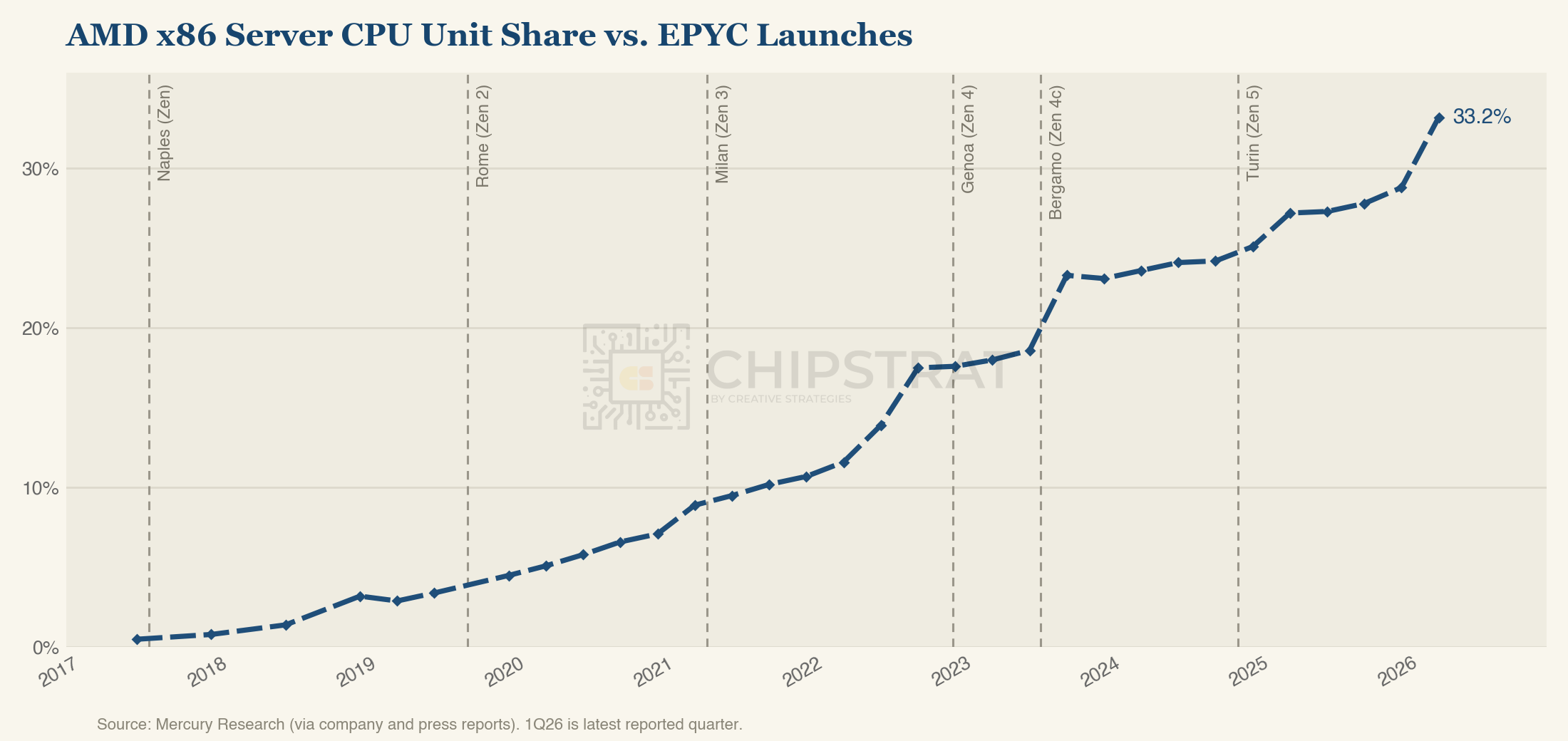
Reminder that we’re only a few years and maybe two generations into the AI accelerator long game. Sure, it’s a different ballgame, and the GPU market has different dynamics from x86 CPU, but the leadership and engineering approach is largely the same.