

Good morning, it’s July 27th, 2026.
CXMT makes its heroic STAR market appearance: price goes up 470%. Nomura estimates $2T by 2030. Big commitments are being make by Korean memory companies with US datacenter buildout. More interesting odds and ends.
Let’s get into it. — Austin & Vik
Be sure to check out the Semi Doped podcast on YouTube or your favorite podcast player
Presented by … (this spot is open: reply to this email to talk sponsorship)
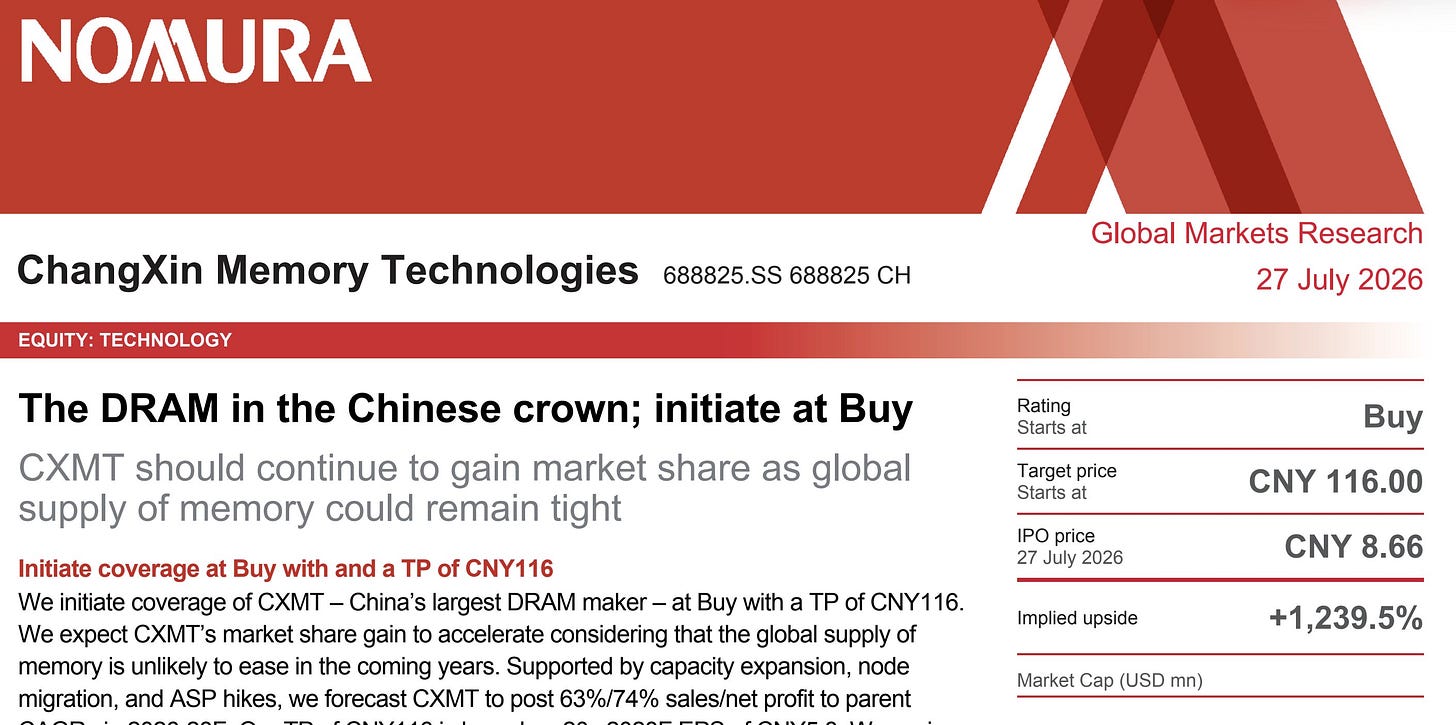
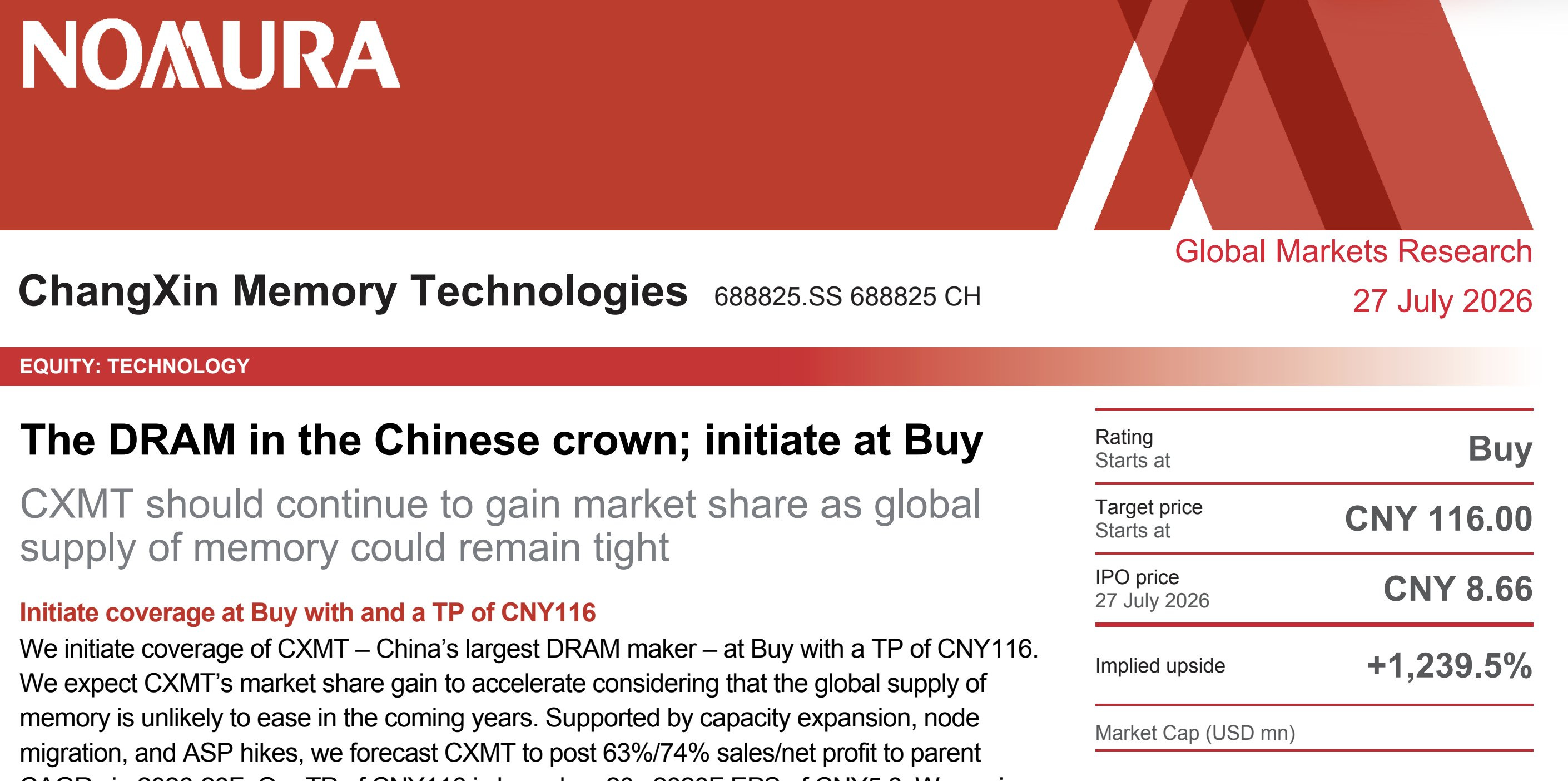
CXMT’s 470% Debut Makes It China’s Largest Listed Firm; Nomura Sees 1,200% More
After PC vendors locked in capacity through 2027, CXMT’s July 27 STAR Market debut delivered a 470–472% first-day surge, briefly pushing market cap to ¥3.6 trillion (~$533B) and displacing ICBC as China’s largest A-share company. IPO price was set to 8.66 yuan, but closed around 49 yuan.
The $9.8B IPO — Shanghai’s biggest ever — now funds a race to 600,000 wafers/month while CXMT prices 64GB server DDR5 RDIMMs above Samsung, signaling a shift from volume supplier to margin-seeking market-power player.
Nomura projects a further 1,239% upside from IPO price on market-share gains Bloomberg Tech
Via @jukan05 on X
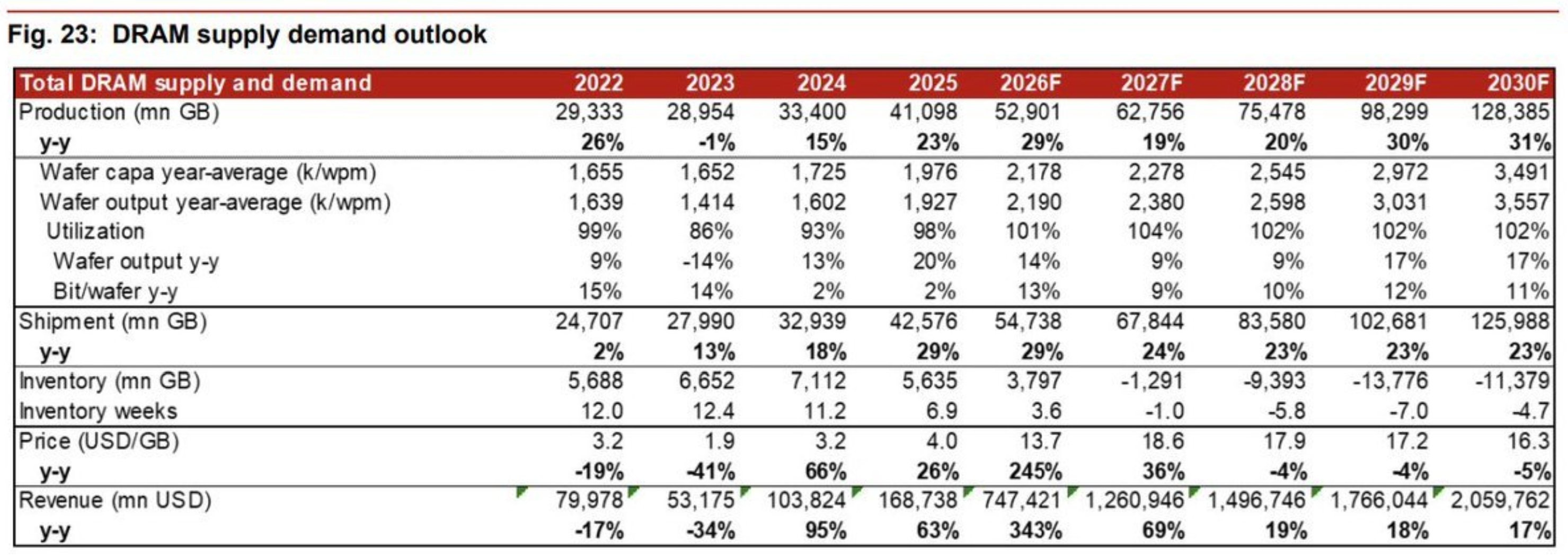
Nomura projects DRAM revenue to hit $2T by 2030. Also look at the $/GB line to understand what pricing power looks like.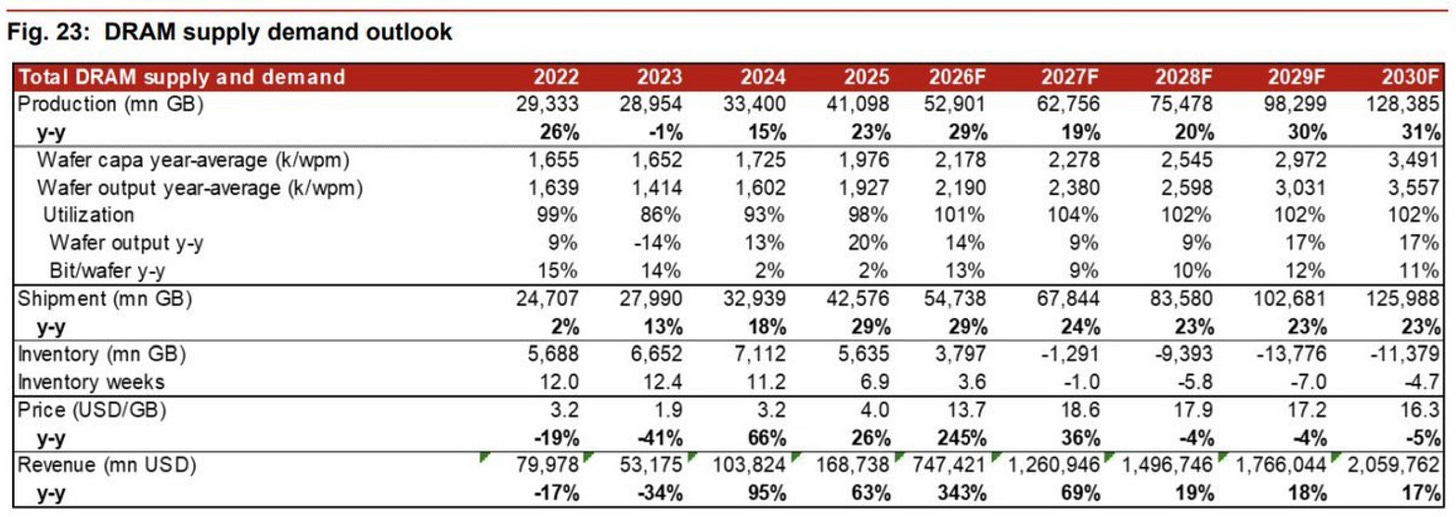
Source: Nomura via @rickyho_1989 on X $8.6B in fresh capital targets capacity expansion, advanced process development, and accelerated new products
China’s chipmaking sector posted a 2,580% profit jump in H1 2026, the macro backdrop underwriting CXMT’s premium pricing power
Vik: Too many people view CXMT as a low-cost supplier of consumer memory, but in this memory market, anybody with DRAM supply commands a premium price power, especially when customers like Apple are willing to increase prices to absorb the costs. There’s no reason Apple won’t increase prices again, and no reason for CXMT to become the low-cost provider. They are going to play the memory margin game just like anybody else
Austin: CXMT is in China, meaning it doesn’t have access to EUV… so CXMT is using DUV multipatterning, which means more steps, more overlay error, more cost per bit. In a normal cycle and commodity market, the highest cost producer is the first to suffer when supply outpaces demand. And lots of supply is coming online in 2028-2030.
Of course, is that supply going to actually outstrip demand? And has CXMT figured out other ways to bring down cost even without EUV? Finally, CXMT is state-backed, so can they still keep running even when not profitable during a downcycle?
Korea’s $950B AI Summit Locks Samsung, SK Hynix Into Nvidia’s Supply Chain, Nvidia invests in Naver
Samsung Electronics and SK Group have signed a combined ~$950 billion in partnership agreements with major US technology companies, announced at a summit in San Francisco, cementing South Korean memory and foundry capacity as core infrastructure for American AI buildout. (Reuters)
Broadcom awarded Samsung a $200 billion memorandum of understanding spanning foundry, high-bandwidth memory, and advanced packaging through 2030 — a win attributed by South Korean reporting to Broadcom’s view that TSMC was “too costly, too slow.” (Seoul Economic Daily) The two companies will jointly develop next-generation AI accelerators based on HBM, deepening a relationship that now covers leading-edge fabrication alongside memory supply.
Nvidia and SK Group unveiled a partnership valued at more than $500 billion covering large-scale AI factory deployments and long-term HBM collaboration, with CEO Jensen Huang disclosing the figure to South Korean President Lee Jae-myung in San Francisco on July 24. (The Korea Herald) A $1 billion Nvidia investment in South Korean internet platform Naver was also announced at the summit, sending Naver shares up 10 percent. (Reuters)
Vik: These kinds of partnerships go beyond getting supply locked up. Future generations are going to have increasingly custom-designed base dies for HBM, and this uniquely makes HBM a custom component rather than a commodity one. These kinds of partnerships will become more common when you realize that another way Nvidia can lock up SK Hynix supply is to design in a custom base die that is suited for use on their platforms.
Austin: Haven’t heard anyone say TSMC was too costly and too slow before, that caught me by surprise.
Also, we’re saying HBM’s not a commodity… but it’s not the answer either? See next story:
SK Hynix Exec Concedes HBM Will Not Solve the Memory-Wall Problem
SK Hynix’s Hoshik Kim acknowledged at a public event that high bandwidth memory “is not the answer” to the memory-wall problem, agreeing with prior remarks from Pat Gelsinger who called HBM “a lousy memory” that wastes four bits for every one it makes. Kim stated that HBM will not solve the memory-wall problem, describing it as “an inherent AI problem, which you cannot avoid.” He cited thermal constraints, IO limitations, and cost as known drawbacks of HBM, while confirming SK Hynix is pursuing different solutions to address the memory bottleneck beyond HBM.
Sources: firesidealpha
Vik: This whole thing is too funny, so I wrote a post about it today. There are a lot more valuable discussions in the whole talk rather than HBM=Ugly baby.

Apple Smart Glasses at WWDC 2027
Look at the Ray Ban branding.


Quick Hits
Compute
Nvidia is in talks to provide a ~$250B financing guarantee for OpenAI’s planned Ohio AI data center, per WSJ and Reuters, in what would be the largest single infrastructure backstop in tech history. (Reuters)
Microchip Technology signed a definitive agreement to acquire AI chip startup Hailo, adding edge-inference silicon to its embedded and automotive portfolio. (Microchip)
Infineon raised its full-year guidance citing AI data center power semiconductor strength and opened the world’s largest power semiconductor fab in Dresden. (Infineon Technologies IR)
AMD and Cerebras unveiled a disaggregated AI inference platform combining AMD GPUs with Cerebras wafer-scale engines, targeting hyperscale inference workloads. (Bloomberg.com)
Memory
SK Hynix has emerged as Kioxia’s de facto second-largest shareholder after Bain Capital’s record $17B stake sale, deepening Korean control over global NAND supply. (Nikkei Asia)
Foundry & Packaging
LG Innotek reported Q2 operating profit up 2,057% year-over-year to 245.8B won, driven by surging AI substrate demand, with first-half sales topping 10 trillion won. (The Korea Herald)
China & Geopolitics
Huawei founder Ren Zhengfei publicly backed the company’s ‘Tau Scaling Law’ as the primary path to AI chip self-reliance within three years, framing it as a workaround to US sanctions. (South China Morning Post)
Models & Demand
Google Cloud posted 82% year-over-year revenue growth in Q2 on AI inference demand, while Alphabet raised 2026 capex guidance to $195–205B, leading hyperscaler spending. (The Elec)
BlackRock launched a $12.3B bond sale to fund Meta’s Texas AI data center, but the offering met weak demand, signaling bond-market anxiety over hyperscaler debt-fueled capex. (Bloomberg.com, Briefs Finance, CNBC)
Presented by … (this spot is open: reply to this email to talk sponsorship)
Key Data
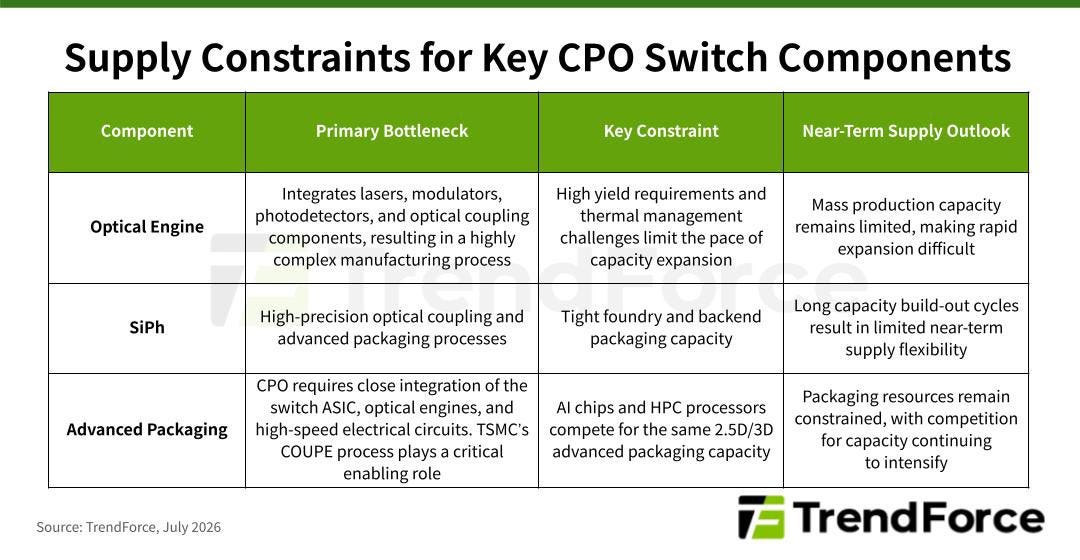
A lot of these constraints exist even for NPO. Rapid expansions are always difficult.
Interesting Observation
Anthropic’s GM has risen rapidly, which means that even if compute and memory are getting extraordinarily expensive, the process of selling tokens is even more profitable. As such, Anthropic will be more inclined to make more investments in compute because their return is outsized.

