China ships domestic immersion DUV tools and Korean chip stocks trip circuit breakers, Cadence raises its AI outlook, PJM calls an emergency power auction.
China has reportedly begun mass producing domestic immersion DUV lithography systems, spooking Asian markets and triggering circuit breakers on South Korean exchanges. Cadence beat Q2 estimates and raised its full-year outlook on AI chip design demand. PJM is also running an emergency capacity auction after Bloomberg tied a US power shortfall to the data center build-out.
Let’s get into it. — Austin & Vik
Quick hits, high signal. Takes from semi industry experts. Sign up for free daily updates!
Be sure to check out the Semi Doped podcast on YouTube or your favorite podcast player!
China Enters Mass Production of Domestic Immersion DUV Lithography Tools
China has reportedly begun mass producing homegrown immersion DUV lithography systems, with The Information breaking the story and TrendForce separately confirming that deliveries are on schedule for this year. The equipment covers the tier of chipmaking tools that ASML has long dominated and whose export to China has been curtailed by controls from the Netherlands and the United States. State-backed Chinese semiconductor programs have treated domestic lithography development as a top priority since those restrictions tightened.
SMIC, Hua Hong, and CXMT are each slated for delivery before year-end. Both of China’s largest contract foundries, SMIC and Hua Hong, are on the customer list, as is CXMT, the country’s primary domestic DRAM producer. Techzine Global characterized the machines as China’s ASML alternative, a framing that reflects ASML’s decades-long position as the default global supplier of such tools. Immersion DUV systems cover a broad swath of process nodes used in memory, automotive, and industrial chip production.
Vik: Immersion DUV lithography can print 28 nm nodes in a single exposure and, via multi-patterning, go all the way down to 7 nm. China is reportedly going to ship about five machines in 2026 and about 20 in 2027, primarily to three customers in China. In contrast, ASML expects to produce about 160 such machines in 2027.
Reportedly, this immersion DUV system, developed by developed by Shanghai Yuliangsheng Technology Co, most closely resembles ASML’s twin scan NXT:1950i, which was developed in 2008. ASML is actually generations ahead of this technology, so no need to panic just yet.
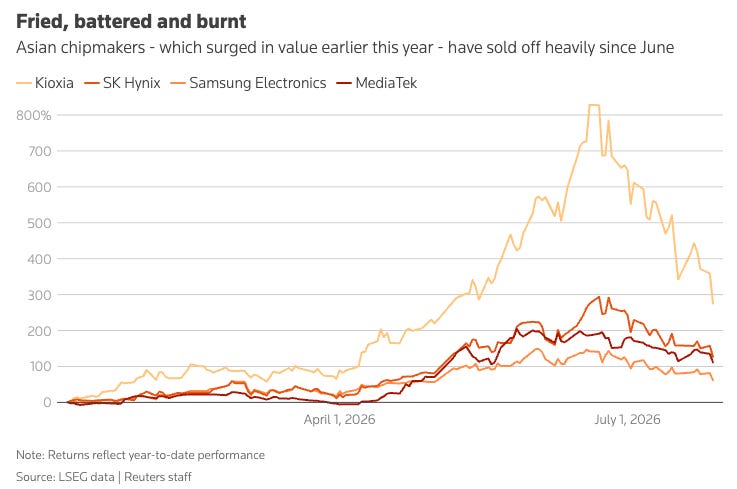
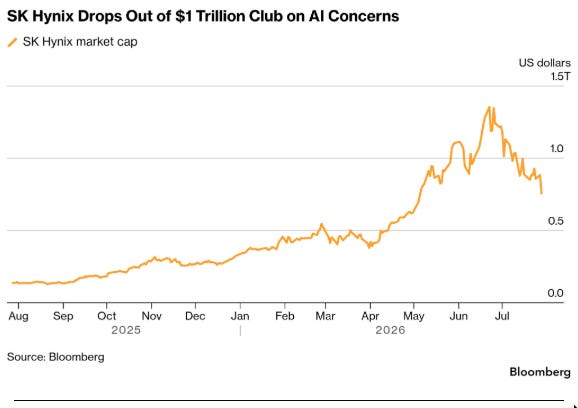
Korean Circuit Breakers Snap as China Fears Rout Asian Chip Stocks
Vik: What a rout in Asian markets! All because China’s immersion DUV system is reportedly entering mass production? That technology is 20 years old compared to ASML and still cannot produce leading-edge chips without crazy techniques like logic folding. I personally don’t understand what all the massive panic selling is about.
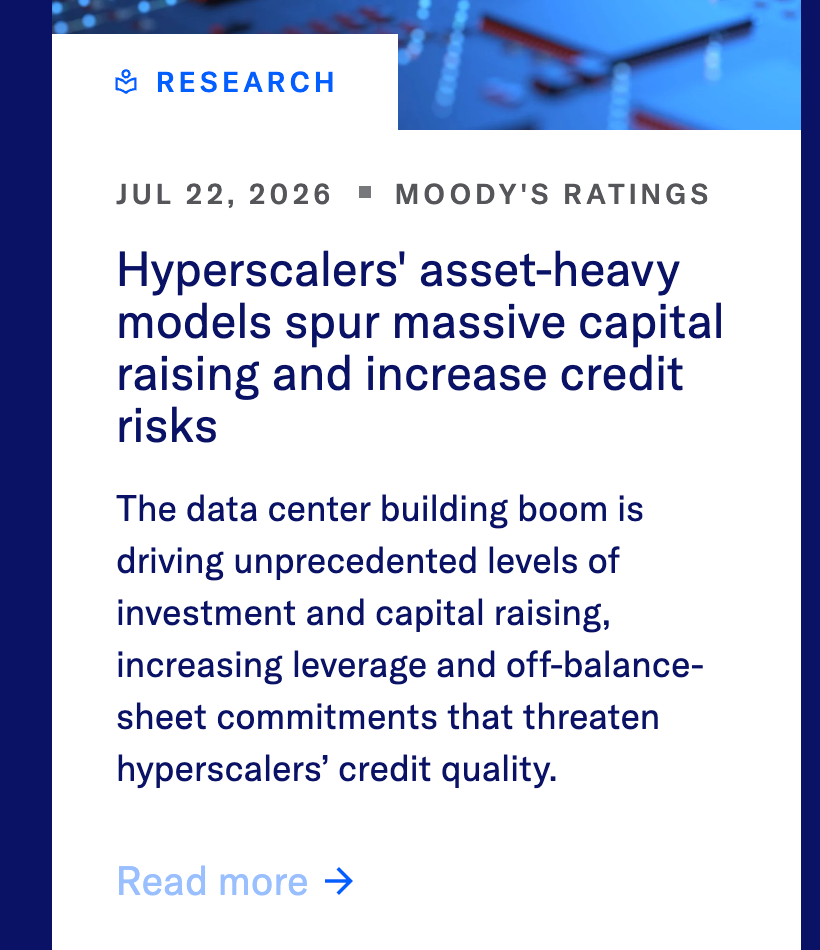
Austin: I think there’s still broader concerns around hyperscaler CapEx, especially as they shift to more debt financing and not just pure cash flow. For example, Moody’s put out a note last week about this debt financing and how it “threatens credit quality”:
Cadence Lifts Full-Year Outlook as AI Chip Design Demand Accelerates
Cadence Design Systems beat Q2 2026 estimates and raised its annual forecasts as hyperscalers and chipmakers increase spending on custom silicon, lifting demand for electronic design automation tools sharply higher. The results pushed shares up, with Barron’s making the case that Cadence’s earnings solidify its AI winner thesis. Revenue at Cadence tracks chip tape-out volume and complexity closely, and the current wave of AI accelerator development has driven sustained demand across its product lines.
Synopsys, the other pillar of the EDA duopoly, has been extending its own reach. Agentic AI collaborations with AMD and Microsoft pull two of the sector’s heaviest chip design users into Synopsys’s AI-assisted workflow program. A new agreement with Intel Foundry targets customer readiness on Intel’s 14A process node, with Synopsys coordinating design tool support across the full silicon-to-systems stack. Intel’s 14A partnership is framed as fast-tracking the path from initial chip design to manufacturing-ready sign-off.
Vik: While everyone is panic-selling, things are still looking up in EDA land. In the long term, AI-assisted chip design holds an enormous amount of value because the amount of grunt work required to produce a chip is staggering. If AI tools can assist with a lot of the verification processes, there is real value add for the chip industry.
Austin: Remember how folks thought EDA was dead because AI? It’s not as simple as that. EDA companies have the PDKs from foundries, they have the installed base with users, and how they are able to use AI to speed up the time to tape out. That’s great for existing EDA vendors.
PJM Launches Emergency Capacity Auction as EPA Clears Data Centers on Emissions
PJM Interconnection, the biggest US grid operator, will run an emergency capacity auction to address a power shortfall Bloomberg attributes to the AI data center boom. Its emergency procurement mechanisms are reserved for situations where committed reserves fall short of planning requirements, a bar the system has rarely crossed. Data center connection requests have pushed load forecasts well beyond what planned capacity additions can cover, and the emergency auction is PJM’s instrument for closing that gap on an expedited timeline.
The EPA ruled that power for data centers can sidestep pollution laws, Reuters reported. That guidance covers backup generation at data center facilities, letting diesel and gas generators operate during grid stress events without triggering Clean Air Act enforcement. It removes a compliance requirement that had applied broadly to large industrial users running on-site combustion equipment during peak demand, carving out data center power supply as its own regulatory category.
Vik: I came across an insightful tweet that explains how BTM generation currently deployed by AI data centers will eventually serve as excess capacity when grid connections actually come on.
Nvidia is in talks to invest $5B in Ilya Sutskever’s Safe Superintelligence startup, extending its pattern of equity stakes in frontier AI labs as a demand-creation strategy. (Reuters)
Supermicro launches the H15 server portfolio on AMD 6th Gen EPYC, expanding its AI data center hardware lineup. (thelec.net)
Data Centers
Meta secures a $12.5B BlackRock-led debt package to finance its $50B Louisiana AI data center campus, the largest single private infrastructure debt raise tied to AI buildout. (Bloomberg.com)
Nvidia backs a $50B Texas data center lease, the FT reports, separate from its OpenAI Ohio campus financing talks. (Reuters)
Orange and Morrison Infrastructure Partners team up on a French data center development, adding European AI infrastructure capacity. (Bloomberg.com)
Optics & Networking
Innolight raises $6.81B in Hong Kong in Asia’s second-largest listing of 2026, pricing below the maximum range amid strong demand for its AI data center optical transceivers. (Bloomberg.com)
Nokia says Nvidia GPUs offer “major benefits” for AI-RAN massive MIMO radio processing in future 6G hardware, though a formal decision between Nvidia and Ericsson-style custom silicon remains open. (Light Reading)
Verizon takes on a $1B dark fiber deal with Google to provide optical connectivity for data center campus expansion. (Lightwave Online)
Power
Navitas Semiconductor Q2 revenue grows 22% sequentially with high-power markets up more than 50% year-over-year, confirming GaN/SiC power IC demand from AI and data center customers. (Navitas Semiconductor)
JMJ Korea plans a new power semiconductor materials fab, citing rising demand from Nvidia AI server platform deployments. (The Elec)
RFHIC posts a 35% year-on-year rise in second-quarter operating profit on 51.5 billion won in sales as GaN component demand accelerates. (The Elec)
Foundry & Packaging
Absolics moves embedded glass substrates into package-level reliability testing at a Taiwanese manufacturing partner, advancing next-gen chip carrier qualification. (The Elec)
LG PRI ships its first commercial maskless Laser Direct Imaging system, removing photomask costs from PCB and substrate manufacturing. (The Elec)
Doosan confirms ongoing acquisition talks for SK Siltron, Korea’s largest silicon wafer supplier, after being named preferred bidder. (The Elec)
Thanks for reading! This post is public so feel free to share it.