

Good morning, it’s Wednesday, July 29.
SK Hynix shares fell a record 19% even as the company posted ₩60.5 trillion in Q2 operating profit, a six-fold year-over-year jump. Corning dropped more than 20%, its worst single-session loss since 2002, on Q3 revenue guidance. Test and inspection earnings are all looking up. Bloom Energy is converting orders to revenue for AI power.
Let’s get into it. — Austin & Vik
Be sure to check out the Semi Doped podcast on YouTube or your favorite podcast player!
SK Hynix Shares Fall Record 19% Despite Six-Fold Profit Surge
SK Hynix posted a record ₩60.5 trillion Q2 operating profit, with earnings growing six-fold year-over-year on surging AI memory prices as high-bandwidth memory demand from data center customers kept order books full. The result still fell short of lofty investor expectations, shaped by the AI memory boom, for the world’s dominant HBM supplier. Record earnings weren’t enough. Shares fell by a daily record of roughly 19% in Seoul on Wednesday, erasing early gains and marking the sharpest single-session decline the stock has recorded.
The company announced plans to earmark at least $31 billion in capital spending for the year, a record outlay that Bloomberg noted arrives alongside growing fears about overinvestment in AI capacity. South Korea’s broader equity market absorbed the hit, suffering a $2 trillion rout that broke national records and dragged chip-adjacent names across the board. Reuters, for its part, described the chip market mood as having moved into panic territory.
Vik: The whole wreckage is coming from the “consensus” that investors had for this stock. The revenue was up a record 257% YoY, with 76% operating margin. A modest miss triggered selling. This goes to show how skittish memory investors are. The demand for memory still stays strong as ever.
Austin: Word on the street is this is amplified by leveraged ETFs and hedge funds unwinding.
Corning Posts Worst Single-Day Drop in 24 Years on Optical Fiber Capacity Ceiling
Corning shares fell more than 20% on earnings day, the worst single-session loss since 2002, after Q3 revenue guidance fell short of Wall Street expectations. The paradox was plain: Q2 results beat estimates, with revenue up 17% year-over-year and adjusted EPS of $0.78, driven by optical and solar strength. The problem isn’t demand. Corning cannot build fiber fast enough to fill hyperscaler orders, a capacity ceiling driving the guidance shortfall rather than any softening in end-market appetite.
Q3 adjusted EPS guidance came in at $0.85, meeting the earnings estimate but missing on revenue, because Corning cannot ship more fiber than its current production facilities allow. Optical stocks sold off broadly in sympathy, with Corning leading the rout. Morningstar urged investors to buy the fundamentals and look past the pessimism, arguing the underlying demand picture remains intact. The WSJ also flagged a smartphone-driven display glass slump as a second headwind weighing on the company’s outlook alongside the fiber supply wall.
Vik: Another supply limited story. The demand for optics and optical fiber remains strong, but production capacity takes time to build. That requires Capex investment, and orders have to convert to revenue. These things take years not quarters.
Austin: Think of Corning like TSMC: demand for what they make is effectively unlimited, so the revenue model is effectively two inputs. How fast can they add capacity, and how much do ASPs rise each year?
KLA, Teradyne, Advantest, ASM All Beat Estimates and Raise Guidance
The semiconductor equipment sector swept the quarter. KLA, Teradyne, Advantest, and ASM International all beat analyst estimates and raised guidance in the same earnings window, covering inspection, test, and deposition together. ASM International posted EUR 1.003 billion in Q2 revenue, clearing consensus, with its forward outlook also beating estimates as AI-driven chip-tool demand pushed orders higher through the period. Advantest lifted its annual forecast above consensus after demand for the testers chipmakers use to build increasingly complex AI data-center chips came in well ahead of the company’s own prior projections.
Teradyne beat on its second-quarter results and forecast upbeat revenue for the coming quarter, shares jumping on the news. KLA reported fiscal fourth-quarter and full-year 2026 results that beat across the board, covering the inspection tools foundries deploy at leading-edge process nodes. Per Bloomberg, Advantest traced its raised outlook directly to soaring demand for AI chip testers at data-center chipmakers.
Vik: It’s not all doom and gloom in the selloff. Fundamentals remain strong. Test and inspection demand is still going steadfast.
Austin: This is a market where demand is faster than expected, but not necessarily unlimited. So the dynamics are different than logic & memory wafers, InP, fiber, and so on.
Bloom Energy Posts First Billion-Dollar Quarter on AI Data Center Demand
Bloom Energy crossed $1 billion in quarterly revenue for the first time in Q2 2026, with earnings roughly double analyst estimates, as hyperscaler demand for on-site power pulled fuel cells into mainstream data center procurement. The company raised full-year guidance on the back of the beat, and shares climbed on the news. The surge came as AI infrastructure buildout pushed data center operators toward distributed generation: interconnection queues at utilities have lengthened enough that on-site fuel cells now offer a faster path to megawatts than waiting on the grid.
Bloom also logged strong profit and cash flow in the quarter. The core thesis, that fuel cells can serve load-dense facilities directly and sidestep grid constraints, found buyers in data center procurement as AI capital expenditure accelerated. A Bloom essay published around the quarter argued that on-site power will ultimately determine whether hyperscaler ratepayer protection pledges hold in practice, with the company positioning itself as a provider at the center of that question.
Vik: BTM energy generation is the fastest way to power up datacenters. Building out grids takes time, and the cost can ultimately end up on the public’s electricity bill. Bloom argues that their fuel cells prevent that from happening. Anyway, business is b(l)ooming for them.
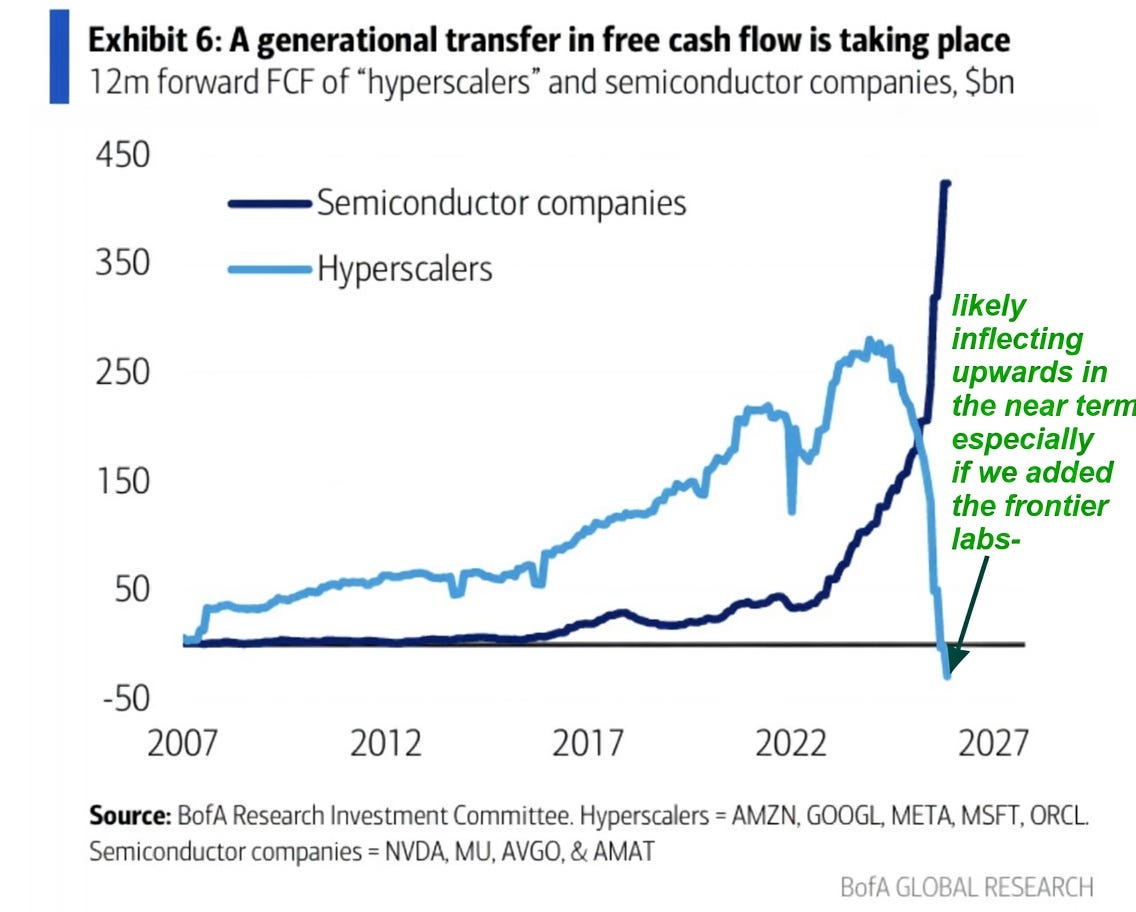
Key Data
Hyperscalers are investing every bit of cash into building more infrastructure, and this cash is going straight to the semiconductor companies. Amazing times we live in!
Sector Watch
Foundry
Intel Foundry completed the RAMP-C program, achieving a key certification milestone toward serving US government secure-enclave chip fabrication requirements. (Intel Newsroom)
IonQ receives regulatory approval to complete its acquisition of SkyWater Technology, forming the only vertically integrated full-stack quantum computing platform company in the US. (SkyWater Technology)
Compute & Edge
Skyworks posted $935M in Q3 FY2026 revenue and $1.08 non-GAAP EPS, with Qorvo regulatory approvals advancing toward a merger close. (Skyworks)
FuriosaAI is developing an AI inference server with 16 PCIe accelerator slots, targeting hyperscale deployments that mix multiple accelerator types. (thelec.net)
Packaging
Samsung Electro-Mechanics raised MLCC prices 30% on AI server demand; Taiyo Yuden separately announced another round of hikes, signaling a broad passive-component pricing cycle driven by AI infrastructure buildout. (Chosunbiz)
Samsung Electro-Mechanics and Soulbrain expanded their glass substrate materials partnership, deepening supply-chain readiness for next-generation advanced AI packaging. (thelec.net)
YEST secured its first overseas fan-out panel-level packaging equipment order for glass substrates from a Chinese semiconductor packaging company. (The Elec)
Data Centers
CoreWeave posted the leading per-GPU DeepSeek-R1 throughput among NVIDIA GB200 NVL72 submissions in the inaugural MLPerf 0.7 Endpoints benchmark. (CoreWeave)
Energy Vault broke ground on its first data center in Snyder, Texas, delivering modular AI compute infrastructure for Crusoe Cloud. (Data Center Dynamics)
Power
Legrand raised its 2026 sales guidance as enterprise customers continue pouring capital into AI data center electrical infrastructure. (Bloomberg Tech)
HD Hyundai Electric posted a 37% rise in second-quarter operating profit, driven by strong power equipment demand in North America. (The Elec)
Gaon Cable, an LS Cable subsidiary, won its first distribution cable order for a US Big Tech power plant project. (The Elec)
Policy & Trade
The US backed a Madagascar rare earths project to loosen China’s grip on critical minerals used in semiconductor supply chains. (Reuters)
Washington expanded trade curbs to cover certain foreign-made robots and inverters, extending controls into adjacent AI hardware supply chains. (Bloomberg Tech)
UK regulators proposed fees to screen speculative data center planning applications, seeking to filter the surge in AI infrastructure submissions. (Bloomberg.com)