China clears Nvidia H200 purchases, SK Hynix's $28B ADR oversubscribes, Nvidia teams with d-Matrix, and SambaNova raises $1B with JPMorganChase on board.
China cleared domestic AI firms to buy Nvidia H200 chips, and SK Hynix's $28 billion ADR oversubscribed. d-Matrix and SambaNova seeing some activity. APS acquired Korean transformer automation leader UPI to enter the AI power infrastructure market. Apple and Broadcom finalized a $30 billion chip supply deal focused on RF components.
Let’s get into it. — Austin & Vik
Quick hits, high signal. Takes from semi industry experts. Sign up for free daily updates!
Be sure to check out the Semi Doped podcast on YouTube or your favorite podcast player!
China Clears AI Firms to Buy Nvidia H200 Chips
China plans to allow domestic AI companies to purchase Nvidia’s H200 chips, according to The Information. The H200, a high-bandwidth memory GPU used for AI training and inference, sits below the H100 in export restriction tiers. The move would mark a policy shift after years of tightening U.S. controls that pushed Chinese firms toward domestically developed alternatives such as Huawei’s Ascend series. No official announcement has been made by either government. (Bloomberg Tech)
Vik: Guess Jensen got what he wanted, as he explained on the Dwarkesh Podcast, to sell chips to China to keep them hooked on American AI accelerators. It might be too little, too late though. China is already underway building their own domestic compute. Now everyone is worried that GLM 5.2 is smart enough to break through cybersecurity measures.
Austin: It’s never too late! Way easier to just buy and build with the best than bootstrap, and I think momentum will shift Nvidia’s way here. That said, Pandora’s box has been opened, and China’s government will fund the development and buildout of datacenters using domestic silicon, networking, power, and so on.
SK Hynix $28B ADR Bookbuild Oversubscribed, Closes Wednesday
SK Hynix will close the bookbuild for its $28 billion American depositary receipt offering on Wednesday after demand exceeded the available supply, according to a source familiar with the matter. The oversubscription signals strong investor appetite for the U.S. listing, which is part of a dual strategy that also includes a 1.4 trillion won commitment to expand its domestic AI supply chain in South Korea. (Reuters, The Chosun Daily)
Vik: Cerebras IPO was oversubscribed too, and look what happened to the stock price after. Guess its IPO hunting season after all.
Austin: Yeah SpaceX too. Never underestimate the power of get-rich-quick-schemes. Let’s be honest, thats why IPOs are oversubscribed.
Nvidia and d-Matrix Combine Hardware in Joint AI System
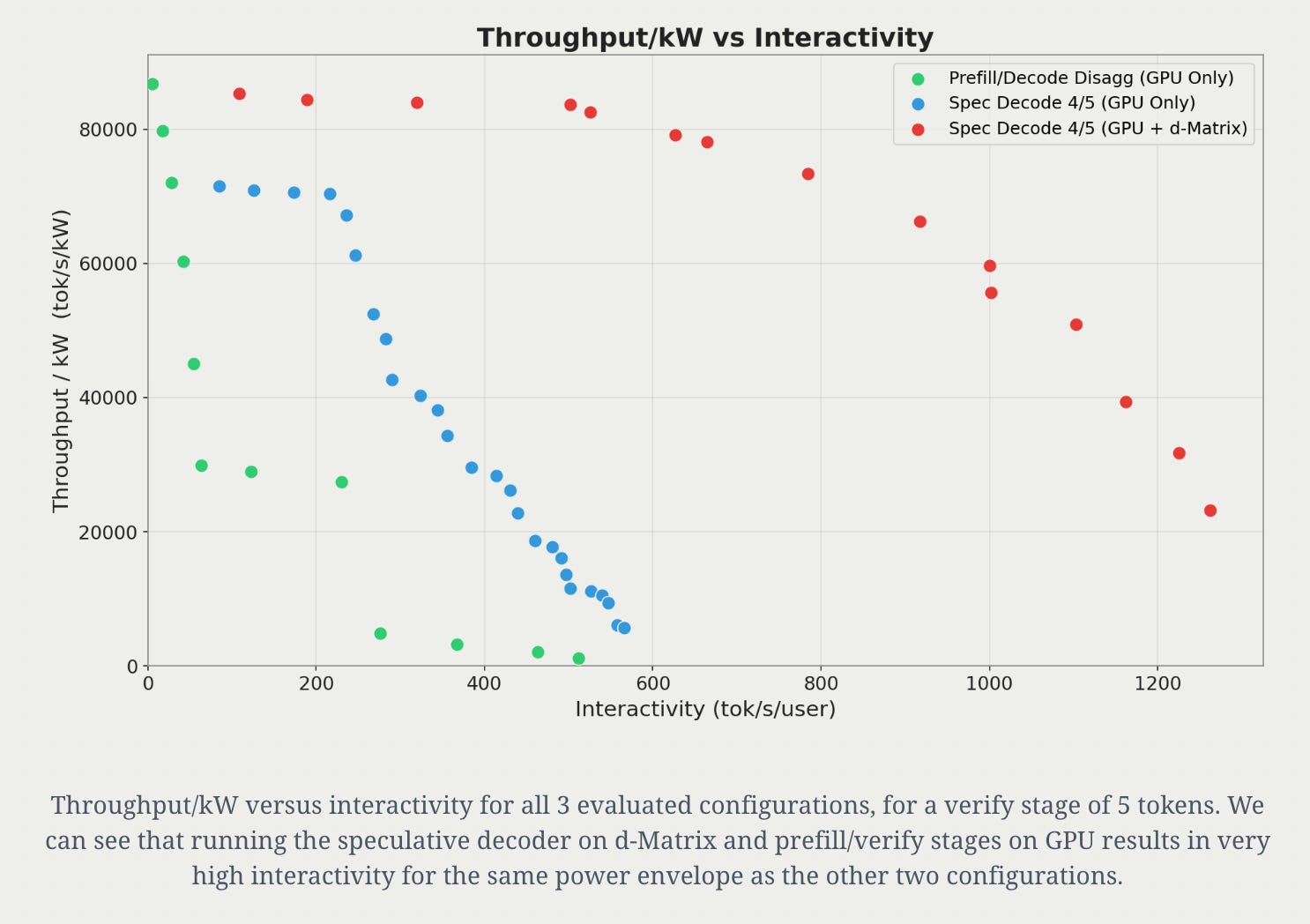
Nvidia and inference chip startup d-Matrix are integrating their respective hardware into a joint system for running AI models, per The Information. D-Matrix, founded in 2019, last raised $275 million at a $2 billion valuation in November and is reportedly in talks for a new round. The tie-up fits a pattern of Nvidia partnering with inference-focused competitors as a hedge, similar to earlier collaborations. (The Next Web)
Vik: No announcement from d-Matrix yet, but I am not sure what “integrating into a joint system” means. Is NVIDIA acquihiring? Are they going to just demonstrate how NVIDIA GPUs are used for prefill, and d-Matrix Corsair for decode? I’d bet on the latter, or some variation of it (like Attention-FeedForward Disaggregation maybe?).
Austin: Heterogenous compute. Maybe they saw my interview with Gimlet Labs and what Gimlet showed is possible with d-Matrix + Nvidia GPUs.
SambaNova Raises $1B Series F at $11B Valuation, Lands JPMorganChase as Customer
SambaNova closed a $1 billion Series F at an $11 billion valuation, five months after its prior funding round. General Atlantic led the oversubscribed raise, with Intel among existing backers. Separately, JPMorganChase signed on as a customer to deploy SambaNova’s hardware for on-premises AI inference. (Bloomberg, Reuters)
Vik: It’s always great for an inference startup when they get a new round of funding to keep the lights on, but what is even better is that they have a customer signed up to deploy their hardware on-prem. This is an interesting trend to me, where companies are starting to deploy their own compute hardware to avoid sensitive data from leaking back to the AI labs. Not all inference startups now need to be “acquired” like Groq by a big hardware company.
APS Acquires Korean Transformer Automation Leader UPI for 18B Won
APS is buying UPI, which holds a 95% share of South Korea’s cut-to-length machine market for transformer manufacturing, for 18 billion won in cash. UPI supplies core processing, winding, and E-stacking automation gear used to build transformers. APS is positioning the deal as an entry into AI data center power infrastructure, riding demand for 765kV ultra-high-voltage transformers and grid replacement projects across the U.S., Europe, and Middle East. (The Elec)
Vik: APS explains what UPI’s moat is:
“The transformer manufacturing equipment market has high barriers to entry because it requires sophisticated equipment design and control technologies, extensive customer-specific process expertise, and long-term supply references.”
Austin:I have a soft spot for heavy machinery / manufacturing companies. The industry dynamics are interesting and the technologies are usually surprisingly advanced and impressive. Would love a tour and an education, give me a call APS!
ZML Offers Software to Speed AI Inference Across Chips
ZML, a French AI startup, released ZML/LLMD, an LLM inference server designed to optimize inference across various AI chips, including those from Nvidia, AMD, Google, Apple, and Intel. The software aims to break vendor lock-in and allow enterprises and clouds to use a mix of chips for AI workloads. ZML has raised $20 million from venture firms. (TechCrunch)
Vik: I can imagine there are many uses for a hardware agnostic inference server. It will break all the ecosystem lock-ins, and treat compute as a fungible entity. According to founder Steeve Morin (that’s the first name, not a typo; also not to be confused with the serial killer), ZML is a competitor to vLLM and SGLang, but goes beyond them to co-design silicon.
Austin: I’ve been tracking ZML for quite some time. Interesting company. The recent Modular acquisition by Qualcomm was proof there’s something to the idea.
Apple has expanded its partnership with Broadcom into 2031, agreeing to spend at least $30 billion on chips under the multiyear supply agreement. Here is a quote from Apple’s IR page: (Apple IR)
“Broadcom is part of Apple’s American Manufacturing Program (AMP), launched last year to accelerate manufacturing in the U.S. This new agreement, which marks Apple’s largest AMP commitment to date, will enable Broadcom to expand and modernize its manufacturing facilities in Fort Collins, Colorado, with a $1.5 billion capital expenditure investment. Broadcom will produce advanced radio frequency components, including FBAR filters, and advanced wireless connectivity technologies at the Fort Collins facility.”
Vik: When this news broke a few days ago, I thought this has something to do with Apple making custom AI ASICs with Broadcom (for sure, I wasn’t thinking clearly; really wtf). As it turns out, the actual press release says nothing about AI chips. The whole thing is about Broadcom making RF chips and FBAR filters for phones and such. This whole thing reeks of a publicity stunt to ensure that Apple products are “made on American soil”.
Must Watch
This is sort of a Bloom Energy BE 0.00%↑ (Sc)andal.
Hunterbrook reports that one of their critical elements required for Bloom’s behind-the-meter energy sources is scandium, and their supply chain is from China. Reportedly, every shipment of scandium from China needs CCP approval. But the Bloom CEO has repeatedly denied that they are reliant on China. If Hunterbrook is right, then China has an OFF switch to US datacenters, as Hunterbrook put it. Spicy!
That said, Hunterbrook Capital is short $BE. So… yeah.
And Bloom says these fuel cells are “supplementing grid power” not the primary off-grid AI-datacenter use case the stock story is built on.
Oh yeah, and most of those datacenters aren’t actually stood up yet.
Besi faces intensifying competition in hybrid bonding as rivals crowd into its once-uncontested “blue ocean” market. (bits-chips.com)
AI & Compute
OpenAI will publicly launch its GPT-5.6 family of models on Thursday after regulatory clearance. (The Information)
Infrastructure
Blue Owl unveils a new infrastructure investment venture focused on data center development to meet growing AI compute demand. (Bloomberg Tech)
Hiring & Layoffs
Microsoft lays off approximately 4,800 employees as the company accelerates its AI infrastructure investment and reshapes its workforce accordingly. (The420.in)
Eaton names Dan T. Simpson President of Global Energy Infrastructure Solutions, a business unit serving data center and power grid markets. (Financial Times)
EDA
Arteris and IC-Link by imec announce a collaboration to accelerate next-generation AI and HPC chip design using Arteris’s network-on-chip IP technology. (Arteris)
Thanks for reading! This post is public so feel free to share it.