

Hello world, its Monday, November 23rd, 2026
Nvidia’s week ended with an SEC probe, and its weekend with the president pressing the board to bring Jensen Huang back. Korea’s chip exports nearly quadrupled anyway, AI server makers are repricing deals they already signed, and CrowdStrike agreed to buy Zscaler for $43.9 billion.
Let’s get into it. --Austin & Vik
Latest episode: Google Built Two New TPUs Without New Silicon: The 8i Max and 8TX — listen on YouTube, Apple Podcasts, or Spotify. Full transcript: daily.semidoped.com.
Presented by Crusoe
Fine-tune and serve open models without managing a single GPU.
When we sat down with Crusoe’s product team, Austin asked: what will you do with my data? Their answer: They don’t touch or see it.
Your training data is encrypted so even Crusoe’s own admins can’t see it, and the fine-tuned model is yours.
Deploy on Crusoe in one click, or download and run it anywhere.
Upload a dataset, pick an open model, and pay per token rather than per GPU hour.
Run a few versions, compare them, and download the one that works best.
Accounts are free, and get $5 in credit when you sign up.
SEC is looking at Nvidia’s accounting; POTUS asks for Jensen’s Return
Nvidia fell 14% on Friday to $125.53 after Reuters reported that SEC enforcement staff are scrutinizing potential accounting issues at the company. The Wall Street Journal had said earlier in the week that the SEC was investigating but couldn’t say what about, so the accounting focus is the new detail. Reuters couldn’t establish when the inquiry began or what exactly is under review. The SEC declined to comment and Nvidia didn’t immediately respond.
Reuters doesn’t say which areas the SEC is examining, but two are drawing scrutiny. Last year Nvidia began reporting revenue by customer headquarters instead of billing address, and Singapore dropped out of its geographic breakdown. The FT reported last week that Singapore had accounted for almost half of Nvidia’s global revenue. Circular financing, where Nvidia backs customers that then buy its chips, is the other. Interim CEO Colette Kress said last Tuesday that Nvidia will be far more selective on those deals.
The White House is pressing the board to bring Huang back. Trump said Friday he'd like to see Huang "make a big apology and go back," and on Sunday posted that he hopes the board rehires him. Bessent, who a week earlier had told the board to look outside for a CEO, softened that stance on Sunday, saying Huang is "on the outside now" and that "we have to see where the buck stops." He also said Nvidia still hasn't answered his export-compliance questions. The board has said it has no plans to bring Huang back. Nvidia was up about 9% in premarket trading Monday.
Source: Reuters · Bloomberg Tax · The Verge · Investing.com on Trump · CNBC-TV18 on Bessent · CNBC premarket · CBS Face the Nation
Vik: Jensen has become the most likely CEO on Kalshi, beating Rene Haas after he said he’s committed to being ARM CEO through 2033. Bessent makes some circular arguments that are funny.



Korea’s chip exports nearly quadruple as memory stocks slide
South Korea’s chip exports hit $38.5 billion in the first 20 days of November, nearly four times last year’s level, customs data showed Monday. Chips made up 49.7% of all Korean exports, up 24.3 percentage points from a year earlier.
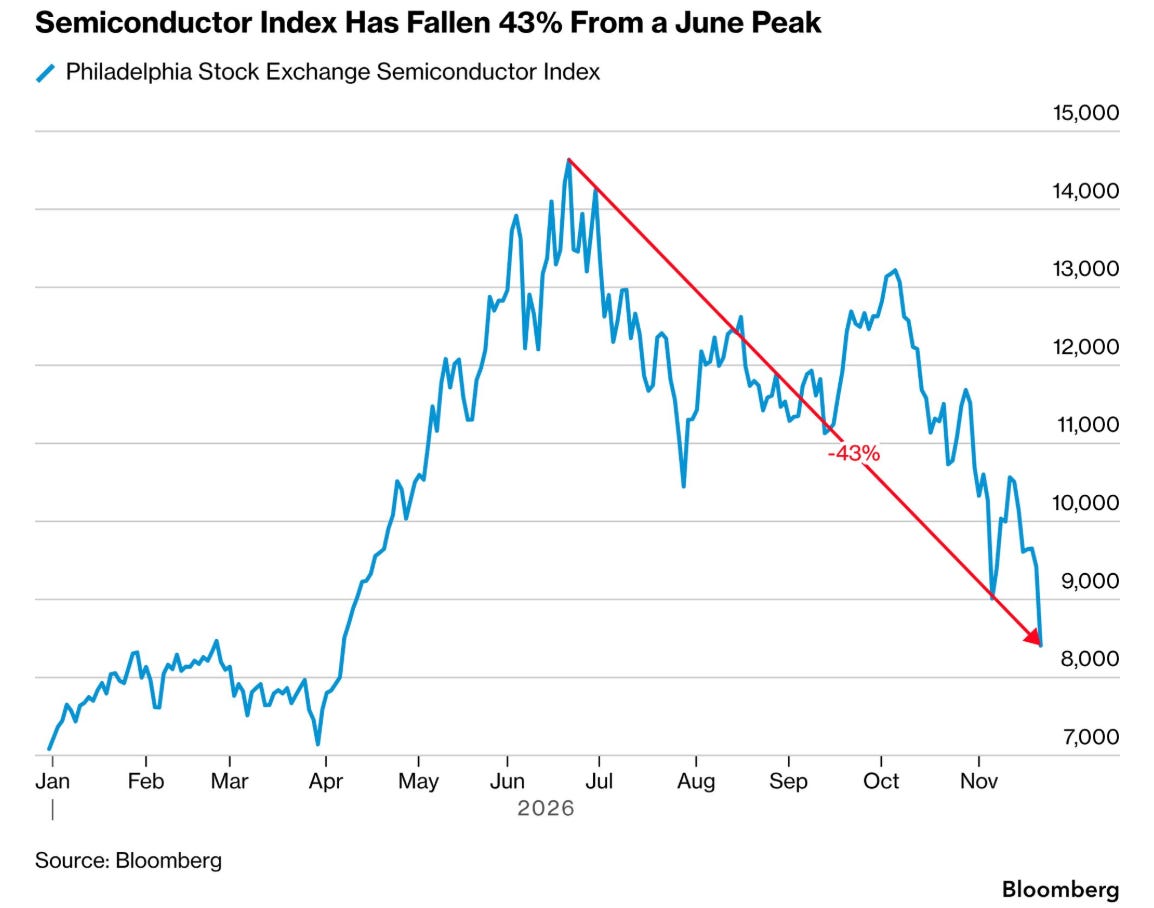
Samsung and SK hynix shares are still about half their peaks, Hankyung reports, on fears that big tech will cancel or shrink long-term supply contracts. Hankyung’s checks found no such requests. Neither Nvidia nor Google has asked to cut or delay next year’s volumes, both makers are effectively sold out for 2027, and more than half of 2028 capacity is under long-term agreements.
Samsung is spending against the doubt. Seoul Economic Daily reports it will lift ninth-generation NAND capacity at its Xi’an X2 fab to 50,000-60,000 wafers a month from about 10,000, with equipment arriving around February and the conversion finishing by November 2027.
Source: Yonhap · Hankyung · Seoul Economic Daily · Newsquawk on earnings week
AI server makers want up to 45% more than they quoted
Dell, HPE, Lenovo and Supermicro are asking some AI server buyers to pay 25% to 45% above the prices agreed months earlier, the Financial Times reports. Memory is the reason. JPMorgan research cited by the FT puts memory costs up more than 400% since the start of 2024.
Irish court filings show how it plays out: Dell agreed a fixed $549 million price with trading firm XTX Markets, which paid another $5 million for price certainty, and then asked for at least $62 million to $70 million more. XTX sued in June, and Dell told it that it couldn’t absorb the higher memory costs.
Jane Street, Optiver and Hudson River Trading are also seeing increases, per the FT. One person told the FT that GPU server prices have risen at least 20% to 30%. Some contracts start with an indicative price, and buyers didn’t confirm whether theirs allow increases before delivery. With demand outrunning supply, buyers have little leverage once orders are ready to ship.
Source: The Times of India (FT report) · Digitimes · TrendForce · Seeking Alpha on the FT report
Vik: Memory is continuing to be the most expensive part of AI. No signs of it abating yet.
Nvidia server partners pause Southeast Asia shipments as Trump targets overseas data centers
At least two of Nvidia’s server partners have suspended shipments to Southeast Asian customers under the latest U.S. export controls, Nikkei Asia reports. One stopped all shipments and new orders, and the other paused deliveries pending a compliance review, according to Nikkei.
On Friday Trump said U.S. companies won’t be allowed to build AI data centers abroad, then added that they can, but “we’re going to put a tremendous tax on them.” He gave no rate or legal basis, and a new federal tax would need Congress. Amazon, Google, Microsoft, Meta and Oracle have all built data centers overseas.
Chip policy toward China itself isn’t loosening. Bessent said U.S. policy on China chip sales is unchanged after Trump’s talks with Xi, with the H200 as the approved ceiling.
Source: Nikkei Asia · Lianhe Zaobao · CNBC · Axios · AP · Digitimes on India
SoftBank shopped for a $1 trillion SK hynix buyout
Masayoshi Son recently approached Wall Street institutions about financing a roughly $1 trillion buyout of SK hynix, The Information reported Friday. A SoftBank spokesperson told The Information the idea “is no longer under active consideration.”
SK hynix said it has no knowledge of the matter and that any foreign acquisition would need prior approval from the Korean government. EE Times reads the episode as a financing sounding rather than a bid, since there is no sign of price talks or a term sheet. For scale, $1 trillion is about 1.7 times SK hynix’s $577 billion market value on Friday.
EE Times argues the interest is strategic: SoftBank owns Arm, Ampere and Graphcore and has backed OpenAI and Stargate, and memory is the one AI layer it doesn’t hold.
Source: Reuters via CNA · The Information · EE Times · Digitimes
CrowdStrike to buy Zscaler for $43.9 billion
CrowdStrike agreed Monday to acquire Zscaler in an all-stock deal that values the cloud-security company at about $43.9 billion. Zscaler shareholders will get 1.135 CrowdStrike shares for each share they own, or about $260.41, a 34% premium to Friday’s close.
The companies say the combination would start with more than $10 billion in annual recurring revenue at close and is expected to close in the second half of CrowdStrike's fiscal 2028, subject to Zscaler shareholder and regulatory approvals. Until then they will keep operating independently. CrowdStrike CEO George Kurtz will lead the combined company, and Zscaler CEO Jay Chaudhry will continue to lead the Zscaler business and join CrowdStrike's board.
Both also reported earnings. CrowdStrike’s fiscal third-quarter revenue rose 28% to $1.58 billion and ARR grew 27% to $6.26 billion; it raised its full-year outlook. Zscaler’s fiscal first-quarter revenue rose 20% to $949.3 million and ARR grew 21% to $3.88 billion. Zscaler was up more than 18% in premarket trading, while CrowdStrike was down more than 8%.
Source: CrowdStrike · CrowdStrike earnings · Zscaler earnings · CNBC · Reuters via Investing.com
Vik: Not a lot of product overlap between these two companies. Should be a good acquisition.
Supported by Meter
You have the GPUs and the power. Now who builds the network, and who do you call when it breaks?
Meter designs, deploys, and runs frontend, storage, and management networks on its own switches and its own network OS.
One call reaches the team that designed the hardware and wrote the software.
Industry Chatter
These are just unconfirmed industry whispers.
Google TPU orders — Ming-Chi Kuo’s survey says Google cut 2027 TPU 8i shipments by about 1 million units, roughly 20%, and will lean more on MediaTek’s TPU 8t, while Broadcom fell about 12% on Friday and neither company has commented (Seeking Alpha · StockAnalysis).
TSMC order checks — TSMC’s Cliff Hou says clients have not cancelled or adjusted orders, though he did not address Google’s TPUs specifically (Liberty Times).
Samsung memory capacity — Most of Samsung’s 2027-2029 memory capacity is already booked, and some customers are asking for supply deals through 2031 (SemiMedia · Wccftech).
Apple optics — Apple is hiring silicon photonics and optical packaging engineers, a sign it is working on co-packaged optics for custom data center chips (Digitimes · Maeil Business Newspaper).
Sector Watch
Memory and compute
Tesla — Elon Musk said memory costs doubled the price of Tesla’s AI4 chip and cut AI4.5 from 32GB to 24GB. (Source: TrendForce)
Noetra — Japan’s sovereign AI project could cost up to ¥800 billion more because of chip prices and the weak yen. (Source: Nikkei Asia)
Nvidia — Nvidia is locking up advanced substrate capacity through long-term agreements while South Korean AI chip startups struggle to find supply. (Source: Digitimes)
Foundry, packaging and equipment
SmartSens — The Chinese image-sensor designer will borrow 1.5 billion yuan to buy 5.6% of Wuhan Chuxing, a 40nm CIS foundry. (Source: NBD · BiGGo Finance)
ASE — Digitimes expects ASE and its SPIL unit to overtake Amkor in advanced packaging capacity in 2027 as server CPUs move beyond CoWoS. (Source: Digitimes)
Lam Research — Lam is in talks with Tata and other new fab builders, which would bring its first equipment revenue in India. (Source: The Hindu)
AI capital
Firmus — The Nvidia-backed AI infrastructure firm is weighing a $1.5 billion bond to buy GB300 chips for an Indonesian data center. (Source: The Business Times (Bloomberg))
China neoclouds — Digitimes reports financing is drying up for China’s neoclouds after the new U.S. curbs on remote access to computing. (Source: Digitimes)
Also worth a read
Austin’s latest on Chipstrat, Intel Custom ASICs?
Vik’s latest on Vik’s Newsletter, Where are we in AI now?
Tell us how to make Semi Doped better! Give us your feedback
Want to become a sponsor? Send an email to sponsor@semidoped.com
Jensen is back as the CEO.