

Hello world, its Wednesday, November 25th, 2026
The AI trade spent Tuesday handing back Monday’s Jensen rally, and Dell responded by adding $10 billion to its year. The memory squeeze is now showing up in PC and phone units, AOI signed a second hyperscaler with lasers for co-packaged optics, and Korea’s memory giants have reportedly taken licenses to Chinese wafer-bonding patents. Canon is also back in ArF lithography, 24 years after its last tool.
Let’s get into it. --Austin & Vik
Latest episode: Cornelis’s Next Fabric Will Accelerate KV Cache and MoE in the Network — listen on YouTube, Apple Podcasts, or Spotify. Full transcript: daily.semidoped.com.
Presented by Crusoe
Fine-tune and serve open models without managing a single GPU.
When we sat down with Crusoe’s product team, Austin asked: what will you do with my data? Their answer: They don’t touch or see it.
Your training data is encrypted so even Crusoe’s own admins can’t see it, and the fine-tuned model is yours. Deploy on Crusoe in one click, or download and run it anywhere. Upload a dataset, pick an open model, and pay per token rather than per GPU hour. Run a few versions, compare them, and download the one that works best.
Accounts are free, and get $5 in credit when you sign up.
Dell raises its year to $202 billion and says 2027 is tighter still
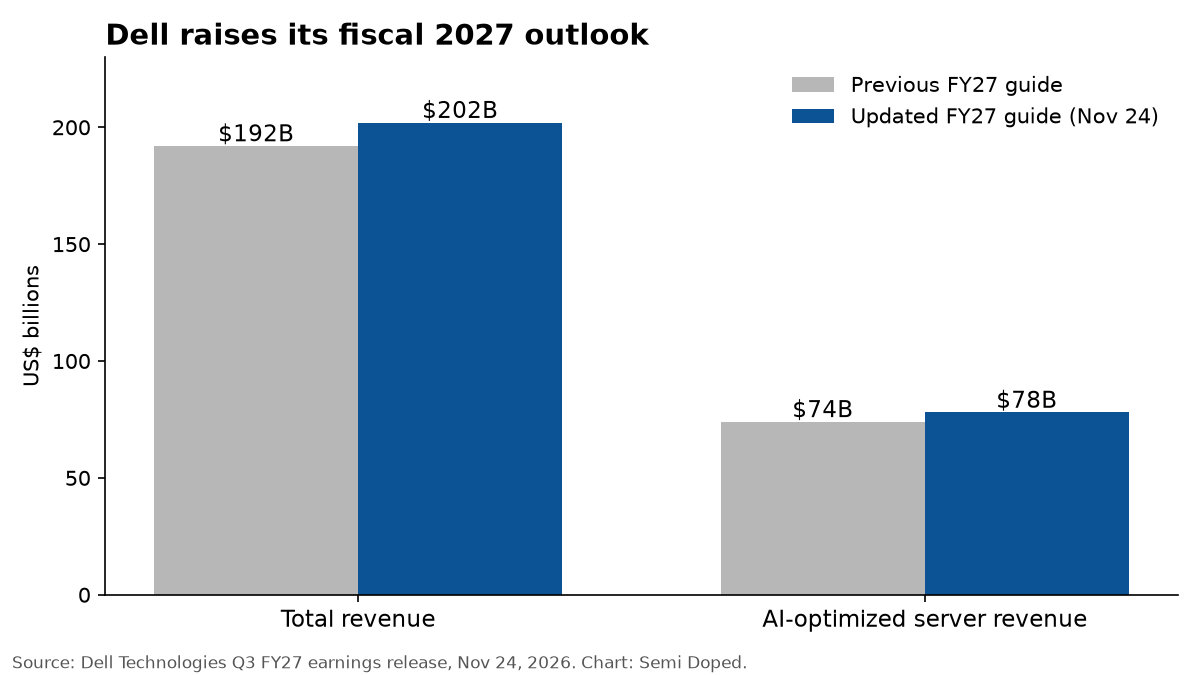
Dell’s fiscal third-quarter revenue roughly doubled to $54.9 billion, and it raised its full-year forecast to $202 billion from $192 billion. It booked $60.2 billion of AI orders in the quarter and ended with a record $132.3 billion AI backlog.
COO Jeff Clarke said Dell has seen no slowdown, and that demand is further ahead of supply in calendar 2027 than it was in 2026. He said every AI order is vetted for the customer’s access to capital, land and power, and Dell raised its AI server revenue outlook for the year to $78 billion.
The split inside the company tells the story. Infrastructure revenue nearly tripled while the PC business grew 3%. The board also added $25 billion to its buyback authorization, which is not what a company expecting an AI air pocket usually does.
Source: Dell · Reuters · Earnings call transcript
The memory bill reaches PCs and phones
HP’s fourth-quarter PC revenue rose 14%, but units fell 29% and the segment’s operating margin was 3%. Ambarella was blunter. CEO Fermi Wang said the memory price spike and shortage “has intensified and is causing many customers to reduce their outlooks,” and guided next quarter to $70 million to $75 million, down from $115 million.
Phones are next. China’s Jiemian reports Xiaomi cut its 2027 shipment target to about 90 million from roughly 120 million, with Samsung, Apple, Oppo and Vivo also trimming plans.
TrendForce on Wednesday cut its 2027 DRAM and NAND revenue forecasts after Chinese cloud providers reduced their memory orders. It now sees NAND prices falling next year as supply grows. DRAM stays tight, but price increases should narrow and could flatten in the second half, with North American clouds so far absorbing what China gave up.
Put it next to Dell and the picture is clear. AI servers are taking the memory, and consumer devices are paying for it in lost units.
Source: HP · Ambarella · TrendForce · Business Standard (Jiemian)
AOI signs a second hyperscaler
Applied Optoelectronics signed a four-year supply agreement with an existing Tier-1 hyperscaler, its second such deal with a different hyperscale customer. The customer committed to about $1.5 billion of 800G transceivers in 2027 and about $0.7 billion of laser diodes in 2028 and 2029.
AOI expects some of those lasers to power co-packaged optics starting in 2028, which makes this as much a CPO light-source deal as a transceiver order. AOI also committed to ship US-made product from the first quarter of 2027 and plans more laser capacity in Texas.
The CFO said the customer’s forecast points to more than $10 billion of demand over the term. Anything beyond the $2.2 billion floor depends on AOI adding capacity and winning more commitments, and the customer put up no capital.
Samsung and SK hynix reportedly license YMTC’s wafer-bonding tech
Samsung and SK hynix have signed cross-licensing deals that let them use parts of YMTC’s Xtacking technology, Nikkei Asia reports, citing three people briefed on the matter. Xtacking builds the NAND memory array and its control circuits on separate wafers, then bonds them, which is where high-layer NAND is heading.
An industry executive told Nikkei the Korean companies signed “just to avoid any legal disputes,” a sign YMTC’s patent portfolio is now hard to design around. YMTC says it has filed more than 12,000 patents worldwide.
No terms were disclosed. Samsung declined to discuss licensing, SK hynix declined to comment, and a Samsung hybrid-bonding deal with YMTC was already reported in Korea in early 2025, so the new name is SK hynix. Still, the top two memory makers licensing technology from a Chinese rival on the US Entity List shows how fast the IP balance in 3D NAND has shifted.
Source: Nikkei Asia · Business Upturn
Canon returns to ArF lithography after 24 years
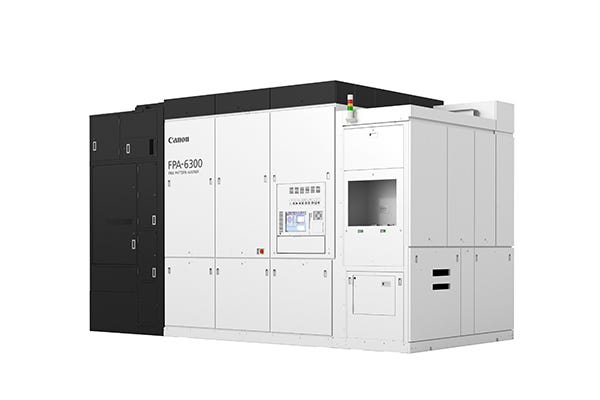
Canon will start taking orders in early December for the FPA-6300AS6, its first ArF dry scanner since 2002. It puts a new 0.93 NA projection lens on Canon’s existing KrF platform and targets memory, power and sensor chips at around 65nm resolution.
Nikkei says the opening is ASML’s supply crunch: ASML’s CFO said in October it cannot fully meet customer demand. Canon stopped taking ArF orders in 2007 after losing that market to ASML.
This is not a leading-edge tool. It is dry ArF, not immersion or EUV. But mature layers in memory and power chips need scanners too, and a second source matters while ASML’s lines are full. Canon will show the tool at SEMICON Japan in December.
Source: Canon · Nikkei · Digitimes
Supported by Meter
You have the GPUs and the power. Now who builds the network, and who do you call when it breaks?
Meter designs, deploys, and runs frontend, storage, and management networks on its own switches and its own network OS.
One call reaches the team that designed the hardware and wrote the software.
Industry Chatter
These are just unconfirmed industry whispers.
Nvidia lead times — Taiwanese ODMs say new B300 orders now carry 26 to 40 week lead times and GB300 orders 14 to 26 weeks, with most orders from the past two quarters shipping in the second or third quarter of 2027. The same report says Nvidia is cutting RTX 50 gaming GPU shipments and the RTX 60 series could slip (TrendForce, citing Commercial Times).
Terafab and memory — Recruiters for Elon Musk’s Terafab have approached four or five engineers at memory companies, a sign Musk may want to make his own memory chips (damnang2 on X).
Rubin transistor count — A source close to large-chip tape-outs puts Nvidia’s Rubin at 160 billion transistors per die, up from Blackwell’s 104 billion, with two dies per package (Andreas Schilling on X).
Sector Watch
Memory
Samsung — Samsung will present a 48GB HBM4E running at 17Gb/s per pin at ISSCC in February. (Source: ISSCC 2027 Advance Program · The Elec)
Huawei and CXMT — In the same ISSCC session, Huawei will show a custom HBM with a built-in memory controller and CXMT a vertical-gate DDR5. (Source: The Elec · IT Home)
Analog, optics and photonics
Analog Devices — Record fourth-quarter revenue rose 42% to $4.37 billion, led by data center, and next quarter is guided flat. (Source: Analog Devices · Investor’s Business Daily)
ams OSRAM — Samsung Display will invest €210 million to become its largest shareholder and co-develop ultra-small microLEDs at the Kulim 2 fab. (Source: ams OSRAM · Yonhap)
Avicena — The laser-free microLED optical interconnect startup raised a $100 million Series C and targets its first commercial product in 2027. (Source: Avicena · TNW)
AIXTRON — Nokia placed repeat orders for AIXTRON’s G10-AsP deposition tools to scale indium phosphide photonics, with deliveries through 2027. (Source: AIXTRON · eeNews Europe)
AI infrastructure and capital
Nscale — The UK neocloud told staff it can stay private for now as the tech selloff clouds its planned $35 billion IPO. (Source: Financial Times · Newsquawk)
Fluidstack — It launched Blackbird, factory-built data center modules that scale to 400 MW and are designed to be assembled in six months. (Source: Fluidstack · Interesting Engineering)
Policy and enforcement
Huawei — A Brooklyn jury convicted Huawei on 10 of 12 counts, including sanctions violations and conspiracy to steal US trade secrets. (Source: US Justice Department · AP)
Nvidia — Reuters found Alice Huang-linked firms pledged $270 million of AI servers as collateral in China, without evidence of restricted chips. (Source: Reuters · US News (Reuters))
Also worth a read
Austin’s latest on Chipstrat, AMD Custom ASICs?
Vik’s latest on Vik’s Newsletter, Where are we in AI now?
Tell us how to make Semi Doped better! Give us your feedback
Want to become a sponsor? Send an email to sponsor@semidoped.com