

Happy Thanksgiving!!
Its Thursday, November 26th, 2026
Nvidia told its server partners to stop shipping to four Southeast Asian countries, and the banks funding the region’s data centers had already reached for the brakes. Amazon’s Trainium3 showed up on SemiAnalysis’s agent benchmark with a cost-per-token number Nvidia won’t frame, and Kioxia wants SSDs to pass as GPU memory. Washington also spared memory chips from its new overcapacity tariffs, while circling Korea’s chip subsidies in red ink.
Let’s get into it. --Austin & Vik
Latest episode: Cornelis’s Next Fabric Will Accelerate KV Cache and MoE in the Network — listen on YouTube, Apple Podcasts, or Spotify. Full transcript: daily.semidoped.com.
Presented by Crusoe
Fine-tune and serve open models without managing a single GPU.
When we sat down with Crusoe’s product team, Austin asked: what will you do with my data? Their answer: They don’t touch or see it.
Your training data is encrypted so even Crusoe’s own admins can’t see it, and the fine-tuned model is yours. Deploy on Crusoe in one click, or download and run it anywhere. Upload a dataset, pick an open model, and pay per token rather than per GPU hour. Run a few versions, compare them, and download the one that works best.
Accounts are free, and get $5 in credit when you sign up.
Nvidia halts server shipments to four Southeast Asian countries
Last week, Nikkei Asia reported that two of Nvidia’s server partners had paused some Southeast Asian shipments. Now Nvidia itself has told partners including Dell and Supermicro to stop shipping servers with its chips to Malaysia, Singapore, Thailand and Indonesia, the Financial Times reports, citing three people. It is unclear whether the halt is temporary while Nvidia works out how to comply with the US rules that took effect last week.
The region is not a rounding error: Nvidia booked $104 billion of revenue through its Singapore subsidiary in 2025, according to company accounts cited by the FT. Some of that is Taiwan and China revenue routed through Singapore, so not all of it is exposed.
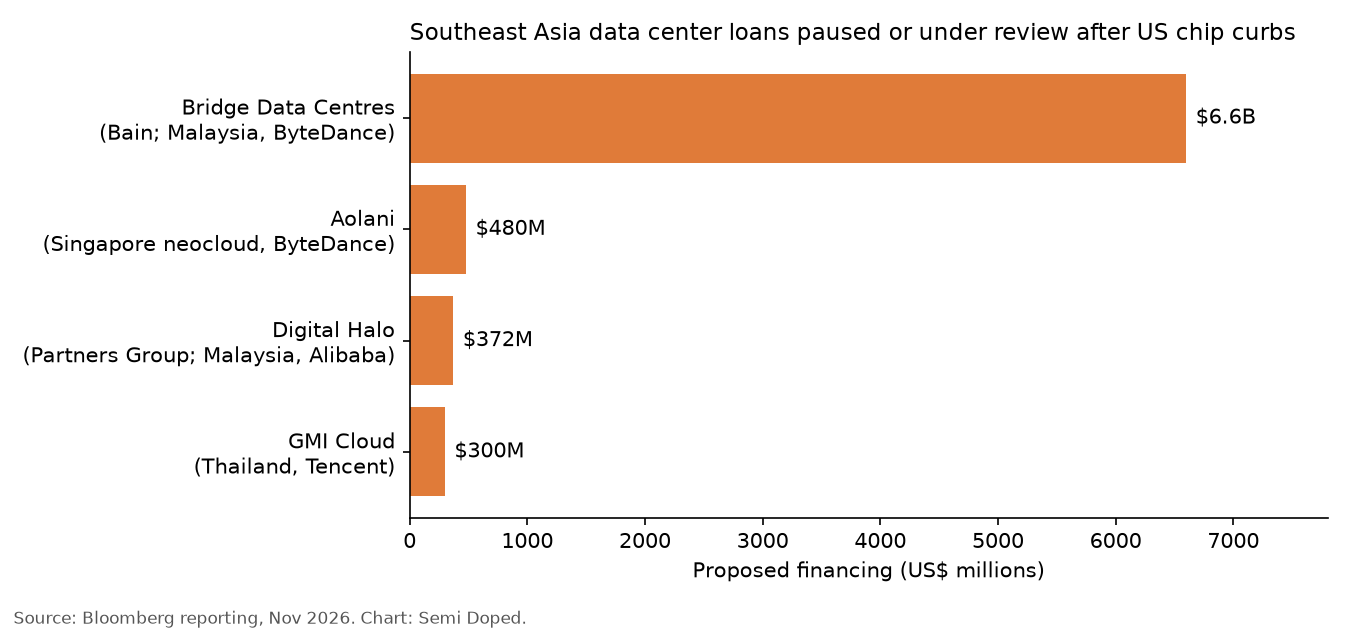
The money behind the buildout is stalling too. Bloomberg reports lenders have paused loans tied to ByteDance, Alibaba and Tencent, led by a $6.6 billion upsized loan for Bain’s Bridge Data Centres in Malaysia. Data centers serving restricted Chinese firms have 90 days to win a license, and one cloud executive told the FT that nobody knows how to apply.
Source: Financial Times via CNA · Reuters · Bloomberg · The Straits Times
Vik: Jensen’s may have returned, but things won’t just go back to normal. Changes will be enforced. If hardware shipments from Nvidia start to slow, that’s bad news.
Trainium3 beats Nvidia GB300 on cost in SemiAnalysis’s agent benchmark
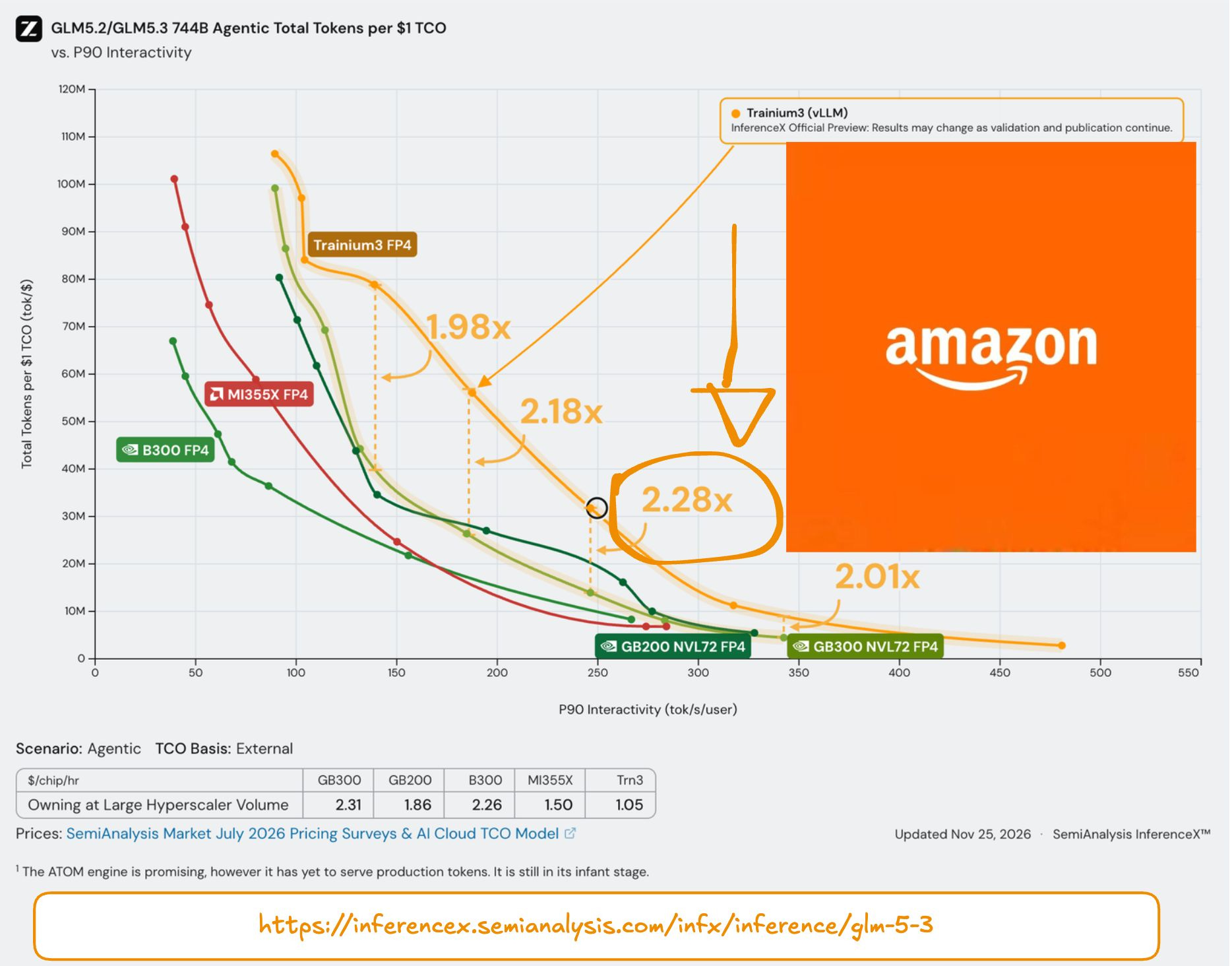
Amazon submitted its first Trainium3 UltraServer results to AgentX, SemiAnalysis’s benchmark that replays real coding-agent sessions with long, heavily reused prompts. SemiAnalysis says Trainium3 delivered 2.28x the performance per dollar of Nvidia’s GB300 NVL72 at one interactivity point, and beat B300 and AMD’s MI355X too. Google’s TPU joined the InferenceX dashboards on Thursday.
Almost all of the edge comes from cost, not speed: SemiAnalysis prices a Trainium3 chip-hour at $1.05 against $2.31 for GB300, while per-chip throughput at that point is only about 4% higher. Those are modeled hyperscaler costs, not AWS list prices, and the results are labeled a preview.
Nvidia has its own answer on the same dashboard, which shows Vera Rubin NVL72 delivering 3.3x the tokens per dollar of Trainium3. Still, tokens per dollar is the metric Nvidia itself pitches, and its two biggest custom-silicon rivals are now publishing theirs.
Source: SemiAnalysis on X · SemiAnalysis InferenceX · Supercomputing News
Vik: Ok Trn3 beats GB300 and a GLM-5-3 model. Next gen comparison is MI455 vs Rubin vs Trn4.
Kioxia and Nvidia turn SSDs into extra GPU memory
Kioxia and Nvidia showed a GB200 NVL72 rack using Nvidia’s SCADA software to treat 144 Kioxia SSDs, about 1.1 petabytes of flash, as an extension of GPU memory. The software reads in 512-byte chunks, small enough to fetch single vectors for search databases and graph neural networks.
The pitch is that HBM is scarce and expensive, while the knowledge an AI agent looks things up in can live on flash if the GPU can reach it directly. Kioxia also announced the GP2, a PCIe 6.0 SSD built for the job on its low-latency XL-FLASH memory, rated at more than 18 million random reads per second at 512 bytes, with evaluation samples due by the end of 2027.
This is a proof of concept. Neither company gave speed, latency or power figures for the rack.
Vik: There is a constant search for optimizing away from HBM. SSDs have been a strong alternative since DeepSeek. Kioxia’s XL-FLASH is SSD built for AI really.
Washington spares memory chips but puts Korea’s chip subsidies on the record
USTR ruled on Wednesday that 14 economies, including Korea, Taiwan and Japan, run industrial policies that create structural overcapacity, and proposed tariffs under Section 301. Its Korea report says two Korean companies, Samsung and SK hynix, hold more than 70% of the DRAM market and 51% of NAND.
Semiconductors are exempt from the proposed Korea tariffs because they already fall under the separate Section 232 process. Seoul Economic Daily reports that covers DRAM, NAND, HBM and chipmaking equipment.
The report still names Korea’s K-Semiconductor Belt subsidy strategy as a market distortion, and USTR says it could raise the proposed tariff on all Korean goods to 25% from 15% if talks disappoint. Korean press reads that as leverage to push Samsung and SK hynix toward more US investment.
Source: USTR · USTR Korea notice · Seoul Economic Daily
Vik: A push to localize DRAM supply, or face the consequence of tariffs!
SK hynix puts a date on 3D DRAM
SK hynix expects to start mass production of 3D DRAM around 2031, with a first product of 100 stacked layers of memory cells, distinguished engineer Choi Kang-sik said at a Seoul National University forum. It would take about 75 layers to match today’s 10nm-class DRAM density.
Choi said existing tools can build the first 100 layers, but 200 to 300 layers will need dedicated equipment, which is the part equipment makers will be watching. Longer term, SK hynix plans to borrow multi-tier stacking and hybrid bonding from 3D NAND to go past 1,000 layers.
SK hynix says it has already made 3D DRAM cells with refresh behavior comparable to conventional DRAM, and is studying IGZO, an oxide semiconductor with lower leakage than silicon, as the transistor channel.
Source: The Elec · Financial News
Vik: This 3D DRAM is not HBM, nor is it DRAM stacked on logic. It’s something to the effect of stacking 100 layers of DRAM cells? More like NAND? And IGZO too? Sounds like a science project to me.
Supported by Meter
You have the GPUs and the power. Now who builds the network, and who do you call when it breaks?
Meter designs, deploys, and runs frontend, storage, and management networks on its own switches and its own network OS.
One call reaches the team that designed the hardware and wrote the software.
Industry Chatter
These are just unconfirmed industry whispers.
Micron executives have signaled that the company could pause NT$1.6 trillion of further Taiwan investment and consider closing its Taoyuan plant, with about 3,000 jobs, if the union dispute there drags on, according to Taiwanese commentator Hsieh Chin-ho. Taiwan’s economy minister said investment decisions are Micron’s to explain. (Liberty Times)
Analysts cited by Taiwan’s Commercial Times expect Nvidia’s CoWoS demand to rise 57% next year to about 1.22 million wafers, while its share of TSMC’s CoWoS capacity falls to 45.6% from 53.4% as Google’s TPU and other cloud ASICs take more. (Commercial Times)
SpaceX has cut small-cluster Blackwell rental prices to $10 to $12 per GPU-hour from about $15, matching what large customers pay, according to a SemiAnalysis client note. Anthropic is handing back a cluster of about 50,000 H200s that SpaceX plans to re-rent from early 2027. (Wccftech)
Sector Watch
Memory
SK hynix — It is hiring engineers with TSMC 3nm experience to design custom HBM base dies, as Micron steps up hiring in Korea. (Source: Digitimes · BusinessKorea)
Samsung — Samsung will sample its MD310 CXL 3.2 memory module in early 2027, with mass production expected in the second half. (Source: The Elec)
Foundry and substrates
8-inch foundries — Korean 8-inch lines are at or near full utilization on AI power chip demand, and Samsung and DB HiTek are pushing price increases. (Source: Electronic Times)
Substrate makers — Lead times for some FC-BGA substrate tools have stretched to about 30 months from six, and buyers are paying deposits to move up. (Source: Electronic Times)
Nvidia and AI capital
Nvidia — S&P put Nvidia’s AA rating on CreditWatch Negative, saying Huang’s exit and return left board oversight questions unanswered. (Source: S&P Global Ratings · Reuters)
CoreWeave — Its banks plan to sell a $4.5 billion loan, backed by GPUs for its Meta contract, as early as next week. (Source: Bloomberg via Yahoo Finance · Quartz)
China
Chinese AI labs — US chip curbs and a crackdown on model distillation could push Z.ai’s GLM-5.5 and Moonshot’s Kimi K4 into 2027. (Source: Reuters · The Straits Times)
Chinese AI chips — UBS expects domestic suppliers to hold 88% of China’s AI accelerator market by 2028, with Cambricon and Biren leading. (Source: SCMP · AASTOCKS)
Also worth a read
Austin’s latest on Chipstrat, AMD Custom ASICs?
Vik’s latest on Vik’s Newsletter, Where are we in AI now?
Tell us how to make Semi Doped better! Give us your feedback
Want to become a sponsor? Send an email to sponsor@semidoped.com