

Hello world, its Friday, November 27th, 2026
Packaging is where chip downturns show up first, and ASE says nobody has cancelled a thing. Tesla’s AI5 is stuck behind Google and Microsoft in GUC’s 3nm line, and Google may want to design the bottom of its own HBM5 stack. TrendForce has also put a date on the first DRAM price declines, and the Dutch are lobbying Congress to drop the MATCH Act.
Let’s get into it. --Austin & Vik
Latest episode: Cornelis’s Next Fabric Will Accelerate KV Cache and MoE in the Network — listen on YouTube, Apple Podcasts, or Spotify. Full transcript: daily.semidoped.com.
Presented by Crusoe
Fine-tune and serve open models without managing a single GPU.
When we sat down with Crusoe’s product team, Austin asked: what will you do with my data? Their answer: They don’t touch or see it.
Your training data is encrypted so even Crusoe’s own admins can’t see it, and the fine-tuned model is yours. Deploy on Crusoe in one click, or download and run it anywhere. Upload a dataset, pick an open model, and pay per token rather than per GPU hour. Run a few versions, compare them, and download the one that works best.
Accounts are free, and get $5 in credit when you sign up.
ASE says no one has cancelled, and doubles down on 2027
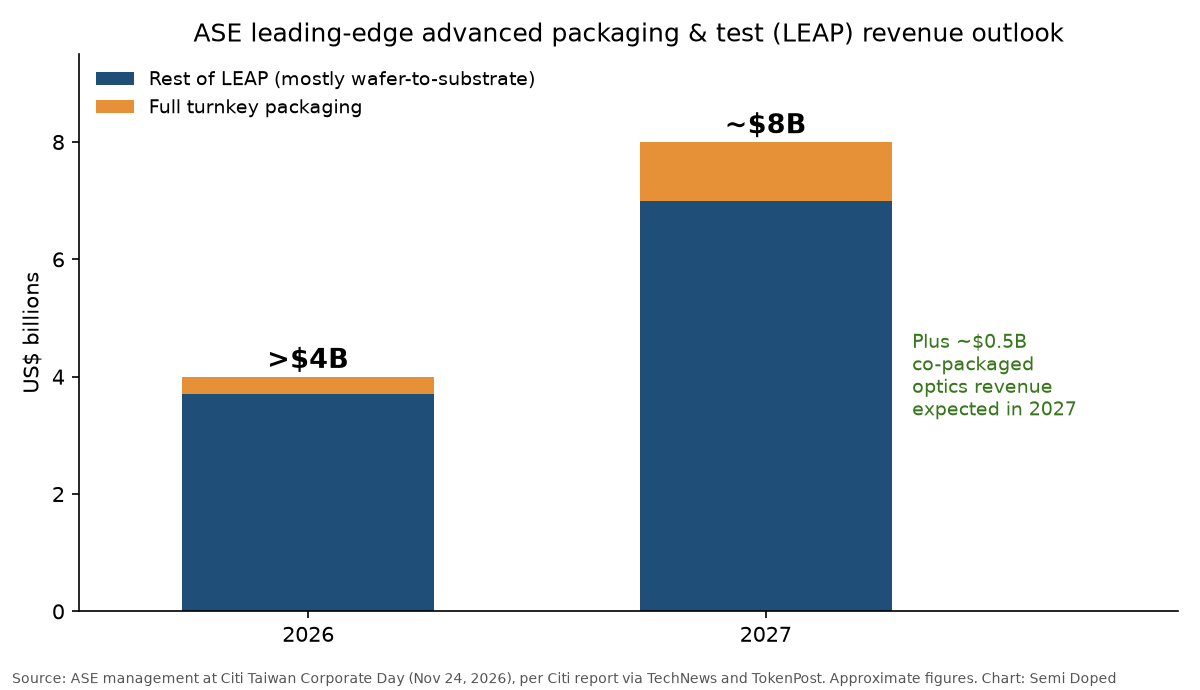
Packaging and test usually crack first in a chip downturn, because customers stop paying to finish wafers they can’t sell. So it matters that ASE told investors at Citi’s Taiwan Corporate Day it has seen no cancellations from the Nvidia turmoil, the new US limits on offshore AI compute, or worries about AI financing, according to Citi’s report. Some China business is delayed while export permits come through, and ASE says it can hand that capacity to other customers.
ASE expects its leading-edge advanced packaging and test revenue to top $4 billion this year and roughly double to $8 billion in 2027, spread across several GPU and custom ASIC customers. Full turnkey packaging should grow from about $300 million to $1 billion, and ASE expects co-packaged optics to bring in about $500 million in 2027.
The spending matches the talk. ASE plans 2027 capex above this year’s roughly $11.5 billion, has 22 construction projects under way, and says factory space is its tightest constraint. KYEC, which tests Nvidia’s GPUs, told the same conference it sees strong demand for AI chip testing, and on Thursday filed to lease a second, larger site in Singapore, six months after opening its first plant there.
Source: TechNews · TokenPost · KYEC filing via MoneyDJ
Tesla’s AI5 waits behind Google and Microsoft for 3nm
GUC, TSMC’s design-services affiliate, will give its limited 3nm capacity to Google’s Axion 2 and Axion 3 server CPUs and Microsoft’s in-house chips ahead of Tesla’s AI5, Taiwan’s Commercial Times reports, citing supply chain sources. GUC won a much bigger N3 allocation from TSMC for 2027, but it still can’t cover all of its large customers.
The report says large-scale use of AI5 in Tesla’s cars may have to wait until 2028, when more N3 capacity comes online. The first AI5 chips go to the Optimus robot. That fits Musk’s comment last week that AI5 goes to Optimus while cars stay on AI4.
The ranking shows who pays best. Analysts cited by the paper say cloud CPU orders carry higher margins and better visibility, and they make those orders the core of GUC’s business.
Source: Commercial Times · TrendForce
Google wants a hand in its HBM5 base die
Google is pursuing custom HBM5 for its 10th-generation TPU, and MediaTek is the leading candidate to design the HBM base die and SerDes, Korea’s Economy Tribune reports, citing industry sources. Brokerages expect the chip to carry 512GB of HBM5.
The base die is the logic chip at the bottom of an HBM stack that talks to the accelerator, and memory makers have designed it until now. If Google and MediaTek design it, Samsung and SK hynix end up building DRAM stacks to someone else’s spec. The paper notes Nvidia took the same step in August with its own base die design.
Samsung is preparing for that. Its chip reorganization this week created a Logic Development Team inside its memory business to handle logic design for products like custom HBM, MoneyToday reports. TPU v10 is still years from volume, with leaks pointing to around 2029.
Source: Economy Tribune · IT Home · MoneyToday
TrendForce pencils in DRAM price declines for 2028
TrendForce’s new base case has conventional DRAM contract price increases narrowing through 2027, leveling off in the second half, and turning into declines across all product types from the first quarter of 2028. In its bear case, prices start falling in the fourth quarter of 2027.
Most of the reasons are on the demand side. Chinese cloud providers began cutting server DRAM orders early this quarter, phone and PC makers can’t absorb more increases, and buyers are wary of the US midterms, Nvidia’s financing of neoclouds, and the new US limits on compute for Chinese firms. Supply, meanwhile, keeps growing through 2028 as memory makers add capacity and move to newer processes.
That is a 2028 problem. Today’s shortage is still severe: The Wall Street Journal reports electronics makers have set up procurement “war rooms,” with some chip prices up tenfold in a year. In a secondhand account in the same report, Samsung chairman Lee Jae-yong told Elon Musk that everyone offers long-term deals and asked what else he could offer.
Source: TrendForce · The Next Web on the WSJ report · BusinessKorea
The Dutch plan to fight the MATCH Act
Dutch trade minister Sjoerd Sjoerdsma said the Netherlands is working with the European Commission, Germany and France to stop the MATCH Act, which Congress may attach to its annual defense bill in December. If it passes, the Netherlands will ask Washington not to enforce it and look at EU countermeasures, Reuters reports.
The bill would make allies like the Netherlands and Japan match US export controls or face unilateral US limits on their chip tools. For ASML, that puts immersion DUV scanners at risk, along with servicing of tools already installed in China, a market Bloomberg expects to be about 20% of ASML’s revenue this year.
Source: Reuters via Investing.com · Bloomberg · TrendForce
Excellent article by Lithos Graphein on X. Must read.


Supported by Meter
You have the GPUs and the power. Now who builds the network, and who do you call when it breaks?
Meter designs, deploys, and runs frontend, storage, and management networks on its own switches and its own network OS.
One call reaches the team that designed the hardware and wrote the software.
Industry Chatter
These are just unconfirmed industry whispers.
Goldman Sachs estimates that 0.5 to 0.75 gigawatts of AI capacity is tied to Chinese customers under the new US remote-access rule. That is about 263,000 to 395,000 Blackwell-class GPUs that need US licenses, new tenants or buyers within 90 days, or roughly $17 billion to $25 billion a year in rent to re-lease. (Crypto Briefing)
BofA argues DRAM operating margins, now above 80%, would still be 50% to 60% in 2028 even if prices fall 40% to 50%. It credits HBM and long-term supply agreements, which make this cycle far more profitable than past downturns. (P Equity Research on X)
A channel check with Chinese laser maker Yuanjie Semiconductor says it is not supplying Eoptolink because its own CW laser capacity is short. It says indium phosphide substrate prices rose several percent this quarter, InnoLight has locked up about 80% of Sumitomo’s substrate capacity, and Yuanjie’s high-power lasers will mainly go to Nvidia as external light sources. (@aleabitoreddit on X)
Sector Watch
Foundry and materials
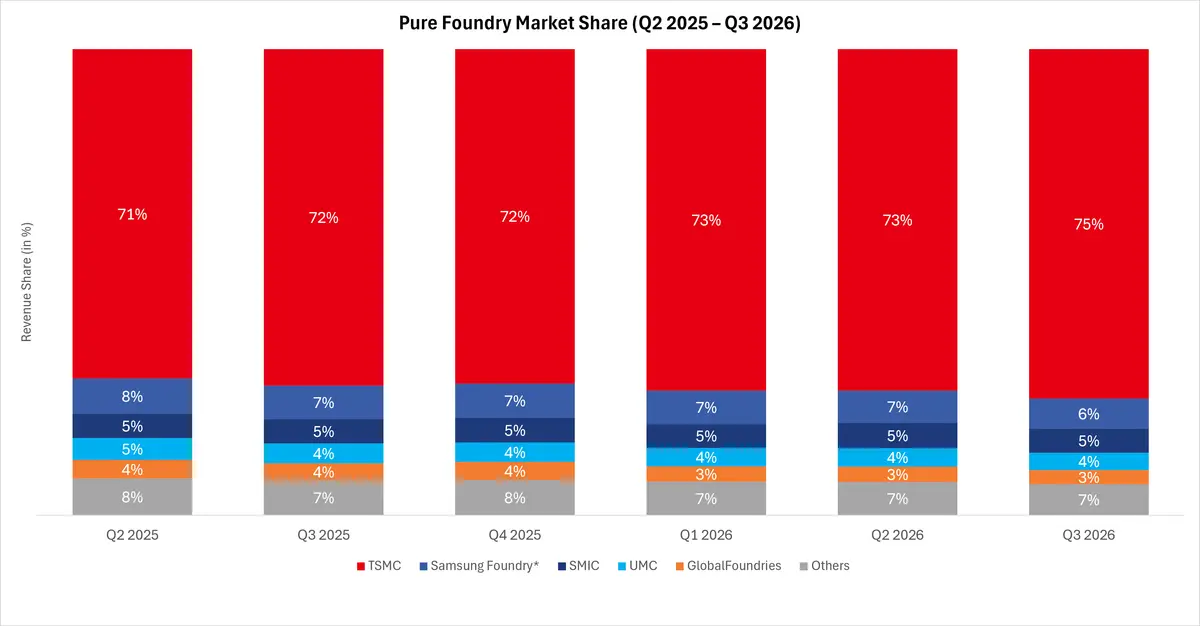
TSMC — Its share of pure-play foundry revenue rose to 75% in the third quarter as the sector grew 36%. (Source: Counterpoint Research · IT Home)
Formosa Sumco — Its 2027 twelve-inch wafer capacity is sold out, with prices rising across the board from the first quarter. (Source: BigGo Finance)
Simmtech — It will raise ₩300 billion in perpetual bonds to build a SOCAMM board plant and add mSAP substrate capacity. (Source: Chosunbiz)
Compute forecasts
Nomura — It raised its 2027 AI server sales forecast on higher prices and sees TSMC’s CoWoS capacity up about 80% next year. (Source: AASTOCKS via Yahoo Finance · BigGo Finance)
Nvidia Vera Rubin — SemiAnalysis data shows Vera Rubin NVL72 getting 2 to 6.5 times GB300’s tokens per dollar on the same inference engine. (Source: SemiAnalysis on X)
Data centers
JERA — Japan’s largest power generator is in talks with Anthropic and Meta to build data centers beside its Tokyo-area plants. (Source: Nikkei Asia · CNA)
Singapore — The government is working with Washington so local firms keep secure access to high-end chips under the new US rules. (Source: The Business Times · Bloomberg)
Schneider Electric — It will double output of liquid-cooling distribution units at its Conselve plant in Italy from January. (Source: DCD · Schneider Electric)
TDK — It will spend about $635 million to double output of its TMR sensors, citing robots and AI data centers. (Source: Bloomberg · The Next Web)
Also worth a read
Austin’s latest on Chipstrat, AMD Custom ASICs?
Vik’s latest on Vik’s Newsletter, Where are we in AI now?
Tell us how to make Semi Doped better! Give us your feedback
Want to become a sponsor? Send an email to sponsor@semidoped.com