

Hello world, it’s Tuesday, November 3rd.
Anthropic’s amended S-1 lists $895.4 billion in cloud and data center commitments against $33.2 billion in nine-month revenue. Short-term compute costs pushed Q3 to a $567 million operating loss. Memory costs are climbing as well: DDR4 hit an all-time high in October, and SK Hynix says the DRAM shortage lasts through 2030. Qualcomm validated first silicon for HBC, its LPDDR-based alternative to HBM, for the AI250. Outside AI, Lattice and Tower posted record quarters. Also in today’s issue: Infineon’s safety subsystem for Snapdragon Ride.
Let’s get into it. — Austin & Vik
Be sure to check out the Semi Doped podcast on YouTube or your favorite podcast player!
Presented by Crusoe
Crusoe builds the full stack for AI, from power and data centers to the cloud. It can also help you tune a small model on your own data for just a few bucks.
For repeatable work like reports, an open model trained on your terminology and formats can match a frontier model, and it’s cheaper and faster to run.
Crusoe’s Serverless Fine-Tuning handles the training: upload your dataset, pick an open model like Llama, DeepSeek, or GLM, and pay per million tokens used, not per GPU hour.
About $2 buys roughly 5M training tokens on smaller models.
Deploy on Crusoe Cloud in one click or download the weights and deploy on your own.
Qualcomm Validates First HBC Silicon for AI250 Inference Racks
Qualcomm says its first-generation High Bandwidth Compute (HBC) silicon is validated, with gains in memory bandwidth and energy efficiency. HBC puts compute in the base die under a stack of LPDDR memory, so data has less distance to travel. HBM works differently: it stacks more DRAM, sits on a 2.5D interposer, and does no compute in its base die. Qualcomm claims HBC gets 6x the bandwidth per watt of HBM. HBC Gen 1 goes into the Dragonfly AI250, which is set to sample in mid-2027. HBC Gen 2 follows in the AI300 in 2028. Qualcomm first showed HBC at its Investor Day in June.
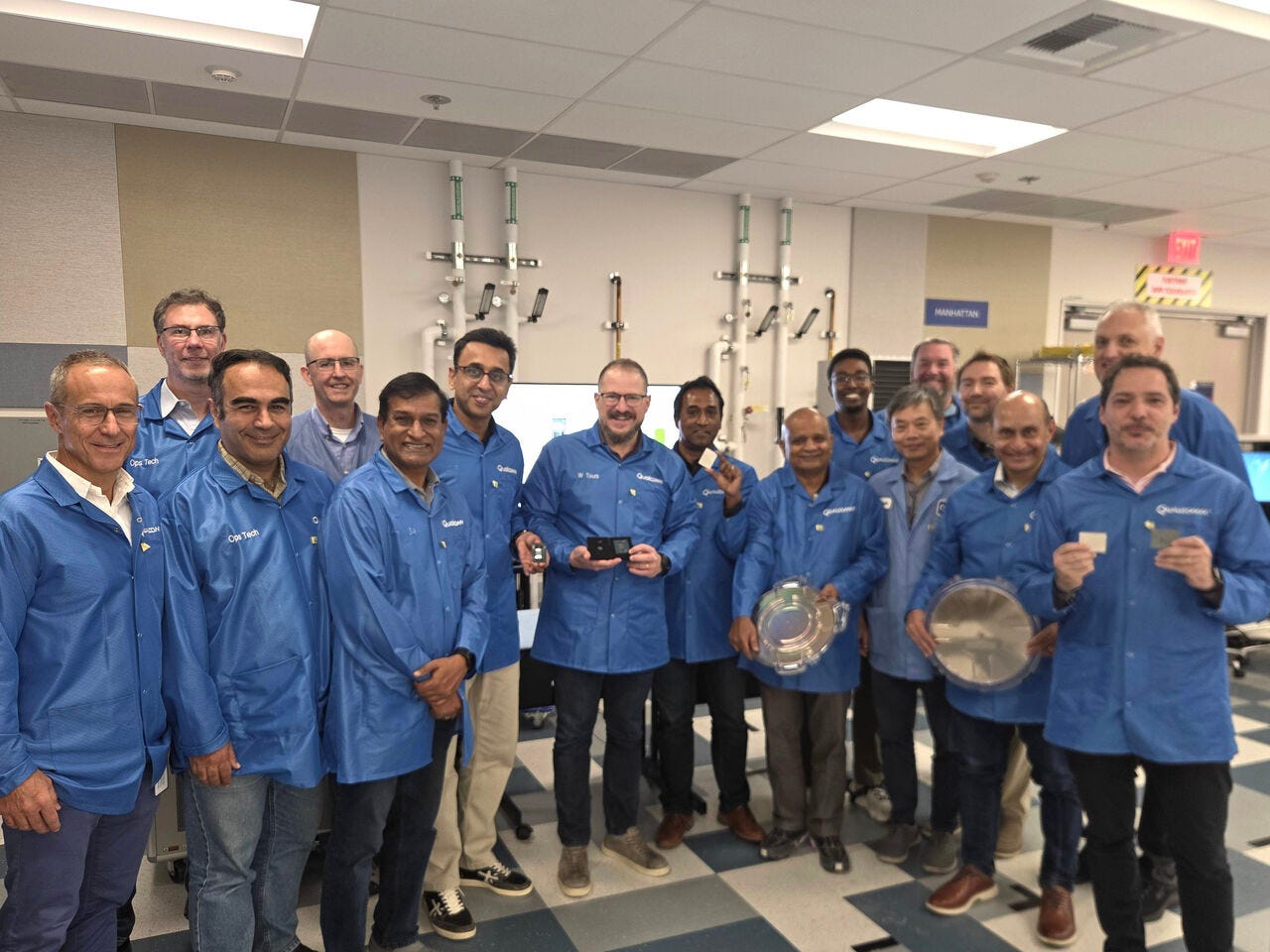
Vik: Ah, familiar lab jackets. I once had one of those with my name on it. I spent so much time measuring transistors on wafers with those. Anyway, good to see a picture of Amon holding an inference chip. I’ve been asking for this sort of a picture for a while. Next step is inference benchmarks. Numbers, we need numbers.
Anthropic S-1 Revision Exposes $895B Compute Obligations Against Slowing Growth
Anthropic’s amended IPO filing landed with a number that stops conversations: $895.4 billion in total cloud and data center commitments, spanning active contracts and unstarted leases, against nine-month revenue of $33.2 billion. Q3 revenue came in at nearly $17 billion but the company swung to a $567 million operating loss, reversing a prior quarter’s profitability as short-term compute costs hit $5 billion. Revenue growth decelerated meaningfully from earlier quarters, a fact Reuters flagged as a financing risk ahead of the Nasdaq debut.
Austin: Short-term compute is the interesting thing here. The filing says short term compute costs significantly more than capacity under the multi-year deals, and Anthropic expects to keep spending on short term compute until new data centers come online. Which explains why the long-term commitments keep climbing... locking in long-term capacity is how you stop paying the short term premium.
DRAM Spot Price Hits All-Time High as NAND Rally Goes Flat
The average price of 8-gigabit DDR4 DRAM climbed 5.77% to $27.50 in October, an all-time high, while commodity NAND flash prices flatlined after 21 consecutive months of gains, splitting the memory market in two directions at once. Apple flagged a margin drop in its holiday quarter, citing rising memory costs, and its pain won’t ease quickly. Shin-Etsu Chemical has started raising silicon wafer prices, though long-term contracts with chipmakers won’t reprice until late 2027, meaning DRAM cost inflation has a long runway. SK Hynix, meanwhile, has characterized the DRAM shortage as persisting through 2030. TechInsights projects memory will account for 62% of total semiconductor revenue by 2027, a share that now looks rather comfortable for suppliers and rather less so for anyone buying chips.
Vik: We know memory is going to be tight all through 2027, and maybe into 2028 as well. No end in sight yet, and that is affecting consumer markets badly.
Infineon Signs Deal to Put AURIX Safety Subsystem on Qualcomm Snapdragon Ride
Infineon signed a technology agreement with Qualcomm to supply a safety subsystem for Snapdragon Ride and Ride Flex. The subsystem is built on an AURIX microcontroller and OPTIREG power ICs. It sits next to the Snapdragon chip and watches over it: it checks system health, runs safety checks, and controls safety-critical functions in real time.
Infineon also provides software that comes pre-tuned for Qualcomm’s platforms, so carmakers and Tier-1s can integrate it faster. On top of that, Infineon supplies Ethernet and USB chips (BRIGHTLANE) and NOR Flash memory (SEMPER) qualified for Snapdragon Ride. The aim is one central car computer that runs driver assistance, automated driving and the cockpit display. The news comes ahead of electronica in Munich next week. No financial terms were disclosed.
Vik: Interesting. Infineon provides all the supporting electronics around Qualcomm Automotive SoCs.
Lattice and Tower Post Record Quarters as Chip Recovery Widens
Lattice Semiconductor and Tower Semiconductor both reported record third-quarter results on the same November 2 earnings cycle, painting a consistent picture of demand strength well outside the AI memory pocket that has dominated headlines. Lattice posted record 3Q26 revenue up 118% year-over-year, a figure that suggests the mid-range FPGA market has moved decisively past its 2024-2025 inventory correction.
Tower, the Israeli analog and RF specialty foundry, recorded $526 million in Q3 revenue, up 33% year-over-year, then guided Q4 to $600 million, a 36% year-over-year gain that puts the company on track for a $2 billion annual revenue run-rate in 2026. That full-year threshold has been a symbolic target for Tower’s management for several quarters. Two record prints, two different end-market profiles, one shared direction.
Sector Watch
PCB & Components
Ibiden posted record first-half profit and raised its full-year outlook. It guides second-half revenue to ¥302.5 billion, up 15% from the first half. (Investing.com)
Isu Petasys will invest 500 billion won to build its seventh PCB plant in Daegu, accelerating capacity amid surging AI server multilayer board demand. (The Elec)
Daeduck Electronics reported Q3 multilayer board sales up 69% year-on-year, with operating profit hitting 87.9 billion won on AI server demand. (The Elec)
Power
Envision put an integrated 800V DC power system into commercial use at its Galaxy AI data center in Ulanqab. Solid-state transformers convert 10 kV AC straight to an 800V DC bus. (PR Newswire)
onsemi’s AI data center revenue grew 175% year over year in Q3. It agreed to buy Ferric for processor power delivery and raised its 2030 AI data center revenue target to more than $3 billion. (onsemi)
GE Vernova reported its order backlog hit $197 billion as data center demand continues to drive record gas turbine sales. (Data Center Dynamics)
Optics & Networking
Lumentum disclosed a second NPO/CPO design win for scale-up networking, backed by more than $5 billion in purchase commitments. (Tech Times)
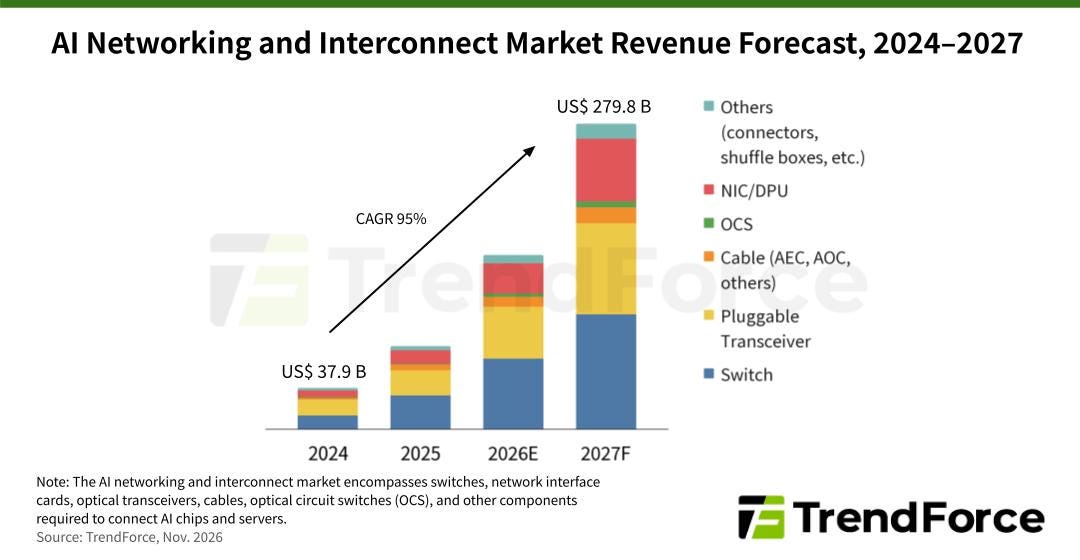
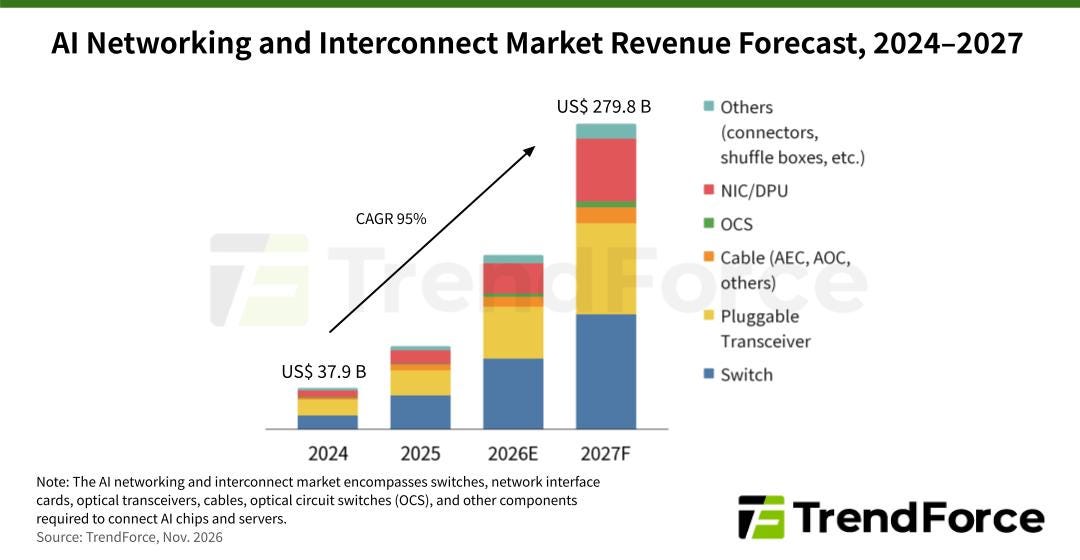
TrendForce projects 2027 pluggable transceiver revenue up 76% to $84.1 billion, with 1.6T modules making up about 56% of it. (TrendForce)
TD Cowen downgraded Marvell over the Lumentum deal, putting the 2027 optical transceiver market at $47 billion against a consensus near $100 billion. (Investing.com)
Tell us how to make Semi Doped better! Give us your feedback! ❤️