

Hello world, its Thursday, November 5th, 2026
Micron reportedly parked a $4.5 billion Taiwan fab over a bonus fight, a deadly blast in Hsinchu took out a slice of the laminate under AI servers, and Qualcomm’s phones shrank while its data center plans (and a Starlink win) got bigger. Turns out the AI supply chain’s newest bottleneck is the union bargaining table.
Let’s get into it. --Austin & Vik
Latest episode: Why Marvell Wants Lumentum: Vertical Integration in AI Optics With Cignal AI — listen on YouTube, Apple Podcasts, or Spotify. Full transcript: daily.semidoped.com.
Presented by Crusoe
Fine-tune and serve open models without managing a single GPU.
When we sat down with Crusoe’s product team, Austin asked: what will you do with my data? Their answer: They don’t touch or see it.
Your training data is encrypted so even Crusoe’s own admins can’t see it, and the fine-tuned model is yours. Deploy on Crusoe in one click, or download and run it anywhere.
Upload a dataset, pick an open model, and pay per token rather than per GPU hour. Run a few versions, compare them, and download the one that works best.
Accounts are free, and get $5 in credit when you sign up.
Micron pauses its new Taiwan fab over a pay fight
Bloomberg reports that Micron has stopped nearly all construction on Fab 11E in Taoyuan. The fab carried a $3–4.5 billion budget, including ASML tools, and was due online in 2028. According to Bloomberg’s sources, Micron has told Taiwan officials and at least one supplier. Only safety-related work continues on site.
The fight is about who shares the memory windfall. Micron settled with the larger of its two Taiwan unions in October, but enough workers dislike the terms that the deal may have to be reopened. The smaller Taoyuan union is asking for 15% of operating profit, all in cash. The October warning strike was the first ever in Taiwan’s chip industry.
Taiwan makes roughly 60% of Micron’s conventional DRAM. So this delays new capacity in a market that is already short of supply. Micron’s statement didn’t mention the fab and said only that Taiwan operations are normal.
Source: Bloomberg · Economic Daily News (Micron statement)
Austin: If I was an MBA professor I’d be writing case studies on memory companies and the power their Korean and now Taiwan employees have at the moment. So many interesting dynamics right now.
Qualcomm’s data center ramp now has a calendar
Qualcomm’s fiscal Q4 came in near the top of guidance, but handset chip revenue fell about 26% and the stock fell about 9% before the open. The more important material was on the data center slide.
Qualcomm guided data center revenue to $650 million-plus in Q1 FY27, rising every quarter to a $7 billion annualized run-rate by the end of FY27. It reaffirmed targets of $5 billion for FY27 and $15 billion-plus for FY29. Design wins now cover connectivity and custom accelerators at Amazon, a CPU at Meta, and more. Qualcomm says it is negotiating new “GW-scale” deals.
The deck also says Qualcomm is raising prices across its products because wafer, packaging, test, and memory costs have all gone up. It expects the full margin benefit in the second half of FY27. Higher input costs are now landing on customers, and it’s happening in phones too.
Phones aren’t the only diversification story. SpaceX picked Qualcomm’s Dragonwing platforms for Starlink Mobile’s U.S. terrestrial 5G network, with rollout from 2027; terms weren’t disclosed (Qualcomm · Axios).
Source: Qualcomm Q4 FY26 earnings presentation · CNBC
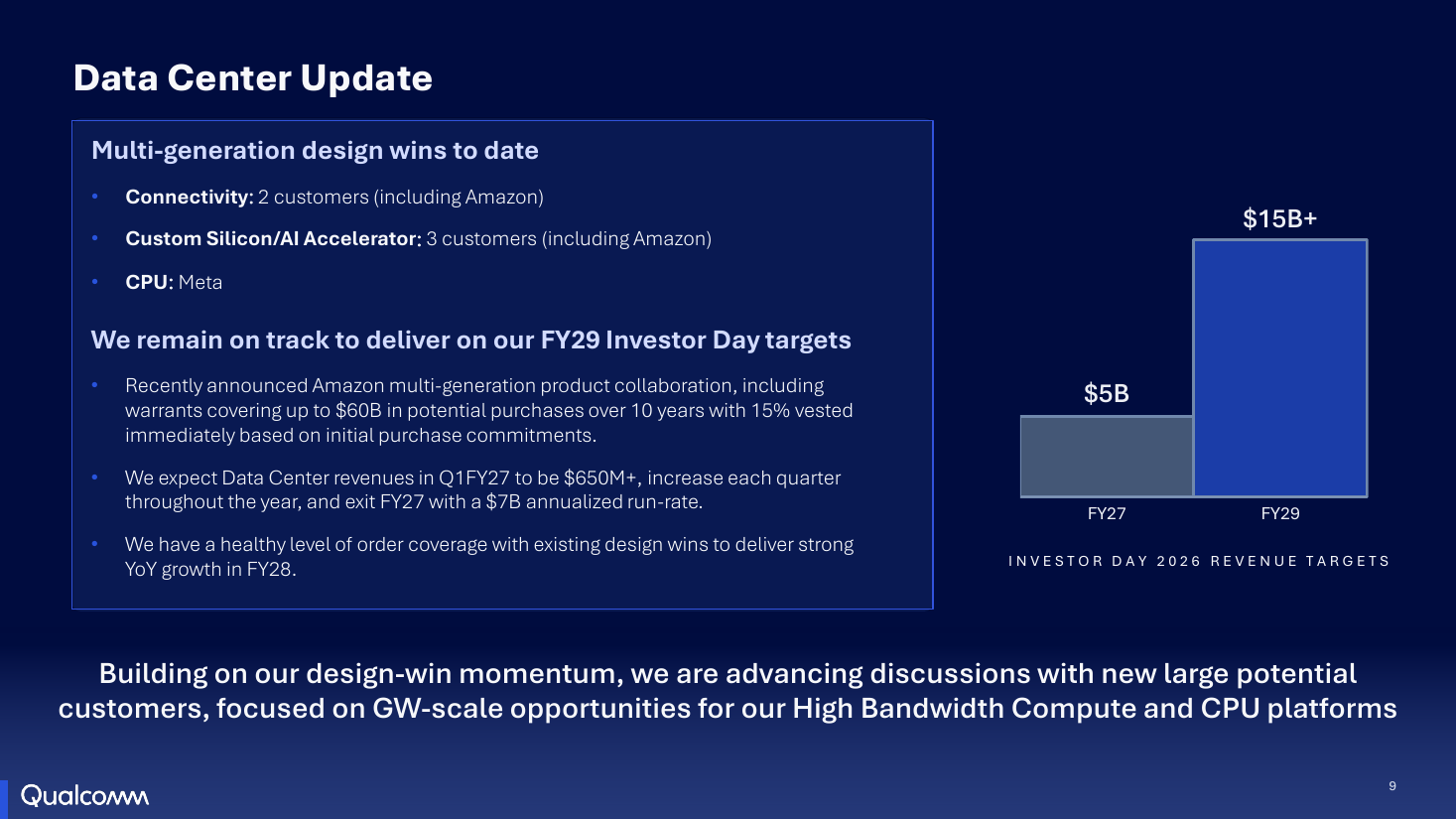
Austin: We’ll be covering QCOM datacenter aspirations in 2027 closely. Very intriguing.
Panasonic laminate plant explosion hits AI board materials
An explosion and fire early Wednesday tore through Taiwan Panasonic Multilayer Materials’ plant in Hukou, Hsinchu. Five people were injured. On Thursday, CNA confirmed that rescuers found the two missing workers dead.
The site makes Panasonic’s MEGTRON high-speed laminates, the low-loss copper-clad laminate used in AI servers and switch boards. Taiwan press estimates it holds about 20% of Panasonic’s MEGTRON capacity and roughly 4% of global high-end multilayer board supply. Repairs are expected to take months.
Normally a competitor’s outage helps rival Taiwanese laminate makers. On Thursday EMC, TUC, and ITEQ fell anyway in a market-wide risk-off session. The open question is whether board makers can qualify substitute laminates fast enough to keep AI server builds on schedule.
Source: CNA · Economic Daily News · Commercial Times
Austin: Dang. Another tragic loss of life in semiconductor and related supply chain manufacturing, after last month’s Intel Fab 28 explosion. Terribly sad.
Arm’s royalty miss hides a data center doubling
Arm grew revenue 27% to $1.44 billion, and licensing jumped 50%. Royalties rose only 8% and missed estimates, because the smartphone weakness that hit Qualcomm also showed up in Arm’s numbers.
Under that, data center royalties doubled. Arm says its share of servers at the top hyperscalers went above 50% in 2025 and should top 60% by the end of 2026. Purchase orders for its own AGI CPU now run into 2027, first deliveries are due in fiscal Q4, and Arm expects about $2 billion of AGI CPU sales over FY27–28.
Austin: Arm’s 2027 story is the impact of building it’s own silicon on the top and bottom line. Watching closely!
Source: Arm newsroom · Shareholder letter
Samsung builds a foundry fab for HBM base dies
Korean outlets report that Samsung is building a new 2nm/4nm foundry fab, code-named “Project Kairos,” at its Giheung campus. The fab would mainly make logic base dies for HBM, with 2nm reserved for HBM5. Part of the existing Line 6 is being converted to advanced packaging.
Industry sources put the cost at about 25 trillion won, rising toward 30 trillion with packaging. Samsung E&A is handling construction, and the fab is designed so it can switch to memory later. Samsung hasn’t confirmed capacity or cost.
The base die is now a foundry part, and Samsung is the only HBM supplier that owns a leading-edge foundry. SK hynix relies on TSMC for its base dies. Kairos is Samsung’s attempt to turn that into an advantage.
Source: BusinessKorea · Seoul Economic Daily · Digitimes
Austin: Nice. Fairly obvious to say “hey we’re the only ones with logic and memory foundries, let’s lean into that”, but not everything that feels obvious is always acted upon.
When will Intel Foundry make HBM base dies?
Industry Chatter
These are just unconfirmed industry whispers.
OpenAI HBM ask — Sam Altman asked SK hynix and Samsung for specialty memory, including HBM, covering 2027 through 2030 in volumes those suppliers cannot accommodate (X tip).
TSMC Texas dual-fab — A roughly $45 billion unnamed Texas project for two advanced wafer fabs is aiming at mass production by the end of 2029, with the market fingering TSMC, which said it would not comment and points overseas-investment detail to its earnings calls (semivision).
Lumentum rival bids — After Marvell’s agreed deal for Lumentum, other buyers are still circling.
TSMC 1nm at Shalun — TSMC is lining up 1nm fabs at the Shalun science park.
Foxconn Texas / India GPU plan — Foxconn’s Texas build schedule and an India government GPU capacity plan are both in circulation.
Microsoft / IREN Aterio — Microsoft slipped some data-center capex, and imagery around IREN’s Aterio site has been making the rounds earlier this week.
Sector Watch
Packaging & Substrates
AT&S — The Austrian IC substrate maker reported its biggest quarter ever, kept its full-year guidance, and said AI substrates now sell for about $200 per unit, against single digits for classic boards (Source).
Tungsten drill bits — China’s tungsten export controls are squeezing supply and raising prices for the micro drill bits that bore holes in PCBs and chip substrates, according to Nikkei Asia’s reporting from Taiwan (Source).
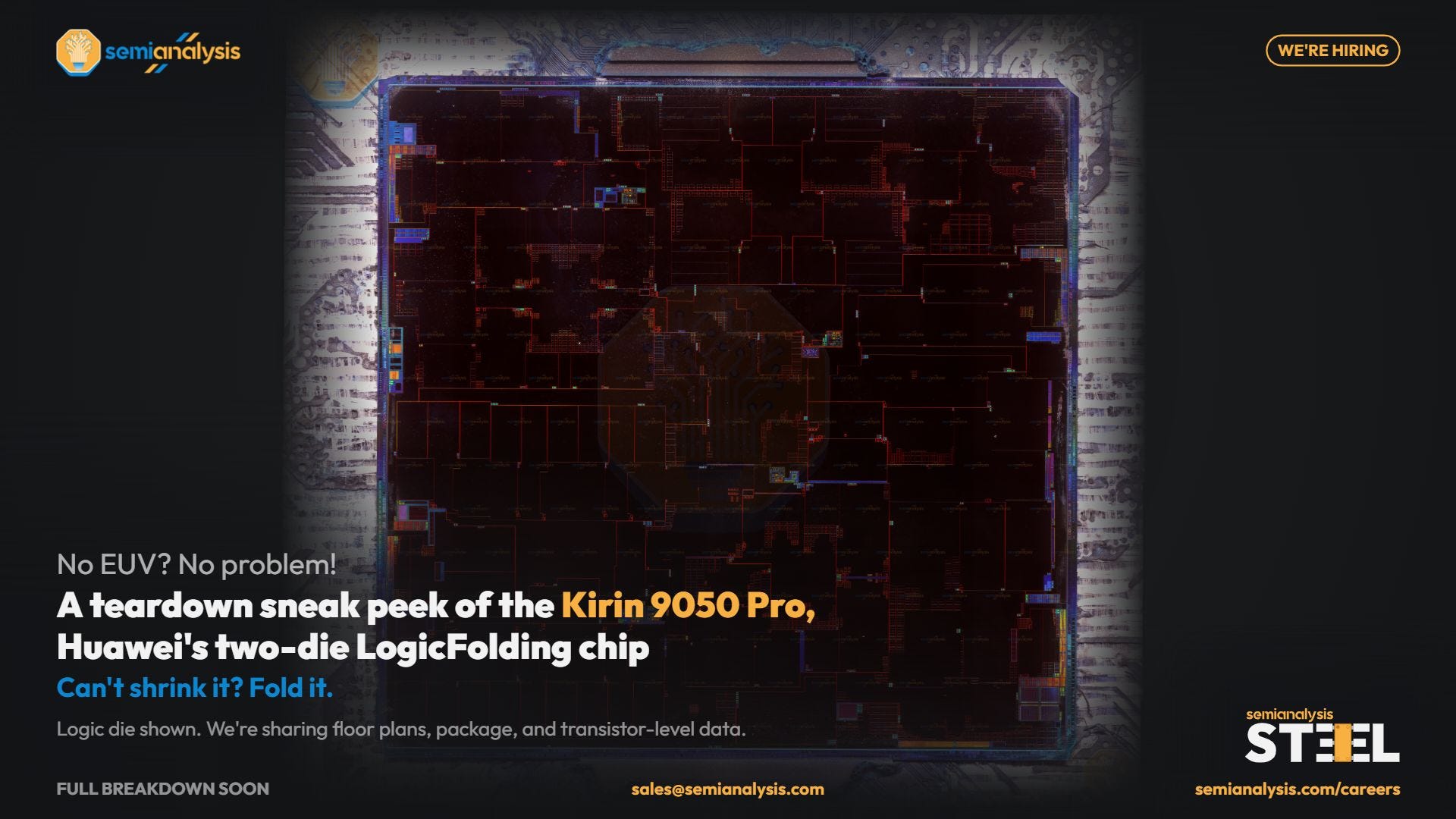
Huawei — SemiAnalysis’s teardown lab posted a die image of the Kirin 9050 Pro, which hybrid-bonds an SMIC logic die face-to-face onto a cache/IO die to get around the lack of EUV (Source).
Optics
Coherent — Coherent beat estimates and disclosed a five-year, roughly $20 billion PhotonLink supply deal with an unnamed AI company, with revenue starting in early 2028 (Source · Investing.com).
Memory & Materials
YMTC — China’s largest NAND maker has paused its roughly $4.9 billion Shanghai IPO and will likely list in the first half of 2027 instead, as regulators slow AI and chip listings, according to Reuters (Source).
Siltronic — The wafer maker raised its 2026 sales guidance again, and its CEO said AI servers use three to four times the silicon area of normal servers, pulling supply away from phones and PCs (Source · Reuters).
AI Infrastructure
Microsoft / Nscale — Microsoft decided not to use an option that would have more than doubled its Nscale contract in Ward County, Texas. The FT reported it first and Reuters confirmed. The existing lease stays in place (Source).
Tell us how to make Semi Doped better! Give us your feedback
Also worth a read:
Austin’s latest on Chipstrat, When Agents Are the Interface
Vik’s latest on Vik’s Newsletter, Intel: Why Didn’t We See This Coming?