

Hello world, it’s Thursday, September 24th.
Let’s talk about ‘super-intelligence.’
TSMC has locked in 3-6% wafer price hikes for 2027 while pushing its A14 node toward a 2028 production ramp, with Cadence and Synopsys already certifying flows. Qualcomm renewed its Apple patent license effective April 2027, DeepSeek is reportedly targeting an 8-trillion-parameter model trained on Huawei Ascend chips, and Nscale’s S-1 quietly revealed that a ByteDance entity drove 73% of its 2025 revenue.
Let’s get into it. — Austin & Vik
Be sure to check out the Semi Doped podcast on YouTube or your favorite podcast player!
Tell us how to make Semi Doped better! Give us your feedback! ❤️
TSMC Locks 2027 Price Hikes as EDA Vendors Certify A14 Flows
TSMC has confirmed 3-6% wafer price increases taking effect in 2027, squeezing chip designers even as the foundry accelerates its A14 node toward a 2028 production target. Cadence and Synopsys have both certified A14 design flows, with Synopsys expanding its TSMC partnership to cover A14 IP support and co-packaged optics alongside agentic AI design tools. Siemens completed its own A14 flow certification through an expanded TSMC collaboration announced via the Siemens Newsroom. IC-Link by imec joined TSMC’s Open Innovation Platform Cloud Alliance as the first managed-cloud service supporting mixed-partner EDA flows, giving European fabless companies and research groups cloud-based access to advanced-node design infrastructure across all three certified toolchains.
Vik: 3-6% and nobody’s pushing back. Order visibility runs to 2030 now, so designers have no room to argue - where else are they going to go? TSMC raises because it can. This means that a whole lot of other fabs like Samsung, UMC, and VIS can raise prices.
Qualcomm Locks In Apple License Renewal, Splits Snapdragon 8 Flagship Into Two
Qualcomm has renewed its global patent licensing agreement with Apple, effective April 2027, securing a continued revenue floor from the iPhone maker just as its modem business faces longer-term uncertainty. The chip company also used Snapdragon Summit 2026 in Maui on September 22 to unveil a two-track flagship lineup: the Snapdragon 8 Elite Extreme Gen 6 and a standard Snapdragon 8 Elite Gen 6, designed around physically distinct dies to serve different smartphone tiers. Both chips are manufactured exclusively at TSMC, according to The Elec. CEO Cristiano Amon introduced High Bandwidth Compute technology, borrowed from data-center architecture, as a feature of the new mobile platform, alongside the Adreno Neural Fusion graphics engine targeting console-level gaming performance.
Vik: HBC in a phone is the part I’d watch because the main benefit comes from the extremely low pJ/bit it takes to move data between memory and logic. HBC stacks DRAM on the logic die to get bandwidth and skip CoWoS, but the packaging pain doesn’t vanish - it just moves to 3D die stacking, the harder version. I wrote about that shift here.
DeepSeek Turns to Huawei Ascend for Frontier-Scale Model Training
DeepSeek is planning to train an 8-trillion-parameter model on Huawei chips, according to Seoul Economic Daily sourcing cited by The Elec, marking a concrete commitment to domestic silicon at a scale no Chinese lab has publicly attempted. The hardware of choice is Huawei’s Atlas 960E SuperPoD, a cluster packing 4,096 NPUs and 8 EFLOPS of FP8 compute into a single NPO/Hi-ONE optical-fabric node. That spec puts it in direct competition with Nvidia’s H100-class systems, which U.S. export controls have effectively locked out of China’s frontier AI market. Huawei built the 960E without EUV lithography, a constraint that once looked crippling and now looks like a solved engineering problem.
Vik: DeepSeek’s training right now is 2 trillion params, so this is a big jump on silicon they’ve never trained a frontier model on. Huge bet, reportedly.
Microsoft and Meta Push Hyperscale Spending Into New Geographic and Financial Territory
Microsoft plans $10 billion-plus in Gulf investment across four Persian Gulf countries through 2030, covering infrastructure buildout and cybersecurity, with President Brad Smith announcing an additional $2 billion tranche as the first significant regional update since the U.S.-Iran conflict. The commitment leans explicitly on resilience as a design principle, not just capacity. Meta, for its part, has set a 2026 capital expenditure target of $145 billion, a figure that exceeds every national military budget on earth except those of the U.S., China, and Russia. That number spans a 1 GW Ohio data center already operating, a 5 GW Louisiana facility in planning, and a proposed transoceanic subsea cable at petabit capacity. BlackRock and IFM are separately closing in on a $25 billion Asia data center deal.
Sector Watch
Memory
Kioxia and SanDisk commit more than $31 billion in Japan fab investment to extend NAND leadership through the next technology cycle. (dqindia.com)
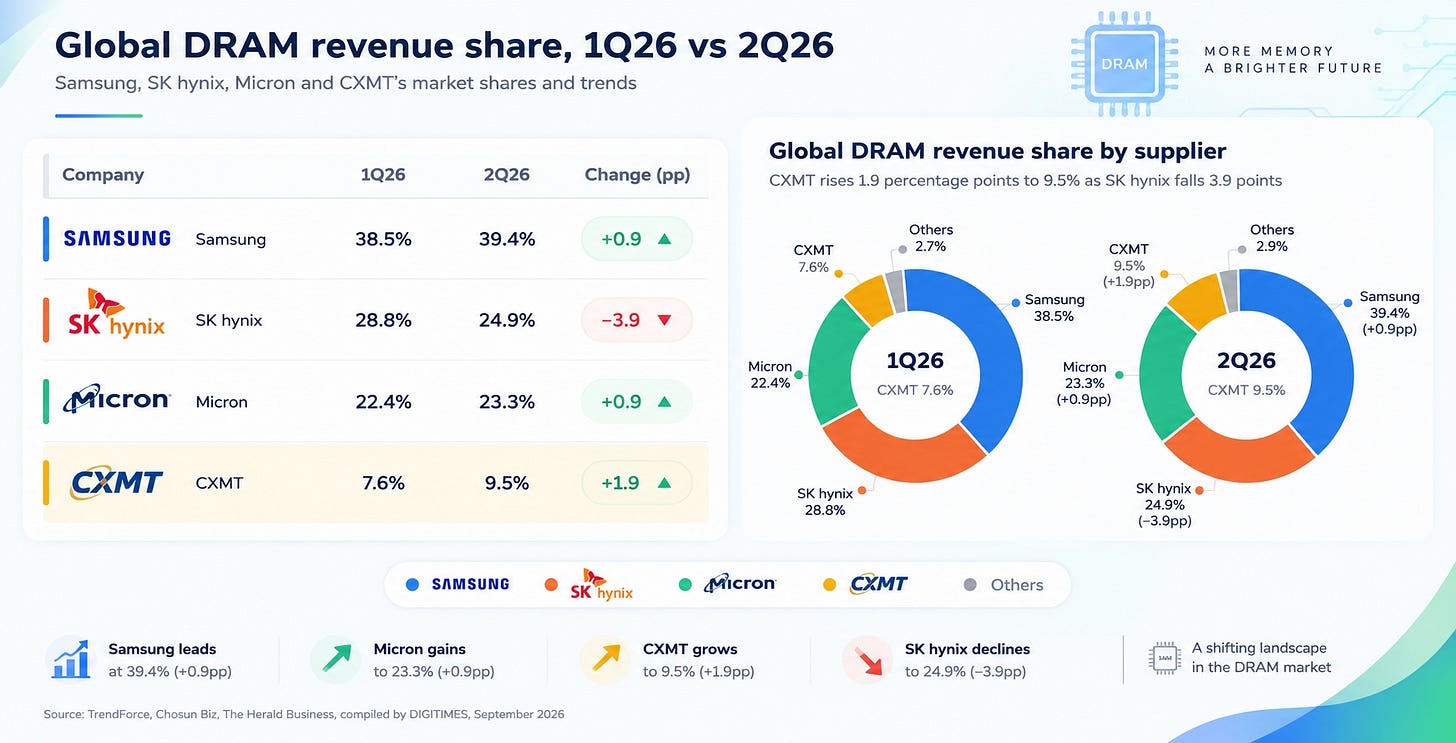
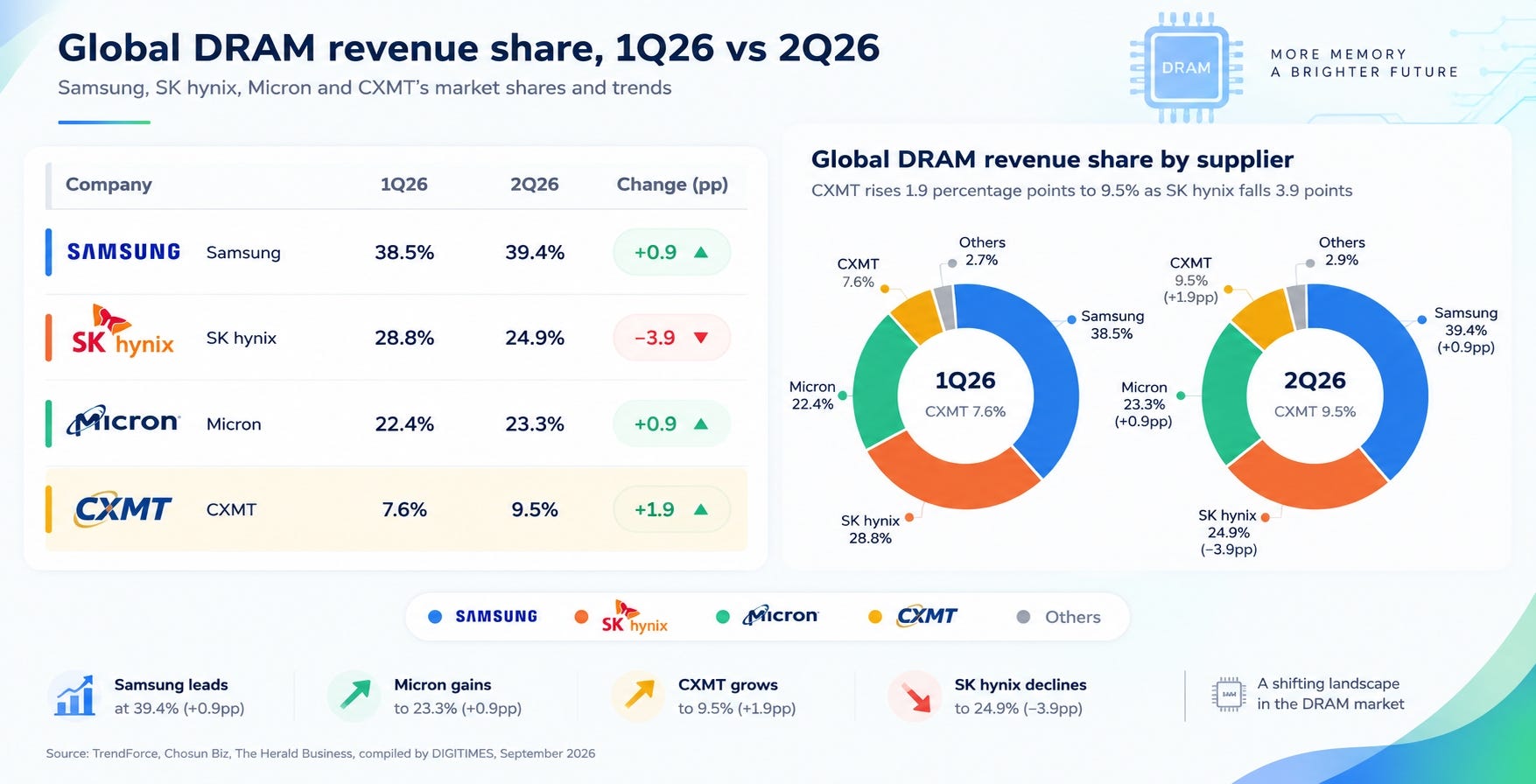
CXMT gains standard DRAM market share as Samsung and SK hynix shift capacity toward HBM, per DigiTimes analysis. (digitimes)
CXMT and SMIC power a 620% surge in China chip-industry profits as AI and cloud demand absorbs domestic supply, per Nikkei Asia. (Nikkei Asia)
Foundry & Packaging
SKC will raise its stake in glass-substrate subsidiary Absolics to 82% by subscribing to Applied Materials’ unsubscribed rights-offering shares, deepening its bet on AI packaging. (The Elec)
Simmtech enters the FC-BGA substrate market using BT resin, adding a new Korean supplier to the advanced packaging materials ecosystem targeted at AI server processors. (thelec.net)
Rapidus links with LSTC to advance Japan’s domestic 2nm-class chipmaking program, adding an institutional design-center partner to bolster the nascent fab’s customer pipeline. (digitimes)
Compute & Edge
Synopsys and Alchip jointly address AI scale-up and scale-out bandwidth constraints, with Alchip collaborating on Synopsys IP to target next-generation ASIC interconnect bottlenecks.
Moore Threads MTT S5000 embodied-RL training curves match mainstream GPUs at 0.976 correlation, with dual-arm accuracy reaching 92%, per Pandaily benchmarks. (Pandaily)
EdgeCortix unveils RAIDEN, a scalable chiplet AI platform purpose-built for physical AI applications at the edge. (Business Wire)
Optics & Networking
PicoJool raises $27.5 million Series A to scale optical connectivity solutions targeting AI data center infrastructure. (Business Wire)
Keppel and StarHub confirm active talks over the possible acquisition of M1, which would mark Singapore’s first telecom consolidation in years. (Light Reading)
T-Mobile files FCC experimental licenses to test equipment in 2.7 GHz and 4 GHz bands, staking early ground in the 6G spectrum pipeline. (Light Reading)
Data Centers
AWS becomes the first hyperscaler to achieve NATO Restricted security approval, opening a path for alliance-member classified cloud workloads. (IT Pro)
Amazon acquires Hong Kong data centers from Grand Ming Group for up to $312 million, adding owned capacity in Asia. (Mingtiandi)
Microsoft opens its fourth India cloud region in Telangana, expanding AI and cloud infrastructure across the subcontinent. (ET CIO)
Power
Renesas introduces its smallest configurable GreenPAK IC family with multi-time programmability in ultra-compact WLCSP and STQFN packages. (Business Wire)
Valens Semiconductor announces a collaboration with onsemi on a cost-optimized high-performance connectivity chipset platform. (Semiconductor Digest)
Hammond Power Solutions signs a long-term lease for new North American manufacturing space, expanding magnetic and power electronics capacity. (Semiconductor Digest)
Policy & Trade
US lawmakers introduce a bill to broaden the entity blacklist to cover more Chinese tech products, with Lenovo among firms facing fresh scrutiny. (SCMP)
Trump confirms no AI guardrails agreement emerged from the Trump-Xi White House summit, leaving governance frameworks unresolved. (Bloomberg.com)
Meta unveils the Charm dedicated AI wearable device alongside $349 camera-free Ray-Ban glasses with Muse AI integration, expanding its hardware AI ecosystem. (Bloomberg.com)
ICYMI / Random:
Trump wants AI to be rebranded as super-intelligence. (BBC)
Tell us how to make Semi Doped better! Give us your feedback! ❤️