

Hello world, it’s Friday, September 4th.
OpenAI dropped GPT-6 Astra this week, declaring “welcome to the AGI era” while safety researchers flagged its “significant jump in cyber capabilities” as a concern worth watching. Elsewhere, a South Korean court confirmed that CXMT’s Project Hefei lifted a 620-step Samsung manufacturing recipe as the Chinese firm closes in on 10% DRAM market share, and Ciena posted a 37% revenue jump to $1.67 billion as AI-driven optical buildout keeps accelerating.
Let’s get into it. — Austin & Vik
Be sure to check out the Semi Doped podcast on YouTube or your favorite podcast player!
Tell us how to make Semi Doped better! Give us your feedback! ❤️
OpenAI Claims GPT-6 Astra Sets New State-of-the-Art Across Key Domains
OpenAI announced GPT-6 Astra as “the most intelligent and aligned model in the world,” claiming state-of-the-art performance across computer use, browsing, software engineering, cybersecurity, science, and professional work. The announcement came via OpenAI’s official X account, with a linked release accompanying the post. The breadth of the capability claims is notable on its face: six distinct benchmark domains in a single launch. Aligned model development has been a recurring public commitment for OpenAI, and folding alignment into the top-line marketing claim puts it on equal footing with raw performance for the first time in the company’s model naming cycle.


Vik: OpenAI’s release video has a dude sitting on a couch vibing on a game involving a rocket evading space rocks. In reality, this Iron Man-Jarvis dream only still works in the movies. Call me a skeptic. I’m sure Astra is good and all, just until the next model drops. Then we will all start calling GPT-6 dumb.
Austin: I have some tasks up my sleeve to put Astra to the test. Check back next week. I’m optimistic. I seriously unlock new levels of productivity with each model, I’m just limited by imagination and time. And it seems to take less and less time to specify and monitor each new model…so I have no excuses.
CXMT Reaches 10% DRAM Share as Samsung Theft Case Exposes Project Hefei
A South Korean court has found that CXMT’s so-called Project Hefei lifted a 620-step manufacturing recipe from Samsung, with defendants allegedly using a written roadmap to systematically transfer process know-how to the Chinese firm. CXMT reached 10% of global DRAM revenue in Q2 2026, crossing a threshold that took Samsung and SK hynix decades to build. The company has opened recruitment drives in Japan targeting DDR5 and LPDDR expertise. Seoul Economic Daily reports the US has separately warned Korean chipmakers to accelerate their pivot toward HBM4, where China’s technology gap remains wide.
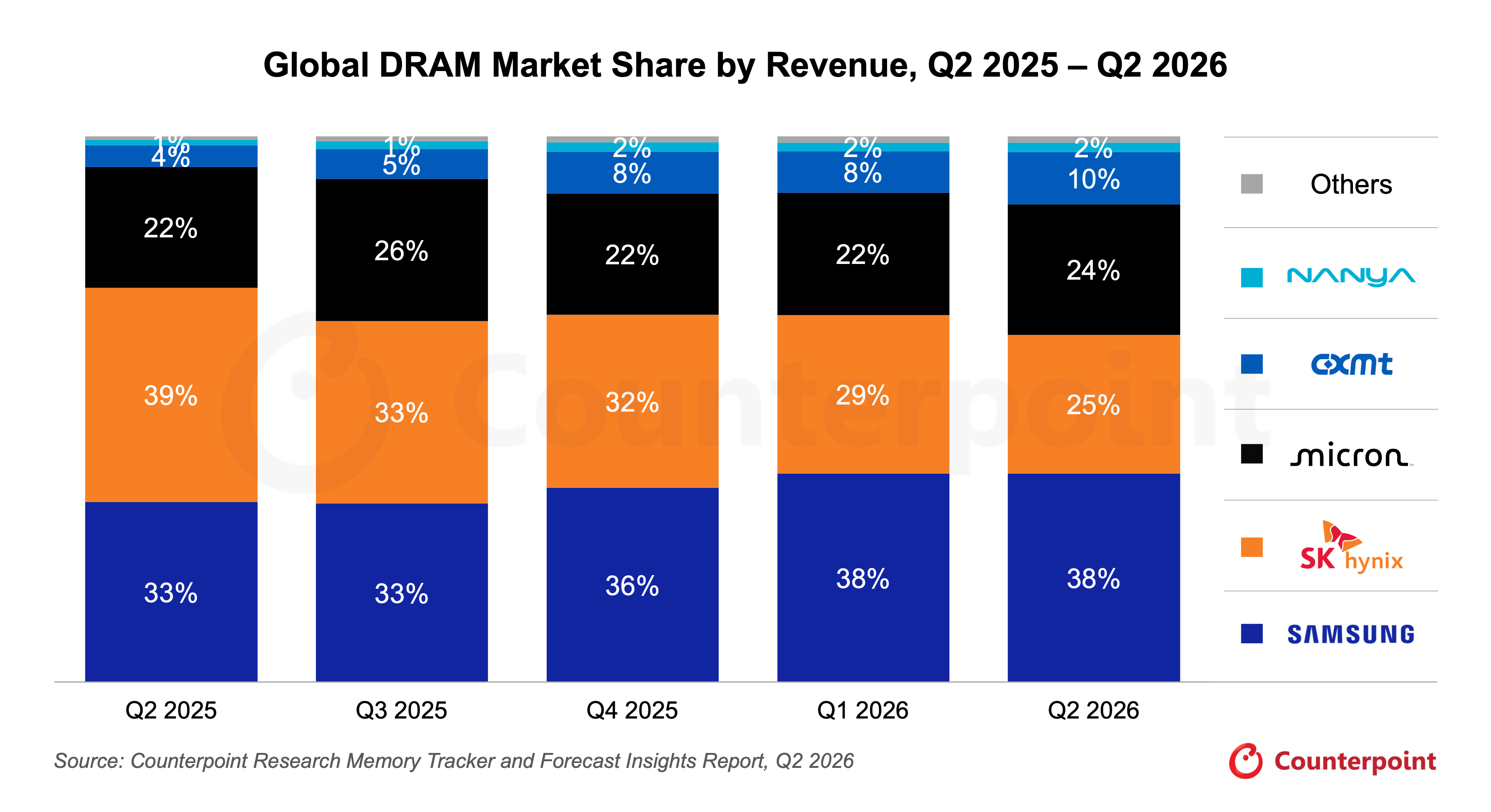
Vik: The key thing to notice here is the CXMT’s market share gain has come at the expense of SK Hynix. This is mainly because SK Hynix has diverted more of their manufacturing towards HBM instead of DRAM. IMO, it does not say anything about SK Hynix’s product quality or China exposure even though it seems like it.
Ciena Revenue Jumps 37% as Optical Backlog Nears $10 Billion
Ciena posted fiscal Q3 revenue of $1.67 billion, up 37% year-over-year, with EPS climbing 215%, as surging demand for data-center interconnect and AI-driven network buildout drove one of the company’s strongest quarterly results on record. Supply constraints, not weak demand, are now the binding limit: Ciena expects its order backlog to exceed $10 billion by fiscal year-end as optical component capacity trails orders. CEO Gary Smith called out a multi-year AI infrastructure investment cycle as the structural force behind bookings growth, with hyperscalers and carriers competing for the same constrained capacity. Shares fell roughly 10% on the day, as investors fixated on in-line forward guidance rather than the beat itself.
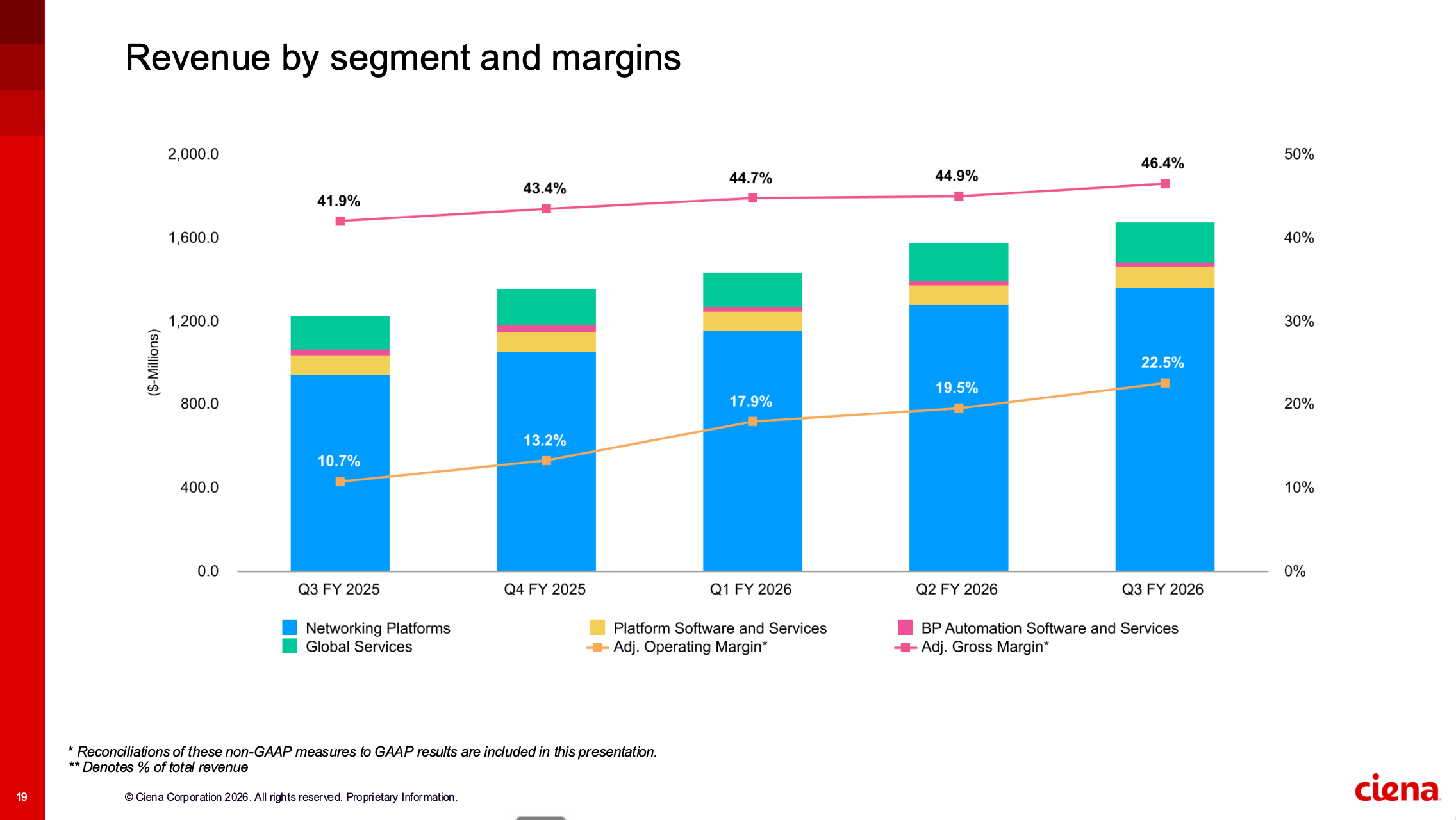
Vik: Optical demand is still strong, even though there is a current market slowdown in optical stocks. Structurally, we will see more of optics as we continue this AI buildout. This limitations only come from supply, not demand.
Kioxia Bids to Replace DRAM with high-speed NAND
Flash storage maker Kioxia is running a parallel campaign: the company is pitching high-speed NAND as a practical substitute for DRAM in AI memory hierarchies, with Micron and YMTC both closing in on the same positioning according to Digitimes. Kioxia’s plan, outlined to Nikkei Asia, targets AI inference workloads where latency tolerances are looser and cost per gigabyte matters more than raw bandwidth. Together, the two moves put commodity DRAM in a tighter spot from both the demand and substitution sides.
Vik: There are definitely use cases for lower token cost inferencing where speed is not paramount. This heterogeneity of workloads means that NAND will occupy a significant portion in the inference stack alongside DRAM.
Austin: Yeah I kind of hate phrasing like “substitute for DRAM” because it should also be followed by “in certain situations”. The future is bright for both DRAM AND NAND.
Figure AI commits $3.5 billion to Nscale GPU cloud for robotics
Figure AI CEO Brett Adcock announced a partnership with Nscale to deploy up to 100,000 GPUs on Nvidia’s Vera Rubin platform, with Figure committing $3.5 billion initially and plans to scale the investment beyond $6 billion. The compute buildout targets what Adcock described as the “massive amount” of processing power required to ship a humanoid robot into every home. Vera Rubin is Nvidia’s next-generation accelerator architecture, and sourcing that scale of capacity through Nscale positions Figure to run large training workloads in-house rather than through general-purpose cloud providers. The deal represents one of the more concrete dollar commitments from a humanoid robotics company to purpose-built AI infrastructure.


Vik: That is a big sum of money going into compute for humanoid AI. It is a signal to pay attention to, because where money flows, good things happen (mostly).
Nvidia PAIR Beta Routes Local AI Inference Across RTX, DGX, and Mac Devices
Nvidia has released a beta of its Personal AI Router (PAIR), software that connects Windows RTX systems, DGX Spark machines, and macOS devices on a local network into a shared inference cluster. PAIR routes AI workload requests across available nodes regardless of operating system, presenting a single local endpoint to applications, and supports Ollama and LM Studio at launch. The software requires no special cables or rack hardware, supports all GeForce RTX GPUs from the 20 Series onward plus Mac M4 or newer, and operates without an internet connection once models are downloaded.
Vik: Woah! Heterogeneous compute on personal devices for local AI! Perfect way to string a bunch of resources and run AI locally. With enough RTX GPUs, I predict that the next wave of companies pivoting to AI inference are animation studios!
Austin: Is it open source, i.e. can it ultimately support AMD GPUs cards?

Sector Watch
Foundry & Equipment
SEMI reports global semiconductor equipment billings rose 23% year-over-year in Q2 2026, the broadest confirmation yet of the CapEx wave underway across leading and trailing nodes. (PR Newswire)
ASML Japan plans to expand its local workforce by 40% by 2030 to support Rapidus and TSMC advanced-node ramps, per Nikkei Asia. (Nikkei Asia)
TSMC plans to boost semiconductor testing operations at its Kaohsiung site, expanding back-end capacity alongside advanced-node front-end ramps. (bisinfotech.com)
PCB & Components
Samsung Electro-Mechanics eyes 30% MLCC price hikes as AI server demand strains supply, with ABF substrate prices also rising, per Digitimes. (digitimes)
Vishay Intertechnology launches a new thin-film high-frequency chip resistor targeting precision RF and high-speed applications. (GlobeNewswire)
Shindo ENG Lab develops Through Glass-Ceramic Via technology as a next-generation substrate alternative addressing TGV limitations in advanced packaging. (The Elec)
Policy & Trade
ASML partner Zeiss SMT CEO states China is 15 years behind in top chipmaking tools; UBS puts China’s EUV at ASML’s 2004 capability level with no viable alternative within a decade. (Bloomberg.com)
China rare earth firms have halted some US shipments over geopolitical concerns, raising supply-chain risk for chip and defense material customers, per Reuters. (Reuters)
YMTC takes a key step toward a marquee Hong Kong IPO, Bloomberg reports, as China’s flash memory sector pushes toward public capital markets. (Bloomberg.com)
Compute & Edge
Nvidia sets an October launch for RTX Spark AI PCs, bringing its latest-generation inference silicon to the consumer edge market, per Reuters. (Reuters)
Qualcomm unveils next-generation Adreno GPU architecture with Matrix Cores and Neural Fusion, targeting on-device AI inference acceleration in mobile. (thelec.net)
DeepSeek plans to order 160,000 Huawei AI chips to power a new Mongolia data center, Bloomberg reports, marking a major domestic-silicon commitment. (Bloomberg.com)
Optics & Networking
HPE and Oracle deepen their networking partnership to support gigawatt-scale AI infrastructure, expanding Juniper-based fabric deployments across OCI. (Business Wire)
Equinix, Nvidia, and Together AI partner to deploy distributed AI inference across Equinix colocation fabric, targeting low-latency edge inference workloads. (techwireasia.com)
POET Technologies will exhibit at CIOE 2026 and present high-power laser light sources engineered for AI interconnects at IFOC. (GlobeNewswire)
Power
Flex agrees to acquire EPC Power, adding high-density power conversion capabilities for AI data centers and grid applications to its manufacturing portfolio. (PR Newswire)
Lite-On makes a $170 million strategic investment in DCX to accelerate its push into AI data-center liquid cooling, per Digitimes. (digitimes.com)
LS Electric and KT Cloud announce a partnership to build power infrastructure for AI data centers, combining grid expertise with cloud operator demand. (The Elec)
Data Centers
Crusoe closed a $3 billion Series F at a $30 billion valuation to expand its purpose-built AI data centers. Crusoe has also been linked to a reported $13 billion agreement with Jane Street.
Meta activates its $1.2 billion Kuna, Idaho data center, its first purpose-built AI facility in the state, with a $100 million local infrastructure commitment.
Humain, the Saudi AI firm, is weighing a $2.5 billion fund dedicated to building data centers, Bloomberg reports, extending the Gulf’s AI infrastructure push. (Bloomberg.com)
Thailand puts 49 data center projects on hold due to power and water resource strain, Bloomberg reports, a significant policy brake on Southeast Asia buildout. (Bloomberg.com)
Tell us how to make Semi Doped better! Give us your feedback! ❤️