

If you thought Oleg Losev’s story was tragic, this one is just as sad.
An estimated 90 percent of semiconductor devices are built with a method that carries his name, yet his own grave went forty-five years without it.
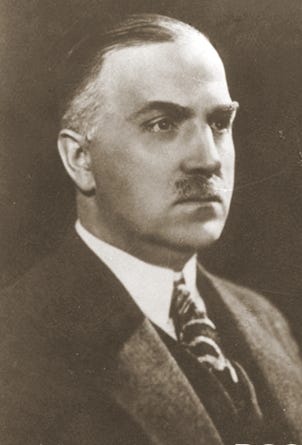
Jan Czochralski was born in 1885 in what was then Exin in the Prussian Province of Posen, German Empire (now Kcynia, Poland). He was the eighth of ten children of a carpenter, and his father did not care for the boy’s chemistry experiments. At sixteen Jan left home for a job in a pharmacy. By one account he destroyed his school certificate because he didn’t like his grades.
He would need that certificate.
He reached Berlin in 1904, and most records say Charlottenburg Polytechnic gave him a chemical engineering diploma in 1910, even though without the certificate he could not formally enroll. In 1907 he joined AEG, the electrical company.
Now, the pen.
The story goes that one evening in 1916 he was writing up the day’s results beside a crucible of molten tin and dipped his pen into the tin instead of the inkwell. It came out trailing a thin thread of metal, and the thread was a single crystal. We could not find a primary source for it, and one Polish science magazine calls it a legend.
What does exist is three printed pages. A German chemistry journal received his manuscript on 19 August 1916 and ran it in 1918 as “A new method for measuring the crystallization rate of metals.” He drew a thread of tin, zinc or lead up out of the melt through a capillary and noted the fastest speed it would take before it snapped.
Other people picked up where he left off. In 1918 Hans von Wartenberg swapped the capillary for a seed crystal, and by 1922 Ervin von Gomperz was calling it the Czochralski method.
Czochralski had already moved on. In 1917 he left AEG to found and run an industrial metals lab in Frankfurt. In 1923 Henry Ford offered him a job running a lab in America. He said no and went on to patent B-metal, a tin-free bearing alloy for railway wagons, in 1924. And it made him rich! In 1927 he walked Germany’s president, Paul von Hindenburg, around a materials exhibition in Berlin.
In 1928 he said yes to a different president. Ignacy Mościcki of Poland, a chemist himself, invited him to Warsaw University of Technology. In 1929 the university gave him one of its first honorary doctorates.
In September 1939 Germany took Warsaw. In November it shut the city’s universities. In January 1940 Czochralski opened a Materials Research Workshop on the university grounds. The Germans gave permission. So did the Polish underground state. On paper it did jobs for city services. It also had Home Army soldiers legally on its payroll, and a secret Home Army cell inside it made weapon parts for the resistance. He used his German contacts to keep people out of prisons and camps.
In April 1945 the new communist authorities arrested him for cooperating with the German occupiers “to the detriment of civilians or the Polish State.” His best defense was the Home Army work. The new authorities treated cooperation with the Home Army as a crime. He spent four months in prison in Piotrków Trybunalski before the prosecutor dropped the case for lack of evidence.
The prosecutor was easier to convince than his colleagues. On 19 December 1945, ten professors at a senate meeting resolved that from the end of 1939, “Dr Jan Czochralski” had ceased to be regarded as a professor of the university.
The man who had turned down Ford, held in enough esteem to walk with Hindenburg went home to Kcynia. In 1946 he started a small chemical works there. It made shoe polish, curing salt, perm lotion and a cold powder sold as “with the Little Dove.”
He died in a Poznań hospital on 22 April 1953.
All this is probably the reason he wrote poems on the side, under the name Jan Pałucki. His oldest known work is a book called Maja. Powieść miłosna (Maja: A Love Story).
So there was a pen after all.
Some time later, Gordon Teal of Texas Instruments told a conference in Dayton, Ohio, that TI had silicon transistors in production, and took a few out of his pocket.
Teal had history with crystals. The first transistor, built by Bardeen and Brattain at Bell Labs in 1947, used a slab of polycrystalline germanium. Teal, then at Bell Labs, began pulling single crystals of germanium in 1948. By 1951 he and Morgan Sparks were growing transistor junctions into the crystal during the pull. At TI his team did the same with silicon, pulling crystals out of the melt the way Czochralski had pulled tin.
Bell Labs had made a silicon transistor in January 1954 but had not announced it. TI was first to put one into production.
From 2004, the European Materials Research Society handed out a Jan Czochralski medal every year in the main hall of the university that had expelled him. In 2011 a report Czochralski wrote to Home Army intelligence turned up in a Warsaw archive. On 29 June 2011 the university senate rehabilitated him.
We write his name as CZ now. It is on the spec sheet of the wafers your phone’s chips came from. And it took until 1998, and some help from physicists in Poznań, for it to go on his grave.
I knew this name sounds familiar... took me back to EMRS 2013 in Warsaw (zero award, three awesome beers)