

Ethernet’s first speed, 2.94 megabits per second, was set by a part that didn’t fit on a circuit board. We’ll get to the board later. The story starts with a Stanford professor killing time at Honolulu airport.
Norm Abramson was on his way to give a paper in Tokyo, and his plane stopped in Honolulu just long enough for him to decide it was a pretty nice place. On the way back he changed his flight, rented a surfboard at the Moana on Waikiki and learned to surf at thirty-three. About a year later he was teaching at the University of Hawaii, and surfed every day for thirty years (without a wetsuit).
The university’s campuses sat on islands within about 300 kilometres of Honolulu, and phone lines to its main computer were poor and expensive. In 1968 his group started planning a radio network instead, and the rule they settled on sounds almost careless: any terminal could transmit whenever it liked, and if two packets collided, each waited a random time and tried again. And just like it is today, memory was expensive, so sending and receiving at once needed a second 704-bit buffer at about $300 a terminal, so they made do with one.
ALOHAnet went live in June 1971. Abramson never patented it, because he was “too busy surfing to worry about that sort of thing,” and published instead, which is how his paper ended up in a blue 1970 conference volume beside a foldout couch in Washington.
That couch belonged to Steve Crocker, an ARPA program manager, and Bob Metcalfe slept on it when ARPA work brought him to town. In May 1972 Metcalfe had failed his Harvard PhD defense and had to tell his parents not to come to Harvard Yard. The committee decided his thesis on building the ARPANET was engineering rather than theory. And most engineers without PhDs are aware of the short end of the stick often enough: theory is credited with nuance, while engineering is accused of brute-forcing things into working, however amazing the result. He went to Xerox PARC anyway.

So he was on the couch, jetlagged, when he took the blue volume off the shelf to read himself to sleep and found Abramson’s paper, or so Metcalfe tells it. Crocker remembers showing him the paper himself. Either way, it was Crocker’s copy.
The math annoyed Metcalfe because Abramson had modelled infinite users who kept typing no matter what, but the terminals didn’t work like that: you sent in a card image, a little light went off, and you waited for the computer’s reply to switch it back on. He redid the model with a few users who wait for the light, and noticed the original never said how long a terminal should wait before trying again; set that too short and the channel went unstable with almost any traffic. Harvard got its theory, and he got his PhD in June 1973.
At PARC, the Alto and laser printer needed a network, and Charles Simonyi had sketched one called SIGNET, for Simonyi’s Infinitely Glorious Network, built to move 50 megabits per second when terminals ran at 300 bits per second. Butler Lampson moved Simonyi to a text editor and handed SIGNET to Metcalfe, who had photographed the building’s wiring closets, rats’ nests of cable running every terminal to one room. He wanted one cable down the hall, and computers that listened for a quiet line, talked, and backed off when they collided.
Hawaii’s radio was no use: the ALOHA modem was about six feet tall, and his network had to fit on a card inside an Alto. He ordered a thousand-foot spool of coaxial cable, took it to the basement and started sending pulses down it, and was struggling with connectors when a Stanford graduate student in a yellow button-down shirt said he knew how to do that and did it. That was David Boggs, and the two were partners from then on, later sharing the patent with Butler Lampson and Chuck Thacker, who designed the Alto.
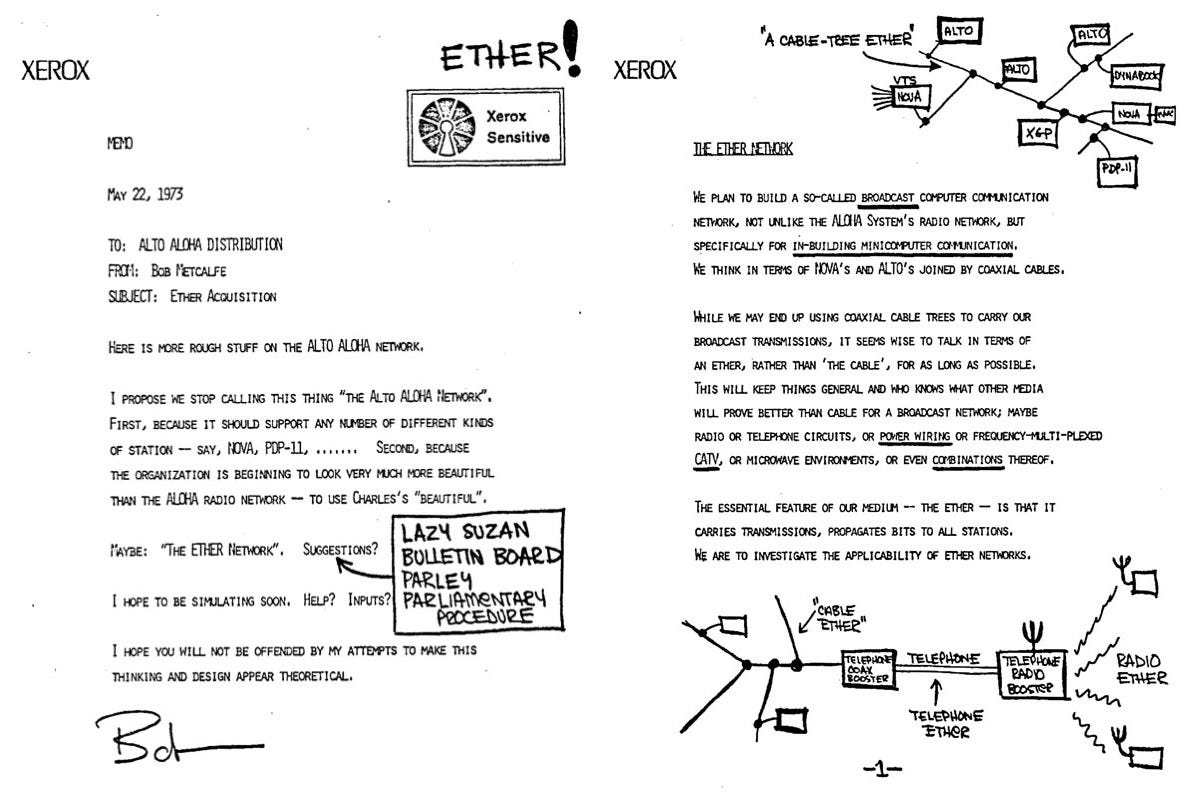
On May 22, 1973, Metcalfe wrote a memo renaming the Alto ALOHA Network the Ether Net, after the medium physicists once believed carried light, until Michelson and Morley looked for it and found nothing. The first two machines were called Michelson and Morley in their honor.
As for the board, it filled up until Boggs had to hang an error-checking chip off an extension at the edge, which left no room for a clock. The Alto already had a clock, ticking every 170 nanoseconds, so they borrowed it. At two ticks per bit, that came to 2.94 megabits per second, and Metcalfe refused for years to round it to 3, because the rounding error was bigger than an entire ARPANET trunk line.