

In early 1948, Bell Labs had just invented the transistor, and its lawyers were doing what lawyers do before a world-changing patent filing: a routine search of prior art. Somewhere in the files they found a set of patents, filed in 1925 and 1928 by a professor who nobody in the building had heard of, describing the thing their Nobel-bound physicists were about to claim. The drawings were twenty years old.
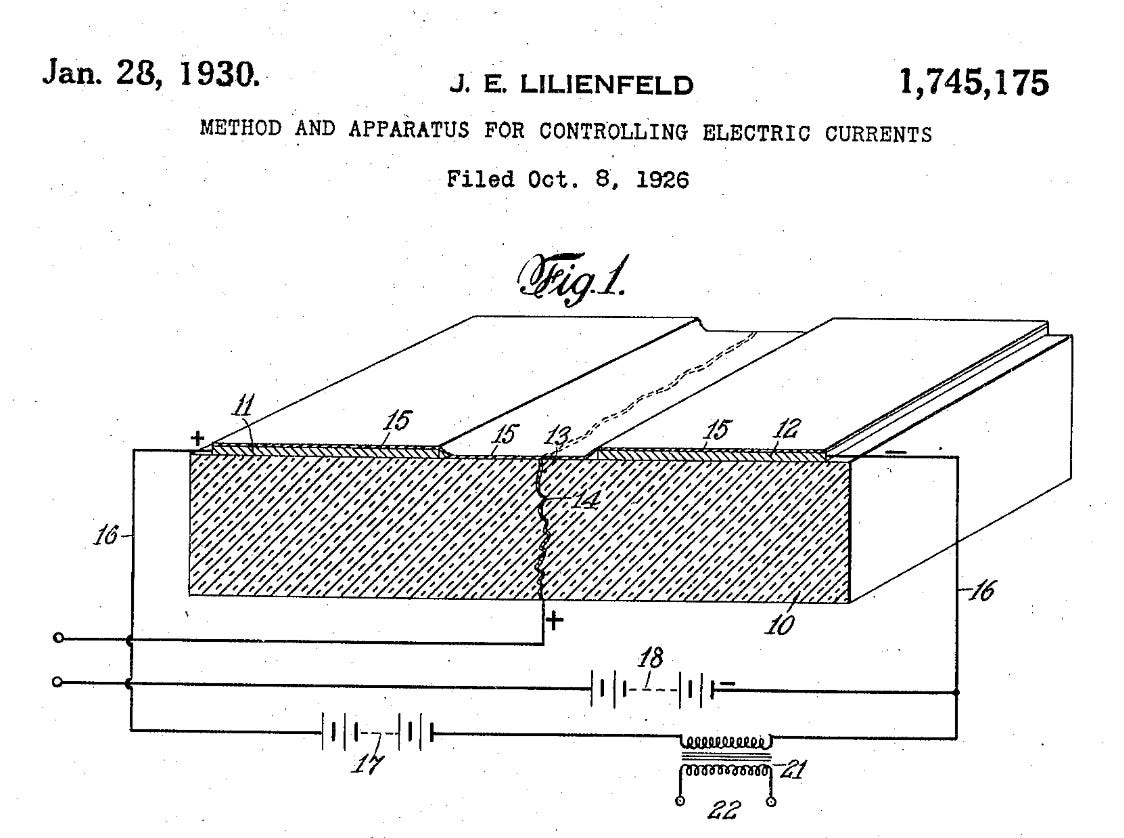
They were also, unmistakably, a field-effect transistor.
The professor was Julius Edgar Lilienfeld, born in Lemberg (today’s Lviv), doctorate under Max Planck, and the man who first characterized field electron emission as a distinct physical effect. He had spent the early 1920s irritated by the vacuum tube which was hot, fragile, and gluttonous. He wondered whether you could amplify a current inside a solid instead. His answer, filed first in Canada on 22 October 1925, was a three-electrode device using a thin copper sulfide film; apply a voltage to a middle electrode and you modulate the conductivity of the channel.
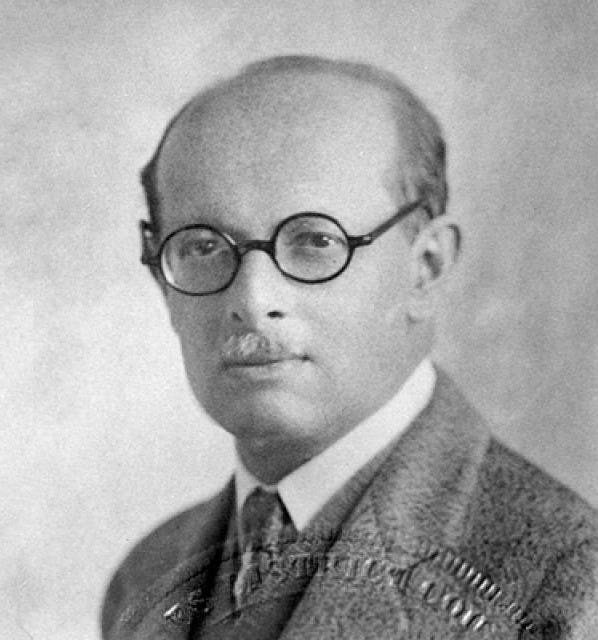
A 1928 follow-up described what we would now call a MOSFET. He had moved to America in 1921 to fight patent battles, patented the electrolytic capacitor in 1931 along the way, and watched the physics establishment shrug at his amplifier for most of his life.
Bell Labs did not shrug. William Shockley had been insisting he be named sole inventor of the transistor, on the grounds that the field-effect concept was his. The lawyers now had to inform him that his concept had prior art from 1925, and the core patent went in under John Bardeen and Walter Brattain alone, for the point-contact device they had physically built. When Bell Labs filed field-effect applications anyway, the Patent Office rejected them in 1948, citing Lilienfeld. A forgotten professor’s paperwork had just carved Shockley out of his own invention; the resentment that followed reshaped an entire industry, but that is a story for another day.
The consolation story - that Lilienfeld was a mere theorist whose devices could never have worked - held up for decades. In 1964, J.B. Johnson of Bell Labs claimed to have tested the designs and found they failed; the historian Robert Arns, who went through the legal files, later wrote that the statement appears to have been deliberately misleading. In 1995, physicist Joel Ross built a replica following the 1925 patent’s prescriptions exactly. It worked, and stayed stable for months. Semiconductor physicist H.E. Stockman claimed in 1981 that Lilienfeld had demonstrated a working tubeless radio receiver repeatedly in the 1920s. Bardeen himself conceded in 1988 that Lilienfeld had the basic concept first, and mused that the point-contact detour may have actually slowed the field down.
Lilienfeld spent his last decades on St. Thomas in the Virgin Islands, where he had moved in 1935 to escape, of all things, a wheat allergy. He died there on 28 August 1963, absent from most textbooks.