

Before the glass-and-steel campuses, the manicured zen gardens, and the stock options that minted thousands of millionaires, Silicon Valley smelled like burnt dust, concentrated nitric acid, and stale coffee.
In September 1957, eight young scientists and engineers – Julius Blank, Victor Grinich, Jean Hoerni, Eugene Kleiner, Jay Last, Gordon Moore, Robert Noyce, and Sheldon Roberts – had just walked out on William Shockley. Shockley was the co-inventor of the transistor, a Nobel laureate, and a manager whose paranoia had driven his brilliant young staff to open rebellion and petition his backer, Arnold Beckman, for a new boss. When that failed, they resigned on September 18 (the date is important). Shockley treated it as a betrayal and reportedly never spoke to Noyce again. The label “Traitorous Eight” stuck to them for the rest of their lives, though nobody has ever documented who coined it. The oldest of them was 32.
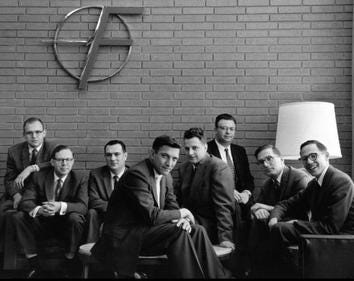
They needed a place to build a company, and they needed it fast. So armed with $1.5 million in backing from Sherman Fairchild’s Fairchild Camera and Instrument - brokered by a young investment banker named Arthur Rock. But before that, the deal was a $1.38 million loan against an option to buy the whole company for $3 million. Each founder put in $500 of his own money for 100 shares. The agreement was signed on September 19 - the day after the resignations. On October 2, Fairchild Camera’s executive VP Richard Hodgson mailed a $3,000 check to Noyce’s house in Los Altos to cover expenses until the corporation formally existed.
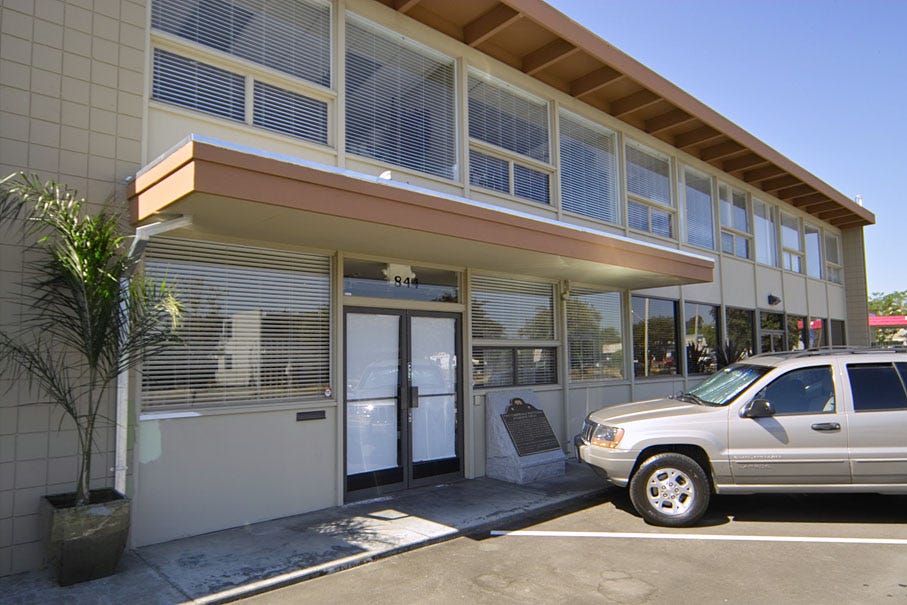
For the first weeks they worked out of the founders’ homes; the first probers and test benches were built in Vic Grinich’s garage at 615 Georgia Avenue in Palo Alto. In October they signed a two-year lease on a brand new 14,000 square foot building at 844 Charleston Road, Palo Alto, on the border with Mountain View, and moved in during November. The building wasn’t a pristine research facility as you would expect for a semiconductor firm. It was a modest, two-story structure, and the team took over the upper floor while the ground level served as space for vehicles and storage. It is now California Historical Landmark No. 1000.
There were no cleanrooms in 1957. There were no HEPA filtration networks, vacuum chambers, or hazmat bunny suits. When the team needed to manufacture double-diffused silicon NPN transistors, they discovered that commercial equipment simply didn’t exist for the scale and precision they required. And they wanted a tool, they had to MacGyver it.
A stringent look at the workshop hardware reveals just how spit-grit-and-a-whole-lot-of-duck/t-tape the operation was. Roberts, the metallurgist, built the crystal puller and grew the silicon ingots. Last and Noyce worked out photolithography, using three matched 16 mm movie-camera lenses to make the masks; Bell Labs had said photolithography was impractical, and Last later said that if they had not made it work they would not have had a company.
Moore ran diffusion and figured out how to make electrical contacts with aluminum. Hoerni worked out the diffusion profiles. Blank, Grinich, and Kleiner built the manufacturing and test equipment, including the furnaces that had to hold silicon at well over 1,000 degrees Celsius for hours while dopants diffused into the crystal lattice.
Blank and Kleiner were the only two with real manufacturing experience (both from Western Electric); everything else was learned on the job. The etch chemistry was hydrofluoric and nitric acid in beakers under exhaust hoods, mixed by people who had learned it at Shockley’s lab the year before.
Their first year was pure, unadulterated chaos. There is some romance to it, we suppose? Because through that chaos came fantastical things.
The immediate goal was a contract. In early 1958, IBM’s Federal Systems Division ordered 100 high-voltage silicon transistors to drive the magnetic core memory in the on-board computer of the B-70 bomber. No established maker could meet the specification, so IBM agreed to pay $150 apiece to a company with no production line and no yield data. Two teams raced in parallel, Moore’s on an NPN device and Hoerni’s on a PNP. Moore’s won, and it became the 2N696 and 2N697 (the same part, binned by gain). The first 100 shipped to IBM in the summer of 1958, less than a year after the walkout. Autonetics then chose it for the Minuteman guidance computer.
Then came the problem that made the company. In late 1958 the mesa transistors developed a reliability failure: tiny particles flaking off the inside of the metal can could land on the exposed junctions at the edge of the mesa and short them. You could make a good device fail by tapping the package with a pencil. The fix came from Hoerni, a Swiss-born physicist and serious mountaineer, who had sketched the idea in his notebook in December 1957 and set it aside while the IBM order got built. Instead of etching away the silicon dioxide grown during diffusion, leave it in place over the junctions; the surface stays flat and the junctions stay sealed. That is the planar process. Hoerni showed Noyce a working version on January 14, 1959.
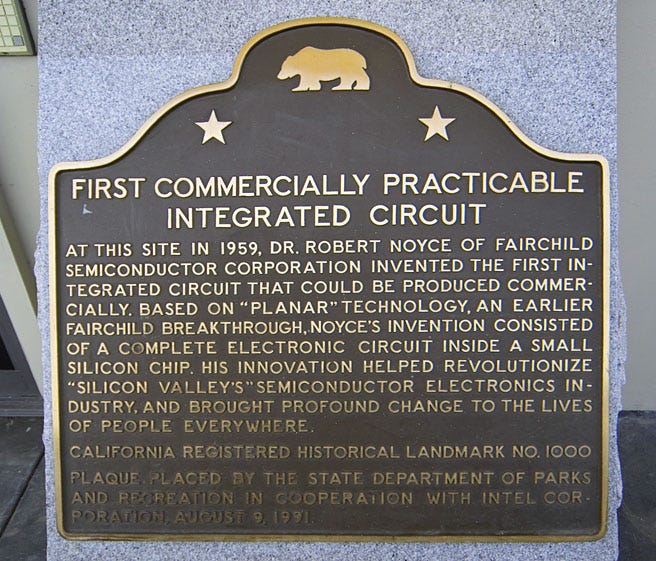
Nine days later Noyce wrote in his own notebook that if the oxide could protect junctions, it could also carry wiring. Evaporate aluminum onto the oxide, pattern it with the same photolithography, and you could connect several transistors, resistors, and capacitors on one piece of silicon without ever cutting it apart. Jack Kilby at Texas Instruments had shown a working circuit on a single chip the previous September, but his was wired by hand with gold; Noyce’s version was the one a factory could make, and the two companies spent most of the next decade in court over it. The first planar transistor, the 2N1613, went on sale in 1960. The first Fairchild integrated circuits, the Micrologic family, followed in 1961.
We like to picture the tech industry as a march of sleek, inevitable progress. We paint it in brushed aluminum and soft white LED lighting. But the foundation of everything - from the phone in your pocket to the servers directing global finance - was laid by eight people between 27 and 32 in a garage on Georgia Avenue and a bare 14,000 square foot lease, making masks with movie-camera lenses, building their own furnaces, and tapping transistors with a pencil to see which ones died.