

Every superhero movie has their origin story. The superhero of the doping process has a mention in some textbooks, and not even a footnote in the ones that matter.
His name was Russell Ohl, and his forgotten story starts with a rock he should have thrown in the trash.
In early 1940 (some accounts place it in late 1939), Bell Labs researcher Russell Ohl picked up a chunk of silicon with a visible crack down the middle and connected it to an ohmmeter. It should have been junk because the semiconductor world of the day was obsessed with purity; any variation in a crystal was a flaw to engineer away, and this slab was riddled with them.

Ohl had spent over a decade at Bell Labs by then, and most of it fighting for permission to keep doing what he was doing. He joined the company in 1927 after a stint building radio receivers, and by the 1930s he had become obsessed with an idea most of his colleagues thought was a dead end: that silicon and germanium crystals, notoriously flaky and inconsistent, might make better high-frequency radio detectors than vacuum tubes, if only someone could grow them pure enough.
Management was skeptical, because vacuum tubes worked. Crystals were what people used before tubes, back when radio reception meant fiddling with a cat’s whisker wire until you found a lucky spot on a lump of galena.
Ohl kept experimenting anyway, purifying silicon in small furnaces, slicing the cooled ingots into wafers, and testing them one by one. But silicon was the unwanted child of mid-century electronics - stubborn, unpredictable, and seemingly impossible to wrangle.
Then came the cracked wafer. It was, by all accounts, an absolute disaster of a sample, riddled with variations and split by a visible fissure running down the middle. It should have gone straight into the bin. Instead, Ohl decided to do what engineers do when they find time, and decided to FAFO. He connected it to an ohmmeter and carried it over to a window. When sunlight hit the slab, the needle on his meter violently jumped. He moved it into shadow and it dropped back. He moved it into light again and it leaped because it was reacting to the light.
The cracked wafer turned out to be the lucky spot. When Ohl and his colleagues examined it, they realized the crack wasn’t damage to the crystal structure so much as a boundary inside it. As the molten silicon had cooled and solidified, trace impurities had settled unevenly, leaving one side of the ingot with a slight surplus of electrons and the other side with a slight deficit. The crack sat right at the line where the two sides met.
What Ohl had walked into, almost by accident, was the p-n junction, the structure modern electronics still runs on. It is why a diode only lets current flow one direction, the switching mechanism at the heart of a transistor, and what lets a solar cell convert sunlight into usable electricity. He had proven, against the purity-obsessed culture of his field, that the future of semiconductors lay not in eliminating impurities but in controlling them; what the industry now calls doping.

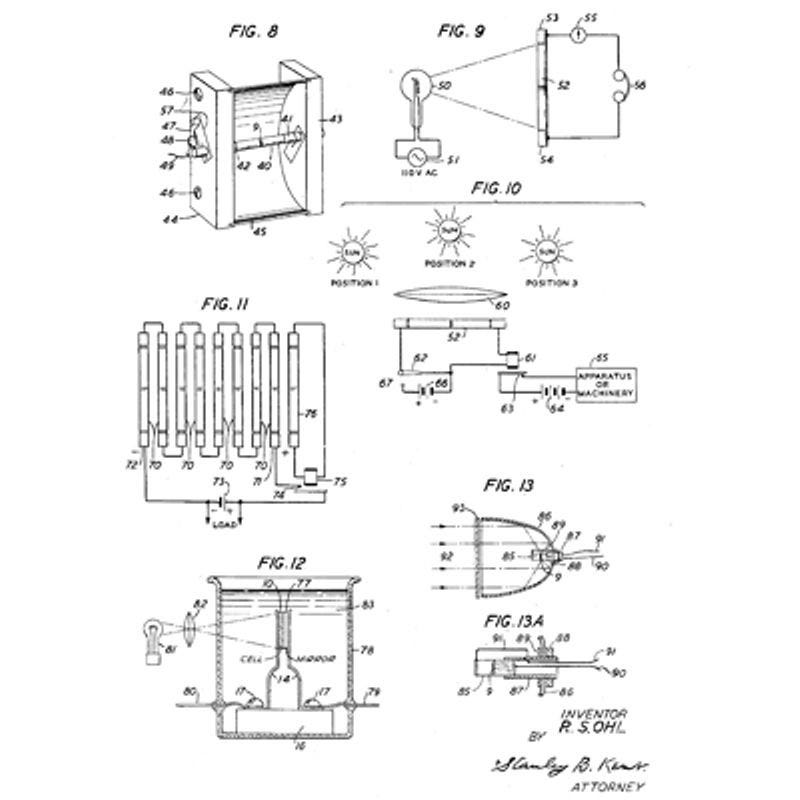
Bell Labs leadership filed the patent on the discovery in 1941, calling it a “light-sensitive electric device,” essentially inventing the silicon solar cell thirteen years before they built a more efficient and practical version from the same principle. They treated the find as a curiosity, useful perhaps for radio detectors or solar cells, not the opening of a new era. It took years more work, and the invention of the transistor, before anyone grasped what door had been kicked open. History is notoriously fickle that way.
When Walter Brattain, John Bardeen, and William Shockley built a working transistor in December 1947, they were standing on Ohl’s junction, whether or not history remembers it that way.
Word of the demonstration reached research director Mervin Kelly, and soon a small crowd of physicists had gathered in his office to watch a piece of rock light up. Walter Brattain, who would win a Nobel Prize seven years later for co-inventing the transistor, is said to have been floored by what he saw: the effect was far stronger than anything anyone had measured with a light-sensitive material before, so much so that he suspected a trick until Ohl handed him a piece to test in his own lab.
The ultimate irony of Ohl’s discovery is that he succeeded by ignoring the dogma of his era. While everyone else was killing themselves to remove impurities, Ohl found the secret to the future in the dirt, proving that semiconductors are not about absolute purity, but about the controlled introduction of atomic flaws.
Ohl retired from Bell Labs in 1958 at 60, moved to California, and spent his later years publishing papers on semiconductor crystals and, by some accounts, studying how plants respond to noise. He died in 1987, holder of some 130+ patents and essentially unknown outside the small world of transistor historians. The men who built their Nobel-winning breakthroughs on top of his cracked silicon, went to Stockholm. Ohl got a broken rock that changed the universe, and barely a footnote to show for it.
Sometimes, the future is found in the beautiful, conductive brokenness of things. It’s why we named this newsletter after the very thing Ohl accidentally discovered: doping.
Nice backstory about the discovery of impurities improving the electrical properties of silicon, reminds me of
(1) this paper about adding guano to graphene https://pubs.acs.org/ancac3/article-abstract/14/1/21/602927/Will-Any-Crap-We-Put-into-Graphene-Increase-Its?redirectedFrom=fulltext
(2) adding chicken feathers to concrete to improve strength https://link.springer.com/article/10.1557/s43580-025-01475-6