

On the afternoon of 26 April 1985, Steve Furber pushed the first ARM processor into a test board in Cambridge, switched it on, and nothing happened.
The chips had come in from VLSI Technology at 1pm. Furber’s board was an ARM second processor that plugged into a BBC Micro. When the first chip sat there doing nothing, he went over the board, found a wiring fault, fixed it, and tried again. This time the chip booted. Sophie Wilson — who had written BBC BASIC — got it running on the new processor, and the screen showed pi. There’s a well-worn version in which the first words were “Hello World, I am ARM,” but it was pi. By about 3pm a brand-new 32-bit processor was working on its first afternoon.

Furber still had one job left, which was to find out how much power the chip drew. The design had been built around a limit of one watt, and nobody trusted the power estimates from the design tools. He connected a meter to the test points, and it read zero.
A working processor drawing no current isn’t possible, so the fault had to be in the board again, and it was. A track on the circuit board had broken. The chip’s power pins weren’t connected to the supply at all, and it had been running BASIC without it. It was running entirely on leakage current through the protection diodes on its I/O pins.
Every input pin on a CMOS chip has small diodes running to the chip’s supply rails, there to drain away static before it can damage the transistors. With the supply connected, those diodes sit reverse-biased and carry nothing. With the supply pin disconnected, any input the board holds at 5 V pushes current through its diode into the chip’s internal supply rail, which settles a diode drop below 5 V. The ARM1 was taking its power from whichever of its input lines happened to be high, and it needed so little that this was enough to run a BASIC interpreter.
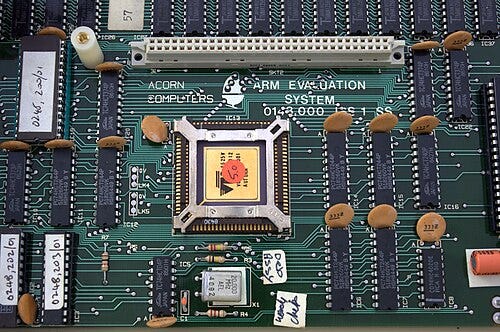
This is usually told as the moment ARM’s best-known trait showed up by accident, and the two designers don’t agree on that. Wilson has called the low power a complete accident. Furber’s version is that it was “to some degree serendipitous but they were not accidental.” Nobody at Acorn set out to build a low-power chip, but the one-watt limit was intentional.
A cheap chip had to go in a plastic package rather than a ceramic one, and plastic topped out at around a watt. The team left a lot of margin under that, and the chip came back using under a tenth of a watt. The usual explanation is that the ARM1 had only about 25,000 transistors, but Wilson doesn’t accept that: 25,000 was more than several 16-bit processors of the day had, and she puts the low power down to design style and targets.
The limit came from Acorn having very little money. Co-founder Hermann Hauser liked to say he gave his chip team two things Intel and Motorola never gave theirs: “the first was no money and the second was no people.”
The company was in no better shape than the budget. On 20 February 1985, two months before that afternoon, Olivetti bought 49% of Acorn for about £12 million, and by the end of the year it had a controlling interest. Nobody told Olivetti about the ARM when it bought Acorn, and once it found out, it didn’t know what to do with it. Olivetti was Europe’s largest maker of IBM PC compatibles, and its sales force had been told to sell nothing else, so Acorn’s machines went nowhere fast.
In November 1990, Acorn moved twelve ARM staff into a joint venture with Apple and VLSI, set up in a converted barn. Apple wanted a processor for the Newton, its handheld computer, and when it announced the ARM610 in May 1992, it said it had chosen ARM for its low power consumption, small size, and low cost. That was enough for a handheld, but phones needed one more change.
In 1993, TI proposed an ARM-based chip to Nokia, which worried that 32-bit instructions would need too much memory. ARM introduced Thumb, a 16-bit instruction set that let the same program fit in less memory. The core built around it, the ARM7TDMI, went into the Nokia 6110, the first ARM-powered GSM phone.
Two of Apple’s three reasons, small size and low cost, were forced on the team by Hauser’s budget. The third had been there since that first afternoon, and nobody measured it until a broken track on a test board made them look.