

Fairchild Semiconductor’s first contract was ten one-dollar bills. In 1957, eight engineers met two New York bankers at the Clift Hotel in downtown San Francisco and agreed to start a company together. Each man signed every one of the ten bills, and for the time being, those bills were the only paperwork the company had.
The eight engineers worked for William Shockley, and their reasons for leaving started with him. In 1956, the year he shared the Nobel Prize for the transistor, Shockley recruited a group of young PhDs to Shockley Semiconductor Laboratory, set up in a former Quonset hut on San Antonio Road in Mountain View. Candidates sat a psychological test before he would interview them, and when a secretary cut her hand on a pin, Shockley suspected sabotage and ordered lie detector tests. The lab’s direction worried his staff more than his suspicions did, because Shockley kept pulling people off silicon transistors to work on his four-layer diode, a device few of them thought was worth the effort.
In May 1957, a group led by Gordon Moore took the problem to Arnold Beckman, whose company funded the lab, and asked him to move Shockley into an advisory role under a professional manager. Beckman offered a manager but kept Shockley as director with full authority. After that, the question was no longer whether to leave but how and when.
Seven of them decided to go, and their first idea was to find an employer that would hire them as a team. Eugene Kleiner wrote to Hayden, Stone & Co., a New York securities firm where his father had an account, to ask whether any company would take them on. The letter reached Arthur Rock, a 30-year-old analyst at the firm, who persuaded his boss, Alfred “Bud” Coyle, to fly to California and meet the group.
Before Rock could pitch the group to anyone, he needed to know who would lead it, since investors would expect one person in charge. The seven had someone in mind, but he was not one of them. Robert Noyce had apparently sided with Shockley in the lab’s disputes, and Shockley considered him his one supporter on staff. Sheldon Roberts persuaded Noyce to come to the meeting with the bankers anyway, which is how eight men came to be sitting at the Clift.
At the Clift, Rock and Coyle proposed a different plan. Instead of looking for an employer, the eight would start their own company, and Hayden, Stone would find a large corporation willing to pay for it. Everyone agreed. Coyle took ten new dollar bills from his wallet, asked each man to sign every one, and explained that the bills would be their contracts with each other.
Finding the backer took far more work than signing the bills, because venture capital did not yet exist as an industry, so Rock drew up a list of about 35 established companies and asked each of them to fund a group of researchers with no product and no experience in running a business. All of them — rightfully — said no.

The backer Rock eventually found was Sherman Fairchild, IBM’s largest individual shareholder (his father had co-founded the company) and the owner of Fairchild Camera and Instrument, a Long Island maker of military aerial cameras. Fairchild Camera agreed to lend the new company $1.38 million over 18 months. Each of the eight put in $500 for 100 shares — about two to three weeks’ salary. Noyce had to write to his parents to ask whether his grandmother could lend him his share. Hayden, Stone took 225 shares, and 300 more were held back for future managers. In return for the loan, Fairchild Camera controlled the company through a voting trust and held an option to buy all of its stock for $3 million.
With the money arranged, the eight resigned from Shockley’s lab on September 18, 1957, and became known as the “Traitorous Eight.” According to one account, Shockley’s notebook records the day in a single line: “Group resigns.”
Fairchild Semiconductor set up at 844 Charleston Road in Palo Alto and landed its first customer within months. In early 1958, IBM’s Federal Systems Division needed a high-voltage silicon transistor to drive the magnetic core memory in the B-70 bomber’s onboard computer, and no established manufacturer could meet the spec. IBM ordered 100 of them from Fairchild at $150 each, and Moore’s team delivered a double-diffused silicon mesa transistor.
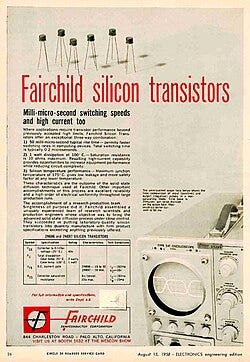
Orders like that made the $3 million option look cheap to Fairchild Camera, and it exercised the option in 1959. Each founder’s $500 stake became about $250,000 in Fairchild Camera stock, and each founder became an employee of a division run from New York.
Under New York’s ownership, Fairchild Semiconductor kept losing people. By later accounts, the parent company would not extend stock options beyond the founders and moved semiconductor profits into its other businesses. Engineers left to start their own firms, and Fairchild’s founders and employees went on to create at least 65 companies over the next two decades. In 1968, Noyce and Moore left too. They called Arthur Rock, who had been doing venture deals from San Francisco since 1961, and he raised $2.5 million to start Intel.
Shockley’s one loyalist became general manager of the company the defectors started, and then he defected from that one too.