

In November 1895, at the Town Hall in Calcutta, legend has it that Sir Jagadish Chandra Bose aimed a spark transmitter at the Lieutenant Governor of Bengal. The beam went through him, through two walls, and reached a receiver 23 meters away in a closed room. There it rang a bell and set off a charge of gunpowder. Nothing connected the two ends.
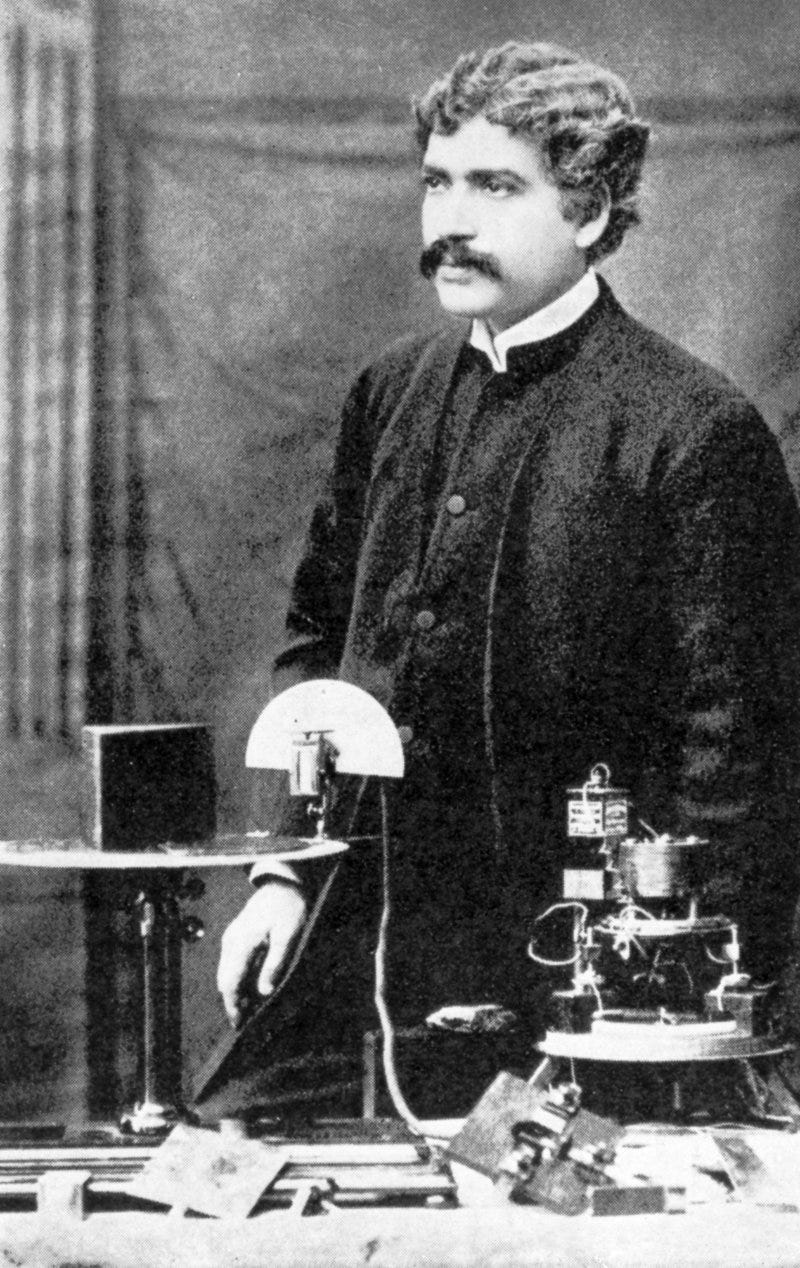
Bose had spent the year before in a small room next to a bathroom at Presidency College. He wanted to know whether radio waves behaved like light. Long waves were no use for that indoors, so he worked between 2.5cm and 5mm. Five millimeters is 60 GHz.
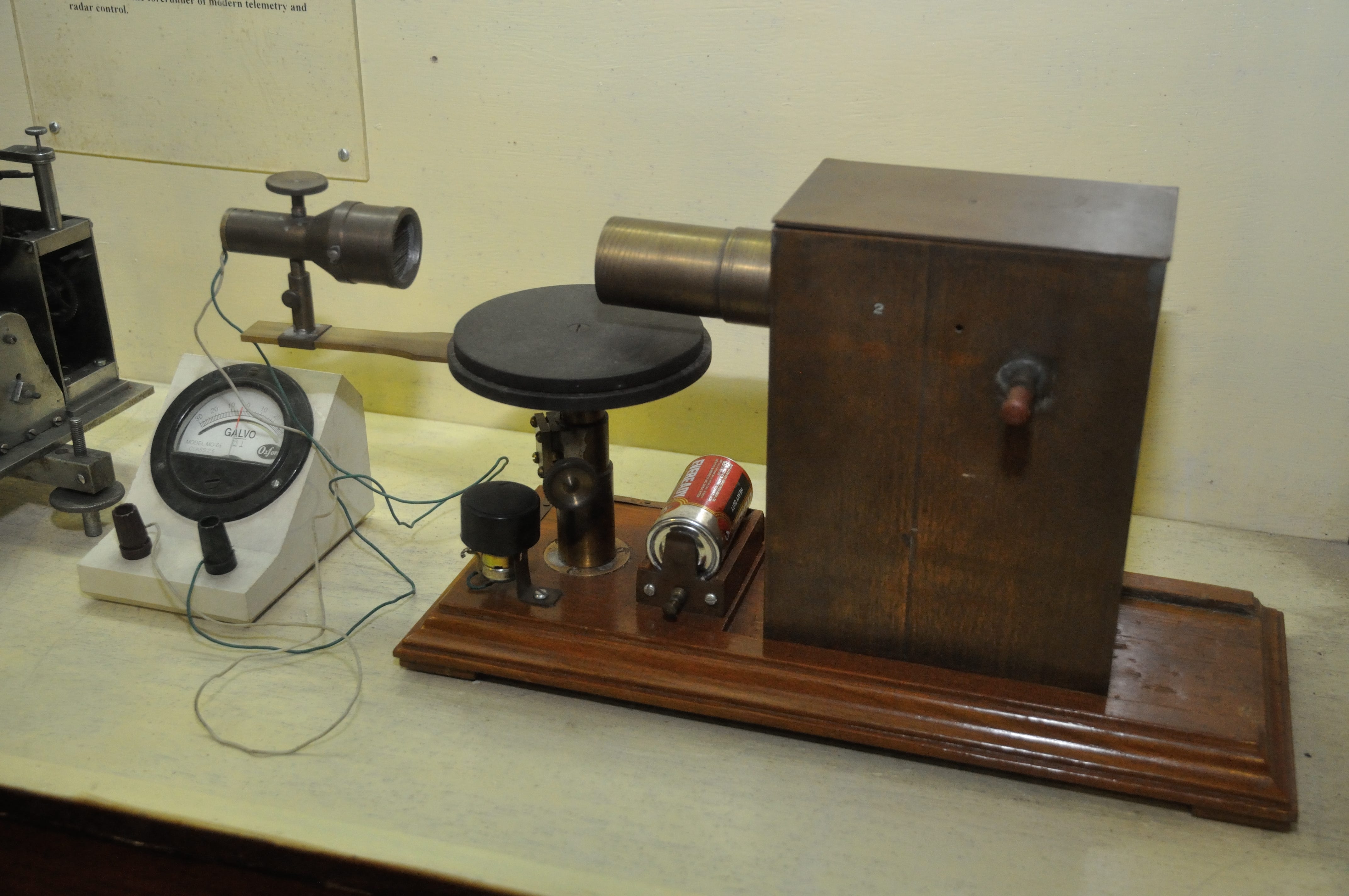
Nobody sold parts for that band, so he made them. A spark radiator that fired between two hemispheres and a sphere set between them. A circular waveguide to carry what it made. A pyramidal horn to collect it at the other end, though he called it a collecting funnel. Lenses of glass and sulfur, cut to refractive indices he had measured himself. For a polarizer, he slid sheets of tinfoil between the pages of a Bradshaw’s railway timetable. In 1898 he twisted a bundle of jute and used it to rotate the polarization of a beam, which people working on metamaterials now point to as an early ancestor of their field.
Then he needed something to detect the waves with, and this is where he went somewhere nobody followed.
Through the late 1890s he pressed metal points against surfaces, measured the current with a galvanometer, and plotted it against the voltage. The plots came out curved rather than straight. He sorted materials into two groups: ones whose resistance dropped as the current rose, and ones whose resistance climbed. He called them positive and negative. On an iron point contact he found a bend in the curve at around 0.45 volts, and found the junction worked best as a detector when he held it there. In 1901 he measured current going down as he pushed the voltage up, which is negative dynamic resistance. He settled on galena, lead sulfide, touched by a fine metal point.
Braun had already seen rectification in metal sulfides back in 1874, so the effect itself was known. Bose was the one who put the junction to work catching radio waves and wrote down how it behaved.
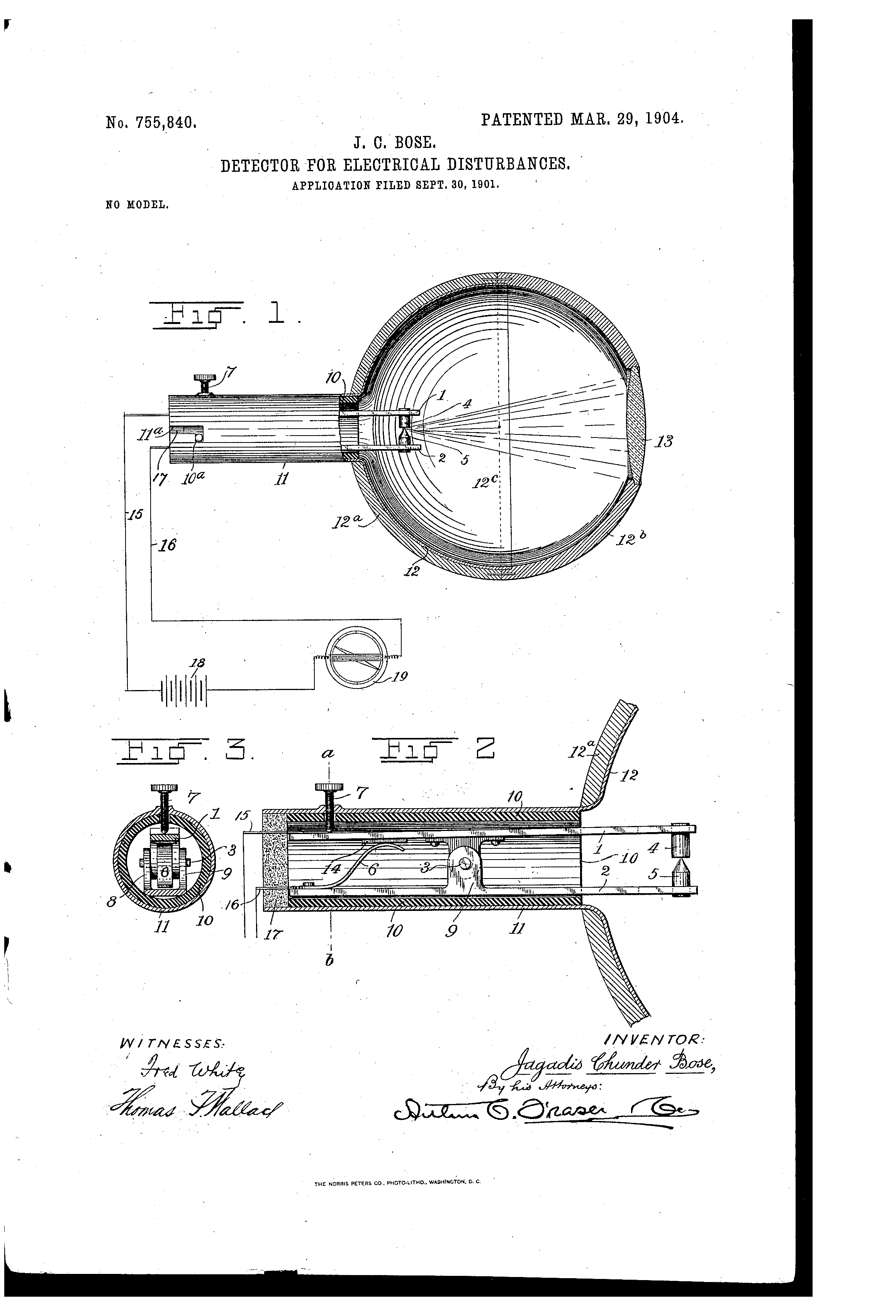
Then he refused to own it. He told an interviewer in London that he had no interest in commercial telegraphy and that other people were welcome to his work. Sister Nivedita and Sara Chapman Bull talked him into filing anyway. Bull lent him the $80 fee and took half the patent. US 755,840, “Detector for Electrical Disturbances,” filed 30 September 1901, granted 29 March 1904. He never used it and let it lapse. Around 1900 he changed fields and spent the rest of his life studying plants and writing science fiction.
Everyone else went the other way. Almost nobody worked at millimeter wavelengths for the next fifty years. When a standard survey of early wireless history was compiled a century later, seventeen of its authors made two references to Bose between them.
He had it right, though. In a 1955 history of semiconductor research, Gerald Pearson and Walter Brattain traced the idea that semiconductor rectifiers were suited to radio detection back to Bose’s 1904 patent. They credited him with finding that point contacts on galena, silicon carbide, tellurium and silicon all worked. Brattain wrote that eight years after building the point-contact transistor, about a man who had characterized the junction in a converted room in Calcutta and then walked away from it.