

Somewhere in your house there is probably a red dot you bought to torment a cat. Hold that thought for approximately nine hundred words.
On 9 July 1962, at a device conference in Durham, New Hampshire, a group from MIT Lincoln Laboratory stood up and said their gallium arsenide junctions were turning very nearly every electron they injected into a photon, with almost none of it wasted as heat. Three of the men listening went home and started building lasers: Robert Hall from General Electric’s lab in Schenectady, Marshall Nathan from IBM, and a GE engineer out of the Syracuse lab called Nick Holonyak.
Hall won the non-race. By the middle of September he had coherent infrared light coming out of a gallium arsenide diode, and Holonyak (who had told an interviewer decades later that he had fully expected to beat everybody), took it about as well as you would expect. He also conceded, every time he was asked, that Hall was a smart guy who simply got there first.
The consolation (for Holonyak) was that Hall’s beam was invisible. So was IBM’s, and Lincoln Lab’s. Every one of those devices emitted in the infrared, which meant you proved you had a laser by pointing it at a detector and reading a trace.
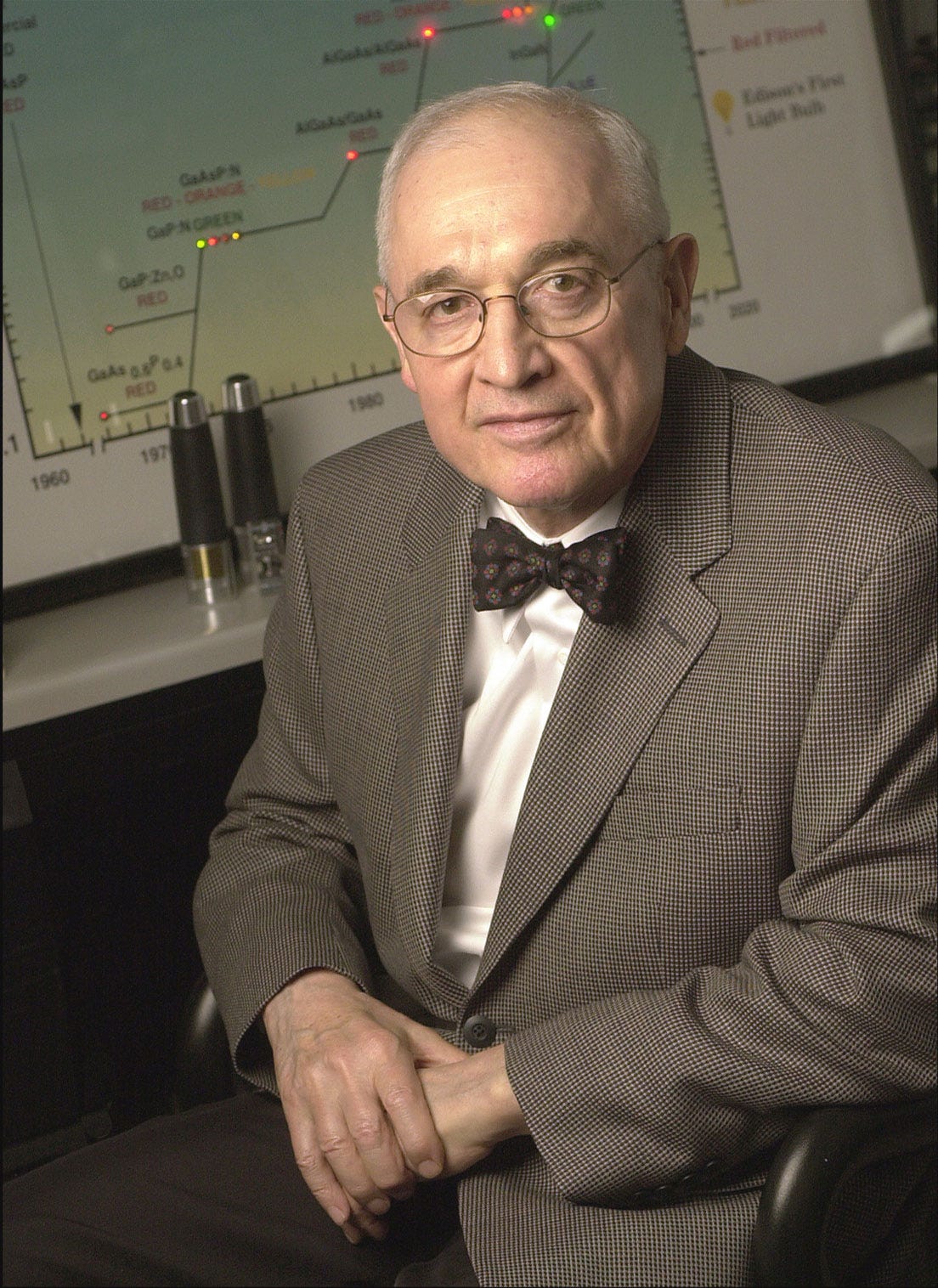
Holonyak wanted one you could look at. Pushing phosphorus into the gallium arsenide lattice widens the bandgap and drags the emission up out of the infrared into red, and he had been growing that alloy for a while, using a trick borrowed from J. C. Marinace at IBM: seal the ingredients in a quartz tube with a halide, heat one end, let the vapor carry the material to the cool end and crystallize there.
The chemists at GE told him the alloy could not be made. Holonyak’s version of that argument is the best thing in the whole story. They were telling him he was crazy in what he called “New York language.”
His mirrors gave him more trouble than his crystals. A diode laser needs two flat parallel faces to bounce light between, and Hall was getting his by polishing. Holonyak tried to cleave his, which works beautifully on a single crystal and not at all on what he actually had. He switched to polishing once he heard what Hall was doing. By then the infrared race was over.
On 9 October 1962, with colleagues watching, he cooled a GaAs₀.₆P₀.₄ diode to 77 kelvin, hit it with pulsed current, and got red laser light.
Aside: Again, not a first; now, not the first red laser. Theodore Maiman’s ruby had done that in 1960, a distinction Holonyak was always careful to draw himself: the first one made of a semiconductor.
Then it warmed up.
At room temperature the lasing collapsed and the diode just sat there glowing, a plain red with no coherence in it at all. GE gave him its Cordiner Award that year - named for the man then running the company - for the laser. Diode lasers would not run at room temperature until 1970, when Herbert Kroemer’s and Zhorev Alferov’s heterojunctions finally made it possible. The useless-looking glow went into production almost immediately and is now in your dashboard, your traffic lights and the indicator on your power strip.
Again, he was not the first person to get light out of a semiconductor. H J Round saw a crystal of silicon carbide glow in 1907. Oleg Losev worked the phenomenon in the Soviet Union through the twenties and thirties, and died with almost nobody in the West having read him. James Biard and Gary Pittman at Texas Instruments filed a patent on an infrared gallium arsenide emitter in August 1962 and had a commercial part on the market that October, the same month as Holonyak’s demonstration. Theirs, again, you could not see. What he produced was the first practical visible one.
Side Quest: Go into the rabbit hole that is the history of the LED.
Reader’s Digest ran a piece in February 1963 under the title “Light of Hope, or Terror.” Harland Manchester had interviewed Holonyak, and the article carried the claim that these things would eventually finish off Edison’s bulb. He was thirty-four and his device only behaved properly in liquid nitrogen. It took about fifty years for him to be proved right.
Holonyak came out of Zeigler, a coal town in southern Illinois. Carpatho-Rusyn parents, a father in the mines, and Holonyak the first in the family to sit in a classroom. At fourteen he assumed he was going underground like most in his town. His father talked him into taking any job that stayed above it, which turned out to be track work on the Illinois Central. Accounts differ on how long that first stretch ran. Holonyak’s own version was that one shift of it settled the question of whether he would work with his back or his head.
At Illinois he became John Bardeen’s first doctoral student, and kept working together until Bardeen died in 1991.
Holonyak collected several awards and accolades: Edison Medal, National Medal of Science, National Medal of Technology, Japan Prize, IEEE Medal of Honor, Draper, Queen Elizabeth Prize. Asked about the Nobel earlier on, he had said it was ridiculous to imagine anyone owed you anything. Then in October 2014 the physics prize went to the inventors of the blue LED, and he told the Associated Press he found that one insulting.
He kept turning up at the lab most days of the week until he retired at eighty-four, and Illinois put his name on the building in 2019. The red dot people buy to torment their cats is his grandchild twice over. If it’s a laser, it descends from the half that worked at 77 kelvin, and if it’s just a bright diode behind a lens, which it often is, it descends from the half that quit.
Thank you for doing these!
Some nice history of LED development!
“Light of Hope, or Terror” simultaneously gave me a mental image of a Star Wars light saber and a cat swiping (thanks!) at a moving LED dot (or light saber)