

More MOSFETs have been made than any other object humans have ever produced. In 2014 the analyst Jim Handy counted every transistor the industry had shipped since 1947 and got 2.9 sextillion, later revised upward to 13 sextillion, a 13 followed by 21 zeros. Roughly 99.9 percent of those transistors are MOSFETs.
One man built the first working one, in November 1959, and almost nobody wanted it.
Ever worked somewhere where a man leans back and tells you he has been doing this since before you were born? Dawon Kahng walked into Bell Labs at Murray Hill in 1959, months out of graduate school. The lab had invented the transistor twelve years earlier. It had collected a Nobel Prize for it three years before he arrived. Everybody there had been doing this longer than he had and made no bones about it.
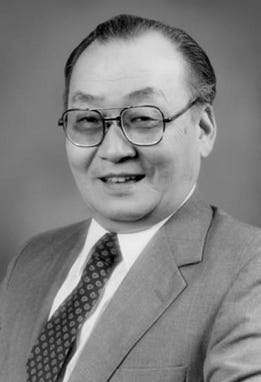
Kahng was born in Seoul in May 1931, though you had to call it Keijō then, Korea being a Japanese colony. He studied physics at Seoul National University and took the degree in 1955. He left for America almost at once. Ohio State walked him through a doctorate by 1959, and he arrived at Murray Hill the same year he left graduate school.
Within a few months, Mohamed “John” Atalla handed him the problem the field had been losing to since 1925.
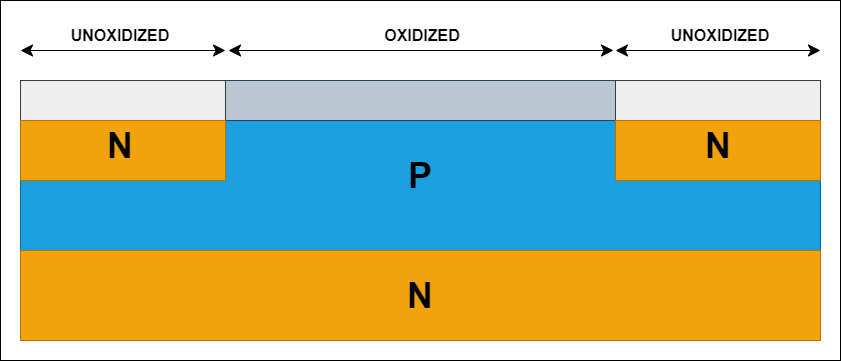
Put a voltage on a gate, Julius Lilienfeld had written in Canada in 1925 and the US in 1926, and steer the current in the channel below. Repeat offending Semi Doped TIL readers will remember how that went. Nobody could make it work, and for thirty-four years nobody knew quite why. The answer turned out to be the surface. Silicon crawls with electronic traps that sit on it and screen out the gate’s field before it reaches anything. Atalla had just found the fix: grow a layer of silicon dioxide on the wafer, grow it clean enough, and the traps quiet down. He published that in May 1959 and handed the follow-up to the newest man in the department.
And like all people fresh out of a university degree and wanting to prove themselves, Kahng got to work.
By November 1959 he had it running. A strip of aluminium a fiftieth of a millimetre long, laid over a hundred nanometres of that grown glass, laid over silicon. He put a voltage on the metal and the current moved underneath. Metal, oxide, silicon, and a field doing the switching. That is where the name comes from – MOSFET.
They took it to the Solid-State Device Research Conference in Pittsburgh the following June, under the title “silicon-silicon dioxide field induced surface devices.” Maybe if they had a sexier name Bell Labs would have given them a better shot?
Because Bell Labs passed, and they were right on the numbers. The gate ran twenty microns. It switched about a hundred times slower than the bipolar transistors already going by the millions into the telephone network. It drifted with temperature and with time. Bell Labs sold switching, and switching is a speed business. Nobody in that building had any use for a slow transistor that wouldn’t sit still.
At the end of the day, Bell Labs had a need. The need for speed.
Kahng kept turning it over anyway. The thing was easy to make. It took fewer steps than a bipolar device and gave you fewer things to go wrong. It wanted no moat dug around it to keep it clear of its neighbours. You could set them down side by side and keep going until you ran out of wafer.
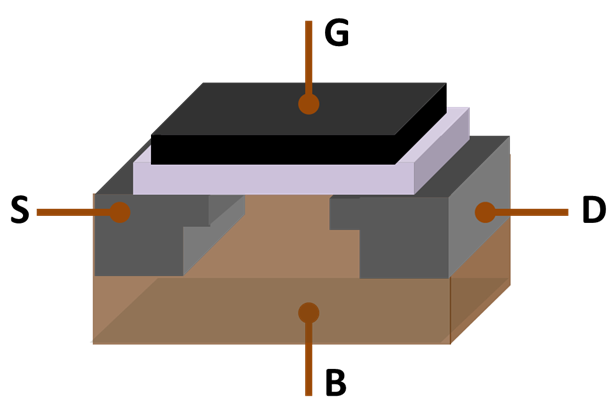
He wrote all of that down on 16 January 1961 in a memo. Nothing whatsoever happened.
Atalla – who had given him the problem in the first place – abandoned ship. He left Bell Labs for Hewlett-Packard in 1962, tired of getting no credit, and helped set up its semiconductor lab. Most people in this industry (and especially Bell Labs) have made a version of that move. Kahng stayed there twenty-nine years.
Kahng kept at the technology too. He and Atalla had previously worked out the PMOS and NMOS processes and proposed the MOS integrated circuit outright. Then in 1967, with Simon Sze, he found a way to strand a packet of charge on an isolated gate inside a MOSFET, where it sits after you cut the power, which is the storage cell inside every EPROM, EEPROM and flash chip built since.
The Franklin Institute got around to Kahng and Atalla in 1975 with the Stuart Ballantine Medal. Kahng retired in 1988 and went to Princeton to set up the NEC Research Institute. He died on 13 May 1992, nine days after his sixty-first birthday. The National Inventors Hall of Fame got to him in 2009, seventeen years after he could feel happy about it.
The blue LED guy had similar traits
This was excellent. Keep it up. Keijo —> 京城