

On a freezing Chicago night in 1954, an eighteen-year-old kid named Walter Jeremiah “Jerry” Sanders III stepped into a street fight to help a friend. The friend ran. The gang turned on Sanders, beating him so violently that a priest arrived at the hospital to read him the last rites. The details get embellished in silicon retellings, but the priest is the part everyone agrees on.
Sanders pulled through, grabbed an electrical engineering degree from the University of Illinois on a Pullman railroad scholarship, and drifted into sales — first at Douglas Aircraft, then Motorola, and finally Fairchild Semiconductor in 1961.
Aside: Why does anyone worth talking about in semis have a past with Fairchild?!
Sanders wasn’t a chip designer, but he sold microchips better than anyone on the West Coast. Legend has it he did all of this in custom silk suits and gold cufflinks, driving a pink Rolls-Royce. Or a Bentley. Or a Ferrari, or an Aston Martin, depending on who is telling it. Almost none of it is corroborated. That is the point: every version was so on brand that nobody even blinked.
In fact, Sanders held the door open for Bob Widlar at Fairchild - the wildling who once brought a sheep to trim the lawns at National Semiconductor. Hollywood keeps churning out sterile corporate dramas, but someone needs to greenlight biopics about legendary lunatics like Sanders and Widlar.
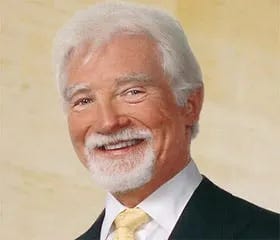
Then the roof fell in. In 1968, new management took over Fairchild and brought in a buttoned-up Motorola crew known as “Hogan’s Heroes.” They took one look at the flamboyant salesman and fired him. Sanders summed it up with characteristic bluntness: he had spent his life treating people fairly, and this was not that.
When tech legends Robert Noyce and Gordon Moore walked out of Fairchild to start Intel, investors lined up to shove money into their pockets. Sanders got no such red carpet. Nobody in the Valley wanted to bet on a salesman. He spent months sleeping on a friend’s couch and pounding the pavement before scraping together $1.5 million alongside $50,000 of the founders’ own cash.
Advanced Micro Devices opened for business on May 1, 1969. The team started in cofounder John Carey’s living room before moving into two back rooms of a Santa Clara rug-cutting shop. Sanders joined on one non-negotiable condition: he would run the show as president. It ruffled feathers, but they agreed.
So. How does a salesman survive when he can’t outspend anyone on research? Sanders started by second-sourcing chips designed by Fairchild and National Semiconductor. To stand out, he guaranteed every single part to strict US military standards — even ordinary commercial chips. AMD’s first product, the Am9300 shift register, wasn’t glamorous, but it worked every single time.
Beneath the bravado, Sanders fiercely protected his people. Long before tech companies offered free donuts in the break room, he handed out stock options to every single employee, right down to the assembly line. His holiday parties were legendary — at one bash, he rode into the ballroom on a live elephant; at another, he raffled off a brand-new luxury car to a factory technician.
When industry downturns hit in the 70s and 80s, rival firms laid off thousands. Sanders slashed executive pay, asked everyone to work longer hours, and instituted a strict no-layoff policy. His core rule remained simple: People first, products and profits will follow.
In 1982, Sanders negotiated a critical licensing deal with Intel to manufacture x86 processors. The contract’s ambiguous language eventually ignited a decade-long legal war that collapsed AMD’s stock, but it also cemented AMD as the only true rival Intel would ever face.
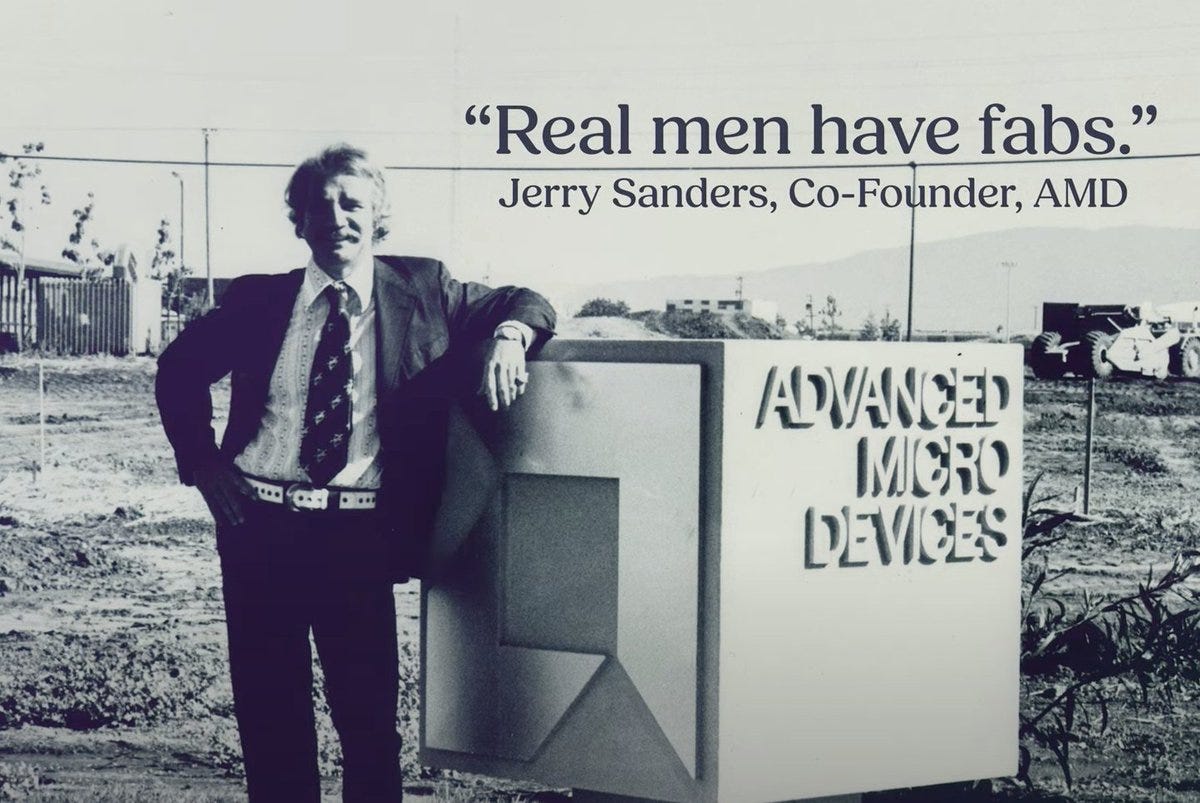
When new startups started outsourcing manufacturing in the 1990s, Sanders scoffed, declaring: Real men have fabs. When AMD beat Intel to the 1 GHz processor milestone in 2000, Sanders took his victory lap, declaring that David hadn’t just hit Goliath with a pebble — he had taken his head off.
Sanders ran AMD for over thirty years before stepping down in 2004. In 2009, AMD sold off its factories and went fabless — the exact model Sanders had mocked. Yet in 2022, AMD accomplished the unthinkable: its market value surpassed Intel’s for the first time in history.