

When radiation was first caught flipping bits in memory chips on the ground, it was the chip’s own packaging — not a ghost or a cosmic ray.
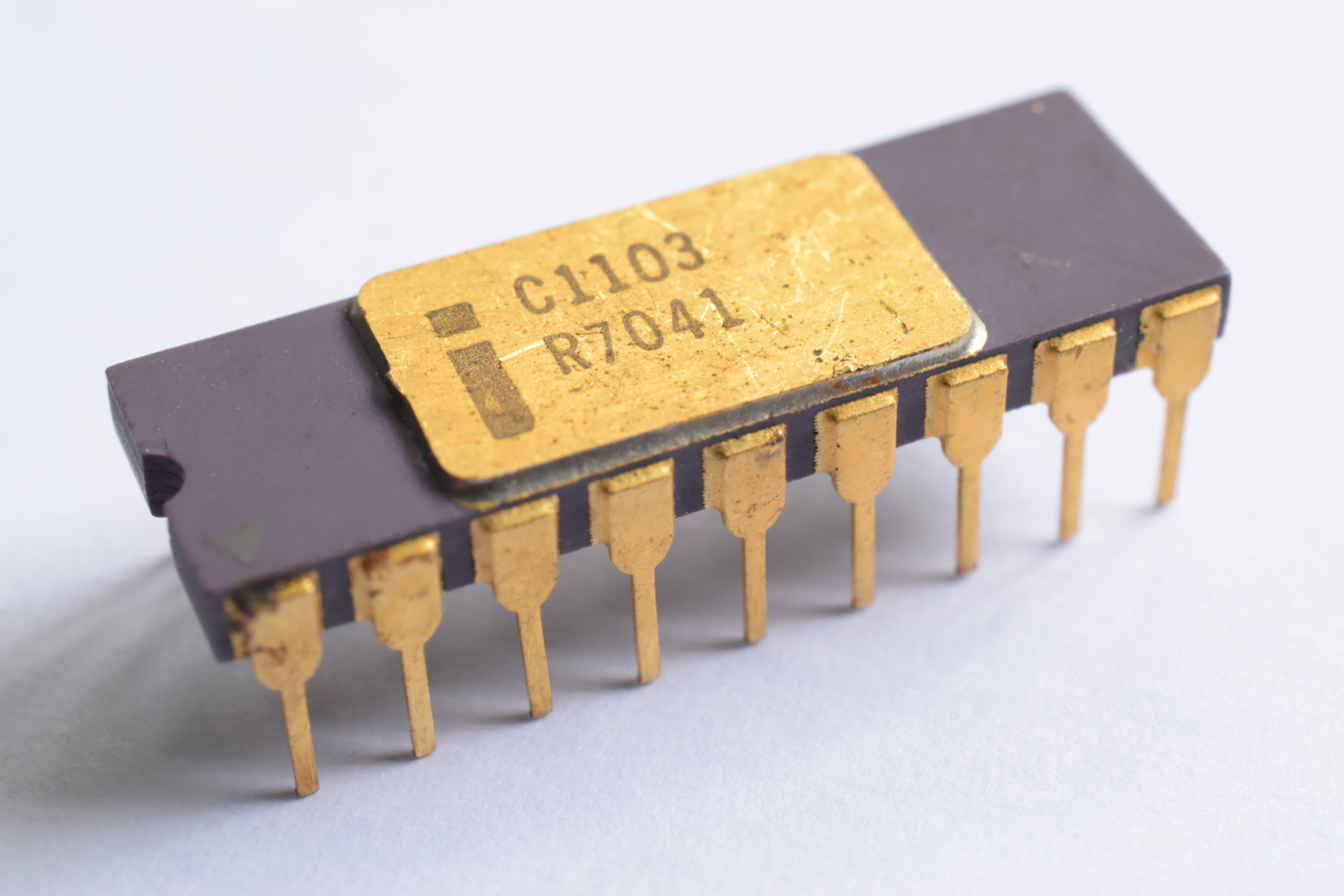
In 1977, a 25-year-old Intel physicist Tim May figured out that the ceramic and glass around Intel’s dynamic RAMs carried trace uranium and thorium. As those atoms decay, they throw alpha particles into the silicon, and every so often one of them turns a 1 into a 0. Cosmic rays turned out to be a problem too, but IBM showed that later. The first culprit was the lid, and the glass that sealed it.
The errors really did behave like a ghost. A bit would read back wrong once, then work perfectly after the next write. Nothing was broken, and the same failure never showed up twice. Engineers had a list of usual suspects for this: system noise, marginal supply voltage, sense amplifiers, and unlucky data patterns. They could clean all of that up and the errors kept coming anyway.
May had skipped graduate school to join what he later called a small semiconductor company, and he knew some geology. He suspected the trace uranium and thorium in ceramic and glass. Zirconia, a common filler in ceramic packages, comes with both built in: in nature, roughly one zirconium atom in 10,000 is swapped for uranium or thorium.
A dynamic RAM cell of the time stored a bit as somewhere between 300,000 and 3 million electrons. A 5 MeV alpha particle goes about 25 microns into silicon and leaves roughly 1.4 million electron-hole pairs in its wake. If enough of those electrons drift into an empty storage well, the bit flips; the chip is fine, but the data isn’t.
Engineers, like the Penguins of Madagascar tend to use spit, grit, and a whole lot of duct tape to get the job done. This time, it involved masking tape. Intel’s engineers taped ceramic lids, glazed with a glass they knew was radioactive, over a test chip. Errors went from 1 to 3 percent per thousand hours to more than 1,300 percent. Then they stuck masking tape on the underside of those lids, and the errors went back to normal. Five thousandths of an inch of tape stops alpha particles and barely touches beta or gamma rays.
With his colleague Murray Woods, May built out the rest of the case: more than 25 million device-hours of testing, plus polonium-210 sources aimed at bare dies, with the errors tracking the alpha flux across eight orders of magnitude. May later recalled a lab stocked with cut and polished uranium and thorium minerals, and said that when they needed americium, they cracked open smoke detectors. The paper carries its own safety note: don’t run polonium experiments above room temperature, because polonium starts to vaporise at 50 to 60°C and is extremely toxic.
Once they went looking, the radioactivity was all over the package. Zirconia filler was the main carrier. Sealing glasses were worse; one glass in common industry use put out more than 45 alphas per square centimetre per hour. Even gold-plated metal lids showed activity, and all of it came from contamination in parts per million.
May and Woods presented the work in April 1978 at the International Reliability Physics Symposium, and IEEE Transactions on Electron Devices ran the full paper in January 1979. It warned that 64K-bit memories would be in trouble unless designs changed, and it recommended error detection and correction. Richard Hamming had published his error-correcting codes back in 1950, and that paper gave DRAM designers a physical reason to pay for them.
Legend has it that Intel’s ceramic vendor had a plant on the Green River, downstream of an old uranium mine, and that the water used to make the packages carried the uranium in. The story traces to an IBM retrospective from 1996, and retellings can’t agree on whether it was a mine or a mill, or whether the plant was in Colorado or Utah. Intel’s own paper never mentions a river, so we’re fully in the realm of conjecture here.
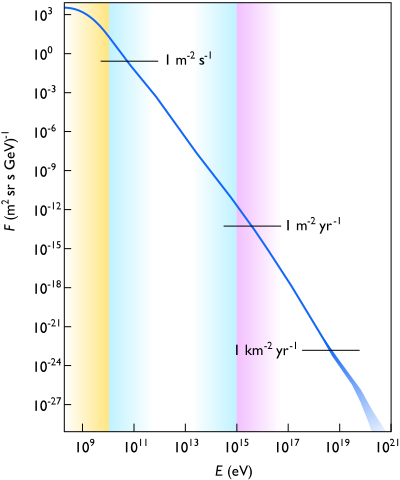
The paper did name a second suspect: Sea-level cosmic rays were “less easily dismissed,” and Intel was running tests inside a 20-ton lead cave to check. In 1979, IBM’s James Ziegler and physicist William Lanford published estimates in Science of how cosmic rays would disturb computer memories. IBM then spent fifteen years testing chips deep underground and at altitude. In 1994, IBM’s Tim O’Gorman reported the first field measurements of cosmic-ray soft errors in DRAM at ground level.
At ground level, the cosmic-ray culprit is mostly neutrons from particle showers high in the atmosphere. Masking tape does nothing to them and neither does a ceramic lid, which is why IBM ran its baseline tests deep underground, where rock absorbs the neutrons and only the package’s alphas are left.
The sky is a different beast altogether. You can’t shield a server from it, so its memory stores a few extra bits on every word, just to catch the flips. So if a server logs a corrected memory error tonight, it isn’t haunted. It’s mostly the sky, and once in a while it’s still the package.
The ghosts have voted, too. In Belgium’s federal election on 18 May 2003, a candidate in Schaerbeek was credited with more preference votes than their whole party list received, which can’t happen. A recount from the magnetic voting cards put the excess at exactly 4,096. That’s 2 to the 12th power: one bit. A panel of experts found no bug in the software and concluded that a spontaneous bit flip was the most likely cause.
As for May, he retired from Intel in 1986. Two years later he wrote the Crypto Anarchist Manifesto with the first line: “A specter is haunting the modern world, the specter of crypto anarchy.”