

In the early 1920s a Stanford psychologist named Lewis Terman went looking for geniuses, and he went about it with the confidence of a man who believed the thing could be found by arithmetic. His assistants worked through the California public schools, screening something like 168,000 children for the project he called Genetic Studies of Genius; the bar for admission was an IQ of about 140, and those who cleared it were followed, prodded and surveyed for the rest of their lives.
Two boys were screened and rejected. Both of them went on to win the Nobel Prize in Physics. One was Luis Alvarez. The other was William Shockley, tested twice as a boy and scoring 129 and 125, who would spend the middle of his life putting the silicon in Silicon Valley and the end of it insisting that numbers like those were the measure of a human being.
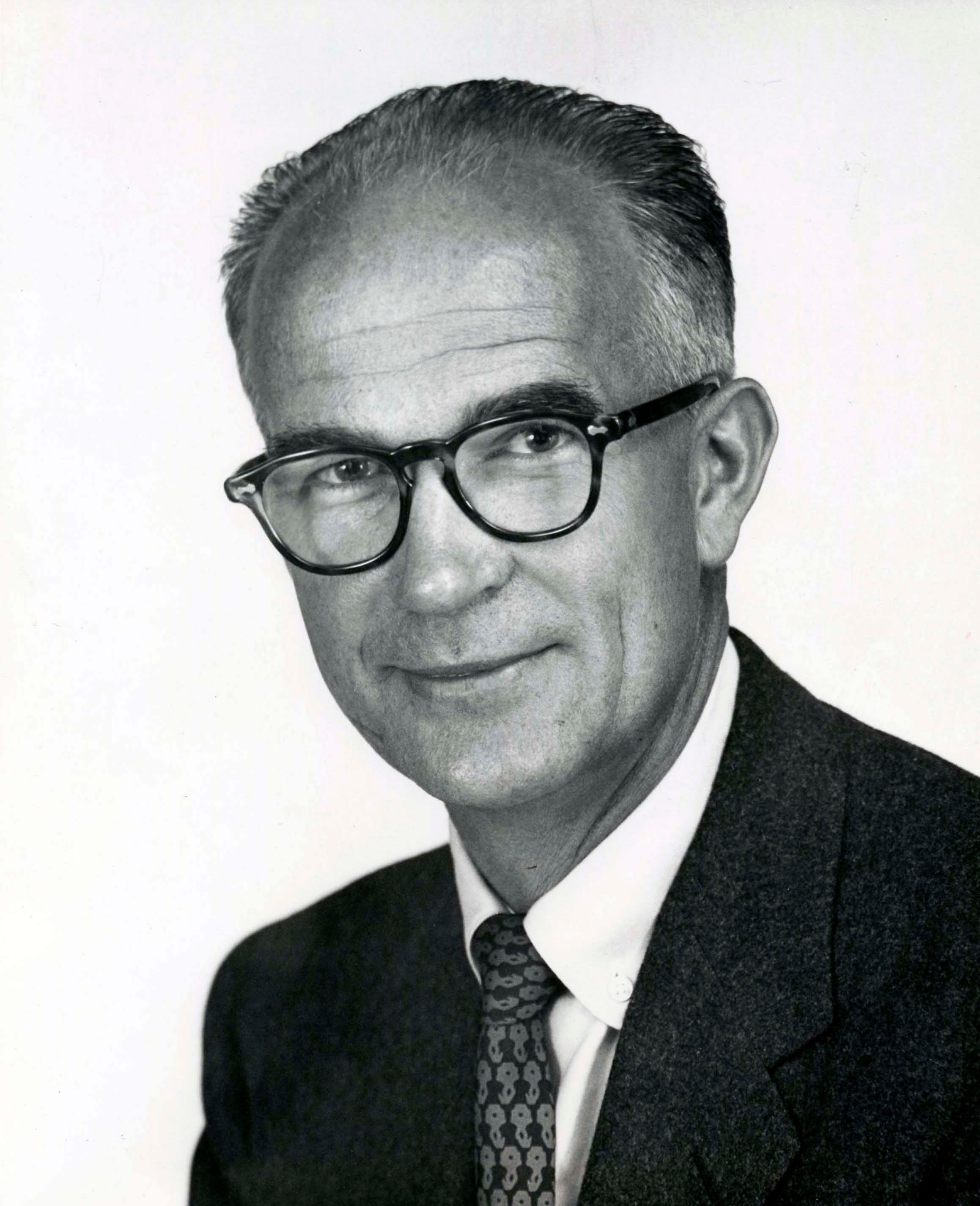
Shockley told the story on himself with visible relish, and it is worth saying that he is the source of it; it first reached print in an interview he gave in 1980, and his biographer Joel Shurkin later documented the scores, adding that an adult test placed him somewhere around the 90th percentile. Nor is the moral quite as clean as it looks. A 2020 simulation study concluded that Terman was never realistically going to catch a future Nobelist, because the prize is too rare and his threshold too high. The smaller, funnier fact stands on its own, though. Of the 1,528 children who did make the cut, tracked for decades, not one ever won a Nobel or a Pulitzer!
The boy who failed had an unusual start even by Palo Alto standards. He was born in London in 1910 to American parents and brought back to California at three, the son of a mining engineer who spoke eight languages and of the first woman in Nevada appointed a US deputy mineral surveyor, in 1906. His parents disliked public schools and his tantrums were violent, and between the two convictions they kept him out of school until he was eight.
What physics he learned early, he got from a neighbor who happened to teach it at Stanford. From there the path straightens out into something conventional and fast: Caltech, then MIT, then a doctorate on the band structure of sodium chloride, and then, in 1936, Bell Labs, which had just decided it wanted solid-state physicists and hired him almost immediately.
The problem he was handed was the one that would define him. Bell wanted something solid to replace the vacuum tube, and Shockley proposed a field effect device that refused, year after year, to work. The war interrupted the argument. Somewhere around 1939 he and a colleague, James Fisk, are said to have worked out a design for a chain-reacting uranium pile, on the insight that lumps of uranium rather than a uniform mass would let neutrons slow enough to be useful; the report was classified on arrival, and lore has it that Manhattan Project physicists later had to derive the same ideas from scratch.
Instead, Shockley spent the war on operations research, redesigning depth-charge patterns and convoy tactics and bomber training, and an old and uncorroborated story has him deducing, purely from statistics, that German bombers carried no radar, without ever laying eyes on a bomber or a convoy.
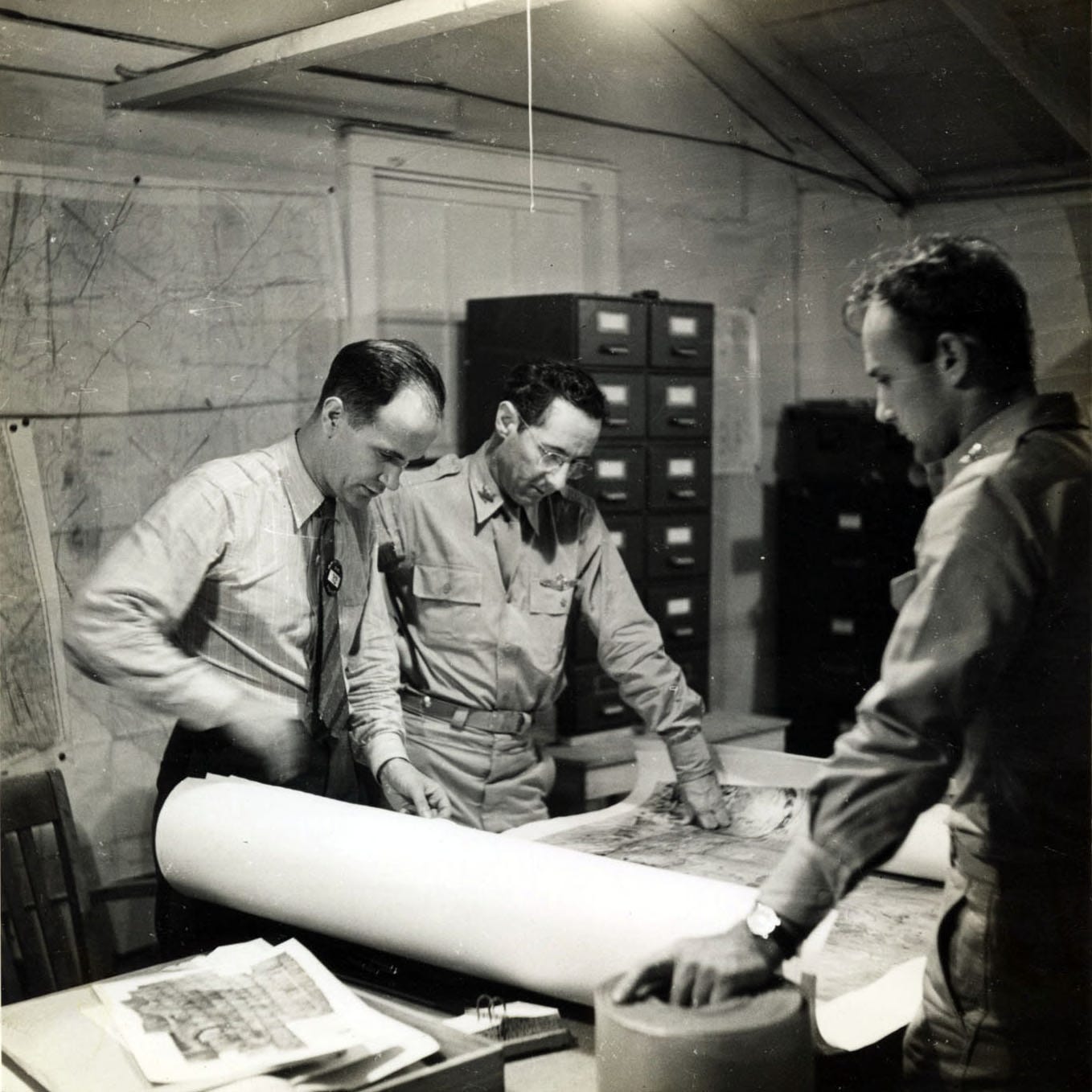
He came back to Murray Hill, to the same unworkable device, and this time the group cracked it without him. John Bardeen worked out why the field effect kept failing, surface states were screening the field, and he and Walter Brattain followed that insight to the point-contact transistor, demonstrated to Bell Labs management on December 23, 1947, while their nominal boss was largely at home pursuing ideas of his own.
Then the lawyers made it worse. Bell’s patent attorneys found that Julius Lilienfeld had filed a field-effect patent in Canada in October 1925, and to steer clear of it they built the application around Bardeen and Brattain’s device alone. The idea that had started the whole program was Shockley’s. His name was on none of it. And he threw a tantrum like the ones from his childhood.
Within a fortnight he was in a Chicago hotel room for an American Physical Society meeting, sitting out the New Year’s Eve party downstairs and filling some thirty notebook pages with a semiconductor sandwich that might do the same job more robustly. It did not quite cohere and he put it away. On January 23, 1948, at home before dawn, it did: the junction transistor, the structure that would carry the industry until MOS displaced it in the 1970s. He told neither colleague. When the invention went public that June he was the most visible man at Bell Labs, and here is the part that complicates the villain: he corrected reporters who gave him sole credit, writing to Newsweek to say plainly that the invention belonged to Bardeen and Brattain. It changed nothing. Bardeen left in 1951. Brattain refused to work with him again.
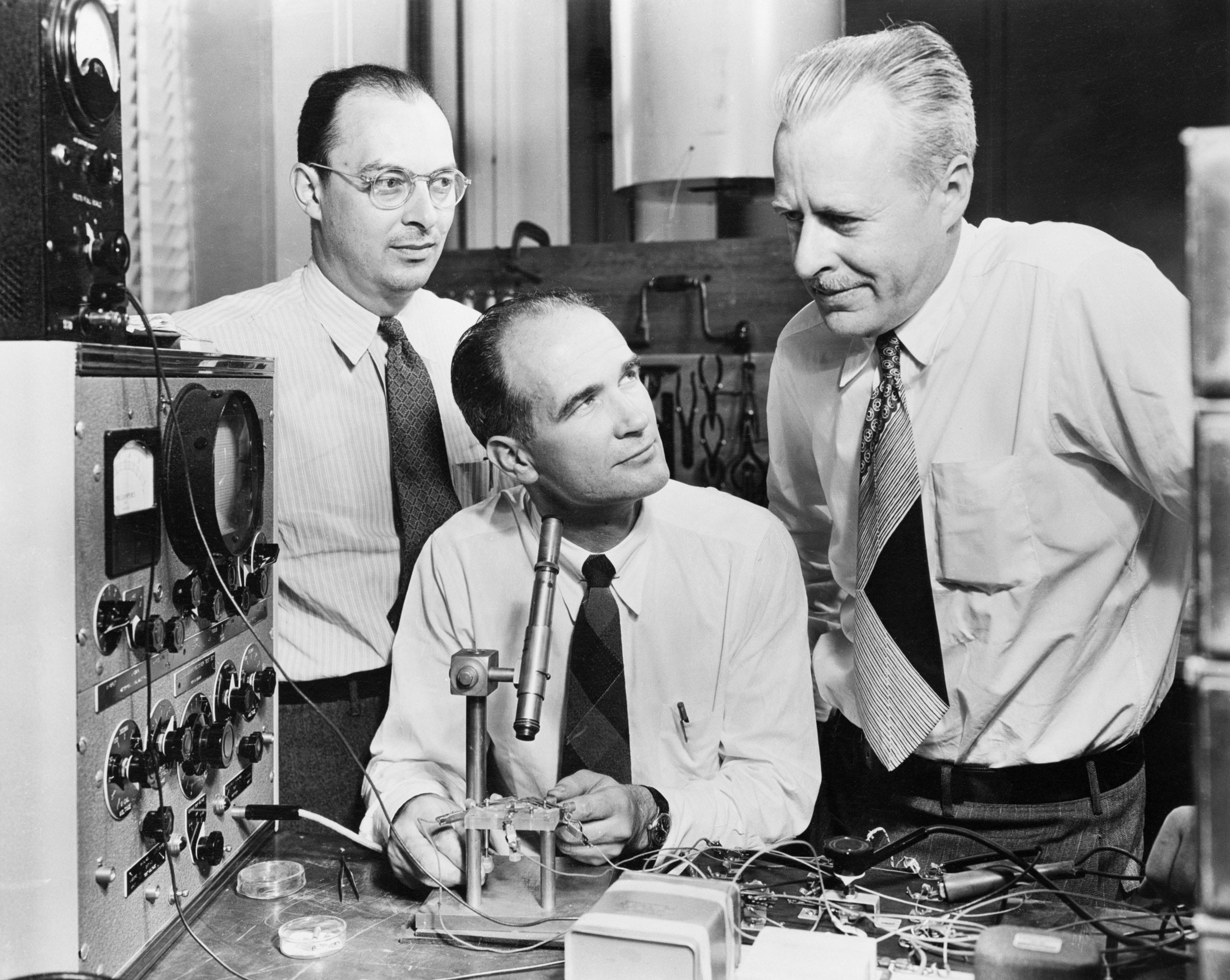
Aside: We just think Shockley was making it clear that Bardeen and Brattain invented the point-contact design, he cleared the historical and legal path to claim undisputed, sole credit for his own subsequent, superior invention: the junction transistor. Ultimately, the Nobel Committee recognized the distinct but interconnected nature of their work, jointly awarding all three men the Nobel Prize in Physics in 1956.
All three shared the Nobel in 1956, and that same year Shockley opened a semiconductor lab in Mountain View, chosen partly for Stanford, partly for the weather and partly because his mother, then in her late seventies, lived nearby. He recruited superbly and managed catastrophically.
Convinced that a secretary’s minor cut was sabotage aimed at him, he demanded lie detector tests. He bet the company on the four-layer diode and set silicon transistor development aside. In September 1957 eight of his best researchers walked out to found Fairchild. He called it a betrayal, and the name that stuck to them — the traitorous eight — is usually laid at his door, which is how the industry got its founding myth.
Everything after that is a string of events recorded as his long descent into madness. He spent two decades arguing that the wrong people were reproducing and that anyone with an IQ under 100 should be paid a thousand dollars per point below it to be sterilized. He taped his calls with reporters and mailed them the transcripts. He ran for the Senate in 1982 and took 8,308 votes, 0.37 percent, eighth in a field of thirteen. He sued a newspaper for libel, won, and was awarded one dollar. When he died in 1989, his children found out by reading it in the papers.
If somehow all Nobel and Pulitzer winners had IQ test results from grade school, I wild-guess the mean to be around 125 with a 5 to 10 point standard deviation. Maybe the distribution skews right too.